golden chalice vine Care (Solandra maxima)

Also known as: cup of gold
golden chalice vine

About golden chalice vine

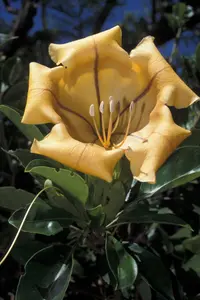
Golden chalice vine, Solandra maxima, is a fast-growing tropical climber from Mexico and Central America. It is typically grown outdoors in warm climates or in large containers under protection. The plant is known for its very large, trumpet-shaped yellow flowers with purple-brown markings and a strong, sweet fragrance. Glossy, oval leaves and long, woody stems create a dense, vigorous vine that needs solid support. Its rapid growth and size make it striking but sometimes challenging in small spaces. It favors bright light, warmth, and evenly moist, well-drained soil. Understanding how to care for golden chalice vine starts with recognizing its need for space, strong light, and regular pruning.

Main Plant Requirements

Care Difficulty

Moderate Care

Light Preference

Full Sun

Water Requirements

Moderate Water

Temperature Preference

Tropical / Frost Sensitive

Hardiness Zone

10–11

Soil Texture

Sandy, Loamy, Organic-rich

Soil pH

Acidic (5.5–6.5), Slightly acidic (6.5–7.0)

Soil Drainage

Moist but well-drained

Fertilization

Moderate (every 2–4 weeks)

Get Personalized Care Plan

Scan your plant to receive care tips personalized for your specific plant

Available on iOS and Android

How to Care for the golden chalice vine

This sun-loving climber needs strong light to bloom well outdoors.

  • Provide 6–8 hours of direct sun daily; morning and early afternoon sun are best for flower production.
  • Tolerates light partial shade, but golden chalice vine grown with less than 4–5 hours of sun often has weak growth and sparse flowering.
  • In hot climates, protect from intense late-afternoon sun to reduce leaf scorch, and ensure open air circulation so foliage cools faster in summer.

This vigorous vine prefers evenly moist, well-drained soil rather than constant wetness.

  • Water when the top 3–5 cm of soil feel dry, soaking the root zone deeply and then letting excess drain away.
  • Reduce frequency in cool seasons, but never allow the soil to dry out completely; leaves that wilt and curl signal underwatering.
  • Yellowing leaves, soft stems, or a sour odor in the soil suggest overwatering or poor drainage and require longer drying intervals or soil improvement.

This tropical species needs warm conditions and does poorly in cold climates.

  • Ideal growth occurs at 65–85°F (18–29°C), supporting strong vines and reliable flowering through the warm season.
  • Below 40°F (4°C) growth slows sharply; brief dips to 32°F (0°C) can cause leaf damage, and hard frost may kill stems.
  • In hot regions, it tolerates 90–95°F (32–35°C) if soil moisture is steady and the root zone is mulched to limit heat stress and evaporation.

This species prefers moderately humid air but usually tolerates typical indoor levels.

  • Aim for 40–60% humidity to keep foliage turgid and minimize stress.
  • It tolerates short periods of drier air, but prolonged very low humidity can cause leaf edge browning and crisping.
  • Increase humidity by grouping plants, using a nearby humidifier, or placing the golden chalice vine above (not in) a pebble tray with water.

Solandra maxima grows best in loose, well-aerated, sharply draining soil.

  • Use a mix of roughly 2 parts loamy potting soil, 1 part coarse sand, and 1 part perlite or pine bark to enhance drainage and air spaces around roots.
  • Keep soil slightly acidic to neutral, around pH 6.0–7.0, avoiding strongly alkaline mixes that restrict nutrient uptake.
  • Incorporate moderate, well-rotted compost for organic matter, but avoid heavy, clay-rich or peat-dense blends that hold water for too long.
  • Ensure the mix drains freely within a few seconds when watered; if water lingers on the surface, lighten it with more coarse sand or perlite.

This species can be grown in containers if the pot supports its vigorous, climbing habit.

  • Choose a large, deep, and heavy container to provide root volume and prevent tipping as the vine becomes top-heavy.
  • Select thick-walled terracotta or similar porous material if extra evaporation is needed in wet climates, or glazed pots in hot, very dry locations to slow moisture loss.
  • Position the container where a sturdy trellis, fence, or railing can be anchored directly to the pot area to stabilize long, woody stems.

Solandra maxima benefits from moderate feeding during its active growing season for strong vines and abundant blooms.

  • Use a balanced liquid fertilizer (for example 10-10-10 NPK) at 1/2 strength every 4–6 weeks in spring and summer.
  • Alternatively, apply a slow-release fertilizer or a thin layer of well-aged compost at the start of spring.
  • Stop or greatly reduce feeding in fall and winter when growth slows, especially in cooler indoor conditions.
  • Always water before applying fertilizer to avoid root burn and to distribute nutrients evenly through the potting mix or soil.

Pruning Solandra maxima keeps growth manageable and encourages a well-branched framework with more flowering wood.

  • Carry out main pruning in late winter or very early spring before vigorous new growth starts.
  • Remove dead, damaged, crossing, or extremely crowded stems back to a healthy junction using clean, sharp bypass pruners.
  • Shorten overly long vines to maintain size and to encourage side shoots that bear more flowers.
  • After flowering flushes, lightly thin or tip-prune young shoots to refine shape and improve light and air penetration.

This vigorous climber often does best in the ground, but container-grown plants of Solandra maxima sometimes need careful repotting.

  • Check for roots circling the pot, emerging from drainage holes, or noticeably reduced growth as signs that a larger container is needed.
  • Aim to repot every 2–3 years in late winter or early spring, stepping up only 1–2 pot sizes with a free-draining, nutrient-rich mix.
  • Water the plant a day before repotting, gently loosen circling roots, and keep as much root ball intact as possible to limit stress.
  • After transplanting or repotting, water thoroughly, provide bright but not harsh sun for 1–2 weeks, and avoid heavy feeding until new growth appears.

Solandra maxima is most commonly propagated from semi-hardwood cuttings taken during the warm growing season.

  • In late spring to summer, cut 10–15 cm semi-hardwood tip cuttings with 2–3 nodes from healthy, non-flowering shoots.
  • Remove lower leaves, dip the cut end in rooting hormone, and insert into a well-drained, sterile mix such as perlite and peat or coco coir.
  • Maintain bottom heat around 70–75°F, high humidity, and bright, indirect light until roots form, usually in several weeks.
  • Seed propagation is possible but slower; sow fresh seed in warm, evenly moist, free-draining medium and expect variable germination.

Cold-sensitive Solandra maxima needs thoughtful winter care in regions with frost or prolonged cool periods.

  • In USDA zones below about 10, grow Solandra maxima in large containers so the plant can be moved indoors or into a heated greenhouse.
  • Before first frost, shift pots to a bright, cool indoor space and reduce watering so the soil stays slightly moist, never saturated.
  • For in-ground plants in marginal climates, mulch the root zone with 5–10 cm of organic material to buffer temperature swings.
  • In mild coastal climates without hard frost, golden chalice vine indoor care is usually unnecessary, but brief cold snaps may still damage young tips.

Care Tips

Sturdy Structural Support

Install a strong trellis, pergola, or tensioned wires before rapid growth starts, as mature vines become heavy and woody and can pull down weak supports.

Root Zone Containment

In warm climates, use a large, heavy container or root barrier to limit runaway spread and simplify access for pruning, inspection, and any future transplanting.

Controlled Leader Training

Select 2–4 main stems early and secure them to the support with soft ties, then regularly remove weak or crossing shoots to create a stable, well-aerated framework that carries large blooms safely.

Flower Drop Management

Place ground cloth, gravel, or easy-to-rake mulch under the plant so large spent flowers can be removed quickly, reducing slippery surfaces and discouraging rot and fungal growth around the base.

Cold-Event Preparedness

In marginal climates, keep breathable frost cloth and stakes ready and pre-mark anchor points so the plant can be covered quickly before short cold snaps without snapping brittle woody stems when you grow Solandra maxima outdoors.

Common Pests and Diseases

Spider mites

This pest often appears in hot, dry conditions and can cause yellow stippling and fine webbing on the undersides of leaves. Symptoms include dull, dusty-looking foliage and gradual leaf drop if the infestation is heavy.

Solution

Rinse vines thoroughly with a strong but gentle stream of water, especially the leaf undersides, and repeat several times over 7–10 days. Improve humidity and airflow, prune heavily infested shoots, and use an insecticidal soap or horticultural oil labeled for mites if populations do not decline.

Scale insects

These insects attach tightly to stems and leaf midribs, appearing as small, rounded bumps that excrete sticky honeydew. Symptoms include sooty mold growth on leaves and a general decline in vigor.

Solution

Gently scrape or wipe off individual insects with a cotton pad dipped in isopropyl alcohol, then prune badly infested stems. For broader infestations, apply a horticultural oil thoroughly to stems and leaf bases according to label directions and repeat after 7–14 days if needed.

Mealybugs

This pest hides in leaf axils and stem joints, producing white, cottony masses and honeydew. Symptoms include sticky leaves, distorted new growth, and slowed overall growth.

Solution

Isolate the plant, then dab visible clusters with a cotton swab dipped in isopropyl alcohol and rinse the foliage after treatment. Follow up with insecticidal soap or horticultural oil applications, making sure to reach leaf axils and any tight crevices where mealybugs shelter.

Botrytis blight

This disease develops in cool, humid, stagnant air and affects the large flowers and leaves, causing water-soaked spots that turn tan or brown and may show gray, fuzzy mold. Symptoms include rapid collapse of blooms and spotting on nearby foliage.

Solution

Remove and discard all affected flowers and leaves, improve airflow around the vine, and avoid wetting the foliage when watering. In persistent cases, apply a fungicide labeled for Botrytis on ornamental vines, following label timing and coverage instructions carefully.

Leaf spot

This disease shows as scattered brown or purplish spots on leaves, sometimes with yellow halos, and is favored by overhead watering and poor air circulation. Symptoms include premature leaf yellowing and drop on heavily affected vines.

Solution

Prune and dispose of spotted leaves, thin dense growth to improve air movement, and water at the base rather than over the foliage. If new spots continue to appear, use a copper-based or other labeled ornamental fungicide at the recommended interval until new growth emerges clean.

Interesting Facts

Night-blooming giant flowers

This species produces very large, creamy yellow, bell-shaped flowers that commonly open in the evening and are strongly scented at night, an adaptation for attracting nocturnal pollinators such as moths and bats.

Color-changing corolla

The flowers typically open pale yellow or cream and then deepen to a richer golden yellow as they age, a visual signal that often correlates with changes in nectar availability and pollinator attractiveness.

Toxic but ornamental

All parts of the plant contain tropane alkaloids, the same chemical group found in plants like Datura and Brugmansia, which makes the plant poisonous if ingested but also of longstanding interest to botanists and chemists.

Botan icon

Did you know?

In frost-free climates this vine can form a massive, woody structure with stems that become trunk-like over time, allowing a single long-lived plant to cover entire pergolas or small buildings when given support.

FAQs about golden chalice vine

Lack of flowers is usually due to insufficient maturity, pruning at the wrong time, or inadequate light and warmth. Heavy nitrogen feeding can also reduce buds. Stable warm conditions and balanced fertilizer support flowering over time.

Grow Healthy Plants with Botan Care

Keep your plants happy and healthy with plant identification, disease detection, and easy care guidance.

Botan plant care app — identify plants on mobile

Explore More Plants