Extend Bloom Season
Shear off the entire spent flower mat with clean scissors after the first heavy flush of blooms to encourage a denser second wave of flowering rather than deadheading one stem at a time.

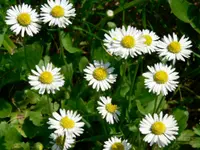
English daisy, Bellis perennis, is a low-growing perennial often used in lawns, borders, and containers. It forms neat rosettes of spoon-shaped leaves and sends up short stems topped with small, button-like flower heads in white, pink, or red.
This species is native to Europe but is now naturalized in many temperate regions, including parts of North America. It tends to be hardy, cool-tolerant, and relatively easy to maintain if given sun, consistent moisture, and well-drained soil, which makes it straightforward for those learning how to care for English daisy.

Care Difficulty
Moderate Care

Light Preference
Full Sun

Water Requirements
Regular Water

Temperature Preference
Cold Hardy

Hardiness Zone
4–8

Soil Texture
Sandy, Loamy, Organic-rich

Soil pH
Acidic (5.5–6.5), Slightly acidic (6.5–7.0)

Soil Drainage
Moist but well-drained

Fertilization
Light (every 4–6 weeks)
Scan your plant to receive care tips personalized for your specific plant
Available on iOS and Android
This low rosette perennial needs bright outdoor light to flower well without scorching.
Bellis perennis prefers consistently moist but not waterlogged soil, especially during active growth.
This cool-season perennial thrives in mild conditions and tolerates more cold than heat.
This species tolerates a wide humidity range and rarely needs special humidity management outdoors.
This species prefers cool, moist, well-aerated soil that never stays waterlogged.
This species is well suited to container growing for patios, balconies, and small outdoor spaces.
This small perennial benefits from light, controlled feeding rather than heavy fertilization.
Pruning Bellis perennis is mainly about deadheading and light clean-up to support compact, floriferous growth.
This species is more often transplanted in beds or lawns than kept long term in containers.
Bellis perennis is commonly propagated by seed and by division of established clumps.
This hardy perennial usually survives typical temperate winters with minimal intervention.

Plant Health Check
Not sure what's wrong with your plant? Check your plant's health inside the app.
What looks like a single daisy flower is actually a dense flower head with tiny yellow disc florets in the center and white or pinkish ray florets around the edge, all working together to attract pollinators.
This species often self-fertilizes within a single flower head, which helps it colonize lawns and disturbed ground quickly even when pollinators are scarce.
The plant forms a low, evergreen rosette of spoon-shaped leaves that hugs the soil surface, allowing it to survive mowing and trampling in frequently used lawns.

In traditional European folklore and early botanical records, this species was so commonly associated with childhood and springtime that it became one of the first wild plants many children learned to identify, often used to make daisy chains long before formal plant education.
This species spreads by short stolons and self-seeding, often forming dense patches over a few seasons. In lawns and open beds it can become persistent, so edge planting areas and deadhead flowers to limit unwanted spread.
Keep your plants happy and healthy with plant identification, disease detection, and easy care guidance.