


scented bouvardia Care (Bouvardia longiflora)

scented bouvardia

About scented bouvardia

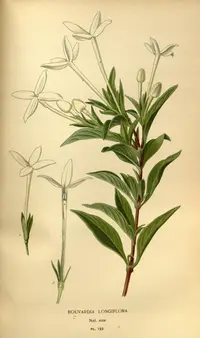
Scented bouvardia (Bouvardia longiflora) is a compact, evergreen shrub valued for its tubular white flowers and strong evening fragrance. It is often grown as a patio, conservatory, or bright indoor plant.

This species comes from Mexico, where it grows in warm, frost-free conditions. In cultivation it tends to stay relatively small and can be pruned to keep a neat, bushy shape.

The plant can be moderately demanding because it dislikes cold, waterlogging, and very dry air. Understanding how to care for scented bouvardia helps keep it flowering reliably.

It generally prefers bright light with some protection from harsh midday sun, evenly moist but well-drained soil, and a sheltered, warm position.

Main Plant Requirements

Care Difficulty

Moderate Care

Light Preference

Partial Sun

Water Requirements

Moderate Water

Temperature Preference

Tropical / Frost Sensitive

Hardiness Zone

9–11

Soil Texture

Sandy, Loamy, Organic-rich

Soil pH

Acidic (5.5–6.5), Slightly acidic (6.5–7.0)

Soil Drainage

Well-drained

Fertilization

Light (every 4–6 weeks)

Get Personalized Care Plan

Scan your plant to receive care tips personalized for your specific plant

Available on iOS and Android

How to Care for the scented bouvardia

Bouvardia longiflora prefers bright, gentle sun that supports flowering without scorching its leaves.

  • Provide 4–6 hours of morning sun with light afternoon shade; east- or southeast-facing exposure suits scented bouvardia outdoors in mild climates.
  • Tolerates light or dappled shade, but flowering decreases if it receives under 3–4 hours of direct or strongly filtered light per day.
  • Protect from intense afternoon sun, especially in summer; leaves may bleach, curl, or develop dry brown patches if exposed to harsh sun for many hours.

Bouvardia longiflora performs best in evenly moist but not saturated soil.

  • Water when the top 2–4 cm of soil feels dry, using enough water so it drains freely from the planting area or container base.
  • Reduce frequency in cool seasons when growth slows, but do not allow the root zone to stay completely dry for more than a few days in active growth.
  • Watch for yellowing, soft stems, or sour-smelling soil as signs of overwatering, and dull, drooping leaves or crisp edges as signs of underwatering.

This species favors mild, frost-free conditions with stable, warm temperatures for best flowering.

  • Aim for 65–80°F (18–27°C) during active growth; short spikes up to about 85°F (29°C) are tolerated if soil moisture and shade are adequate.
  • Protect from cold; growth slows below 55°F (13°C) and plants can be damaged near 40°F (4°C), with hard frost likely killing top growth.
  • In regions with cool winters, treat it as a tender shrub, moving it to a protected spot or providing cover whenever frost is forecast.

This species prefers moderate humidity and reacts if air is too dry.

  • Aim for 40–60% humidity to keep foliage turgid and flowers forming well.
  • It tolerates brief drier air, but scented bouvardia may show curled, crispy leaf edges and stalled buds in prolonged low humidity.
  • Increase humidity with a nearby open tray of water and pebbles or group plants to create a slightly moister microclimate.

This shrub grows best in loose, free-draining, slightly fertile soil.

  • Use a light loamy mix with 50–60% peat-free potting mix, 20–30% compost, and 20–30% perlite or coarse sand for structure and drainage.
  • Ensure the mix drains in seconds rather than minutes after watering to prevent Bouvardia longiflora roots from sitting in stagnant water.
  • Aim for slightly acidic to neutral soil, around pH 6.0–7.0, to support nutrient uptake without causing micronutrient lockout.
  • Avoid heavy clay, compacted ground, or mixes high in fine sand that stay wet, as this promotes root rot and poor aeration.

This species is well suited to container growing outdoors in mild climates.

  • Choose a pot only 2–4 in wider than the root ball so the mix dries evenly between waterings and does not sour.
  • Select a stable, heavier container if growing a taller, bushy form so the plant does not tip in wind or when in bloom.
  • Use a pot material with moderate moisture retention, such as thick-walled terracotta or glazed clay, to buffer quick swings between wet and dry.

Bouvardia longiflora responds well to moderate feeding during active growth for stronger stems and flowering.

  • Use a balanced liquid fertilizer (such as 10-10-10) at half strength every 2–4 weeks from spring through early fall.
  • Alternatively, apply a slow-release granular fertilizer in spring, following label rates, for more even nutrition.
  • In outdoor beds, a light layer of finished compost in spring can improve soil structure and support growth.
  • In winter or dormancy, suspend feeding or limit to a very weak solution once in 6–8 weeks for scented bouvardia.

Pruning Bouvardia longiflora maintains a compact shape and encourages more flowering shoots.

  • Cut back stems by up to one-third in late winter or very early spring before strong new growth starts.
  • Remove dead, damaged, or crossing branches at their base to open the center and improve air flow.
  • Pinch or tip-prune soft new growth in spring and summer to promote bushier branching and more flower clusters.
  • Use clean, sharp hand pruners and make angled cuts just above a leaf node to reduce dieback risk.

Container-grown plants benefit from periodic repotting to maintain root health and consistent flowering.

  • Check for roots circling the pot, emerging from drainage holes, or unexplained slow growth as signals to move up.
  • Plan to repot every 2–3 years in late winter or early spring, just before strong new growth begins.
  • Choose a container 2–5 cm wider, use a free-draining peat-free mix, and gently tease circling roots without tearing heavily.
  • Water well after repotting, keep out of harsh sun for 3–5 days, and maintain even moisture to reduce transplant shock.

Bouvardia longiflora is most commonly propagated from softwood or semi-ripe stem cuttings for reliable clones.

  • Take 7–10 cm softwood cuttings in late spring or early summer from non-flowering shoots.
  • Remove lower leaves, dip the cut end in a rooting hormone, and insert into a sterile, free-draining mix.
  • Maintain bright, indirect light, high humidity, and stable warmth around 70–75°F until roots form.
  • Seed propagation is possible but slower; provide warmth, consistent moisture, and light for germination.

This species is frost-tender and needs protection in regions with cold winters.

  • In climates below 30°F, grow in containers and move plants indoors before the first hard frost.
  • Provide cool, bright indoor conditions, reduce watering, and avoid waterlogged soil during the low-light months.
  • In mild regions, apply a 5–8 cm mulch layer around the root zone to buffer short cold spells.
  • If brief light frosts occur, use a breathable frost cloth over outdoor plants during the coldest nights.

Care Tips

Pinch For Bushiness

Pinch out soft shoot tips with clean fingers when stems have 3–4 leaf pairs to encourage dense branching and more flower clusters instead of tall, weak growth.

Timed Hard Pruning

Cut back the oldest, woodiest stems by 1/3–1/2 in late winter or very early spring to renew growth and maintain a compact, floriferous framework for the coming season.

Support Flowering Stems

Install discreet canes or a small ring support before heavy flowering begins so long, brittle stems are held upright and flowers are displayed cleanly without snapping in wind or during watering.

Deadhead With Precision

Remove spent flower clusters by cutting back to a strong leaf node rather than just snapping off the bloom, which reduces disease risk and redirects energy into new shoots and buds.

Seasonal Container Rotation

Rotate pots every 1–2 weeks and shift them slightly closer to a bright window or sheltered patio during active growth, then pull them back a little in the hottest period to balance light, heat, and air circulation when growing scented bouvardia.

Common Pests and Diseases

Aphids

This pest feeds on young shoots, buds, and leaves, causing curling, distortion, and sticky honeydew on scented bouvardia stems and foliage.

Solution

Blast colonies off soft growth with a firm stream of water, then treat remaining insects with insecticidal soap or a light horticultural oil, repeating weekly until populations collapse; improve air movement and avoid excessive nitrogen fertilization to reduce reinfestation when focusing on Bouvardia longiflora plant care.

Spider mites

These insects are tiny sap feeders that thrive in warm, dry conditions and cause fine speckling, dulling of leaves, and fine webbing on the undersides of foliage.

Solution

Increase humidity around the plant, rinse leaf undersides thoroughly with lukewarm water, and apply insecticidal soap or a miticidal horticultural oil every 5–7 days for several cycles to disrupt their life cycle.

Whiteflies

This pest forms small, white, flying adults and pale nymphs on leaf undersides, leading to leaf yellowing, wilting, and sticky honeydew that can promote sooty mold.

Solution

Vacuum or shake off flying adults in the early morning, remove heavily infested leaves, use yellow sticky traps to monitor and reduce numbers, and apply insecticidal soap or neem-based sprays to leaf undersides at intervals until activity subsides.

Powdery mildew

This disease appears as white to gray powdery patches on leaves and young stems, often leading to leaf distortion and premature leaf drop in dense or shaded plantings.

Solution

Prune to open the plant for better airflow, avoid overhead watering, remove and discard affected leaves, and use a sulfur or potassium bicarbonate-based fungicide according to label directions if new spots continue forming.

Botrytis blight

This disease causes soft, brown, water-soaked spots on leaves, buds, and flowers that develop gray fuzzy mold, especially in cool, humid, and crowded conditions.

Solution

Promptly remove and discard affected flowers and foliage, improve ventilation and reduce leaf wetness, space plants to dry quickly after watering, and apply a registered botrytis fungicide in severe or recurrent cases while keeping spent blooms cleaned off.

Interesting Facts

Night-fragrant adaptations

This species opens its star-shaped white flowers mainly in the evening and releases a strong sweet fragrance at night, an adaptation that aligns with the activity patterns of its primary moth pollinators in its native Mexico.

Narrow tubular corolla

The flowers have a long, slender floral tube that matches the length of moth proboscises, making nectar most accessible to these specialized visitors and helping ensure efficient cross-pollination.

Historical ornamental favorite

Since the 19th century this species has been cultivated in Europe and North America as a greenhouse and cutting flower, valued for its night scent and long-lasting clusters in floral arrangements, and remains a classic subject in Bouvardia longiflora plant care guides.

Botan icon

Did you know?

In its native range in central Mexico, this species often grows in dry, open scrub and rocky slopes, tolerating relatively poor, well-drained soils despite its delicate appearance, which contributes to its resilience as a long-lived shrub under suitable conditions.

FAQs about scented bouvardia

Lack of flowers usually comes from insufficient light, heavy feeding with high-nitrogen fertilizer, or old, unpruned stems. Provide strong light, use a balanced or bloom-boosting fertilizer, and prune lightly after flowering to encourage new, flower-bearing shoots.

Grow Healthy Plants with Botan Care

Keep your plants happy and healthy with plant identification, disease detection, and easy care guidance.

Botan plant care app — identify plants on mobile









