Secure rosette base
Anchor the pot firmly and, if needed, wedge small stones around the base so the rosette cannot rock or tip, since a stable plant forms stronger roots and offsets.

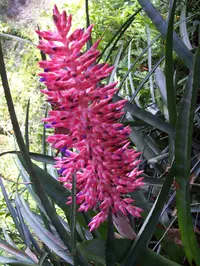
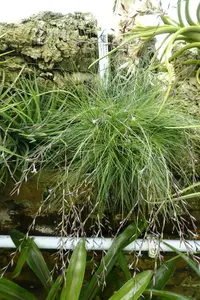
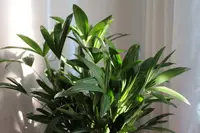
Brazilian vaseplant (Aechmea distichantha) is a terrestrial or epiphytic bromeliad known for its upright rosette of stiff, often spiny-edged leaves that form a central water-holding cup. Mature plants produce tall, colorful flower spikes that are followed by decorative berries, giving strong architectural interest in pots or mixed plantings.
This species occurs naturally in subtropical regions of Brazil, Paraguay, Uruguay, and northern Argentina, where it grows on trees, rocks, or well-drained ground. Its drought tolerance, slow growth, and ability to handle a range of indoor humidity make it relatively straightforward to care for Brazilian vaseplant.
It prefers bright, filtered light, modest moisture in the central cup, and a loose, fast-draining potting mix rather than heavy garden soil.

Care Difficulty
Easy Care

Light Preference
Partial Sun

Water Requirements
Moderate Water

Temperature Preference
Warm Climate

Hardiness Zone
9–11

Soil Texture
Sandy, Loamy, Organic-rich

Soil pH
Acidic (5.5–6.5), Slightly acidic (6.5–7.0)

Soil Drainage
Well-drained

Fertilization
Light (every 4–6 weeks)
Scan your plant to receive care tips personalized for your specific plant
Available on iOS and Android
This bromeliad prefers bright light but benefits from some protection during the hottest hours.
Watering focuses on keeping the central cup filled and the surrounding soil lightly moist but not saturated.
This species prefers warm, frost-free conditions and tolerates brief heat if not exposed to extreme cold.
This bromeliad manages well in typical indoor humidity but benefits from slightly moist air.
Aechmea distichantha prefers a very free-draining, airy medium closer to an epiphytic mix than standard potting soil.
This species is very suitable for container growing, both indoors and outdoors in mild climates.
This bromeliad benefits from light feeding during active growth but does not need heavy fertilization.
Pruning needs for Aechmea distichantha are minimal and focus on hygiene rather than shaping.
Container-grown plants need infrequent repotting, mainly to refresh mix or manage clump size.
This species is most commonly propagated by separating offsets rather than from seed.
This bromeliad is moderately cold tolerant but needs care in areas with hard frost or freezing winds.

Plant Health Check
Not sure what's wrong with your plant? Check your plant's health inside the app.
This bromeliad naturally grows on rocky outcrops and cliffs in Brazil, Paraguay, Uruguay, and northern Argentina, anchoring its roots into crevices rather than relying on deep soil. The stiff, arching leaves form a vase that helps trap water and organic debris in these exposed habitats.
The tough, strap-shaped leaves carry sharp marginal spines that deter large herbivores from pushing through the clumps. In some rural areas of South America, dense plantings of this species are used as a living fence to discourage people and animals from crossing.
Its branched flower spikes can stay colorful for several months, even though each individual flower is short-lived. The pink to reddish bracts surrounding the bluish to violet flowers are what provide most of the long-term display and make Aechmea distichantha plant care popular among collectors.

In its native range, dense clusters of this species act as microhabitats that shelter insects, frogs, and small reptiles, with the water-holding rosettes functioning as miniature reservoirs that support their own tiny aquatic communities.
Blooming often fails when the plant is immature, lacks sufficient light, or has not experienced a slight stress period. Stable, moderate feeding and a few months of cooler, drier rest usually trigger flowering in mature rosettes.
Keep your plants happy and healthy with plant identification, disease detection, and easy care guidance.