Variegated Upright Elephant Ear Care (Alocasia macrorrhizos 'Variegata')

Also known as: Upright Elephant Ear, Elephant's Ear
Variegated Upright Elephant Ear

About Variegated Upright Elephant Ear

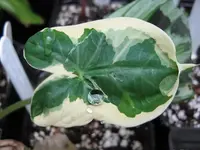
Alocasia macrorrhizos 'Variegata', often called variegated upright elephant ear, is a tropical aroid grown mainly for its dramatic foliage. It forms tall, trunk-like stems topped with large, upright, arrow-shaped leaves splashed with creamy white and green.

This cultivar comes from tropical Asia and performs best in warm, humid conditions that mimic its native climate. It prefers bright, filtered light, evenly moist but not waterlogged soil, and good air movement.

Due to its variable variegation and sensitivity to overwatering, it is not the easiest plant, but patient growers can care for Variegated Upright Elephant Ear successfully indoors or in sheltered outdoor spots in mild climates.

Main Plant Requirements

Care Difficulty

Hard Care

Light Preference

Bright Indirect Light

Water Requirements

Keep Soil Moist

Temperature Preference

Tropical / Frost Sensitive

Hardiness Zone

9–11

Soil Texture

Loamy, Peaty, Organic-rich

Soil pH

Acidic (5.5–6.5), Slightly acidic (6.5–7.0)

Soil Drainage

Moist but well-drained

Fertilization

Moderate (every 2–4 weeks)

Get Personalized Care Plan

Scan your plant to receive care tips personalized for your specific plant

Available on iOS and Android

How to Care for the Variegated Upright Elephant Ear

This variegated alocasia needs bright, indirect light to maintain strong growth and clear leaf patterning.

  • Provide 6–8 hours of bright, filtered light daily, such as near an east window or under light shade outdoors, to keep Variegated Upright Elephant Ear foliage from yellowing or greening out.
  • Allow gentle morning sun but protect from strong midday and afternoon sun, which can scorch white variegation and cause crispy brown patches.
  • In winter, move plants closer to bright windows or supplement with grow lights, as low light slows growth, reduces new leaves, and can cause stretched, weak petioles.

This plant prefers consistently moist but not saturated soil with good aeration around the roots.

  • Water when the top 2–4 cm of soil feels dry, then water thoroughly until excess drains away, ensuring no standing water around the root zone.
  • Use a loose, fast-draining mix; soggy soil causes yellowing leaves, soft stems, and possible root rot in Alocasia macrorrhizos 'Variegata'.
  • Reduce watering frequency in cooler months when growth slows; slightly drooping, dull leaves suggest thirst, while persistent wetness and a sour smell indicate overwatering.

Stable warm temperatures support strong foliage and root growth for this tropical species.

  • Aim for 70–85°F (21–29°C) during active growth; short exposures down to 60°F (16°C) are tolerated but growth slows noticeably.
  • Protect from cold; below 55°F (13°C) leaves may yellow or collapse, and light frost can kill foliage even if underground parts survive.
  • In hot spells above 90°F (32°C), increase shade and air movement and avoid dry soil, as combined heat and drought stress can cause leaf edge burn and rapid wilting.

This plant needs consistently high humidity to keep its large variegated leaves healthy.

  • Aim for 60–80% humidity; prolonged levels below 50% often cause leaf-edge browning and crisp tips.
  • In dry indoor air, watch for curling, dull patches, and stalled growth as signs of humidity stress.
  • Increase humidity with a nearby humidifier, grouping plants, or a wide pebble tray that allows air to move around the Variegated Upright Elephant Ear.

Alocasia macrorrhizos 'Variegata' prefers a loose, airy, organic-rich mix that drains quickly but retains slight moisture.

  • Use a base of peat or coco coir with added compost for organic matter and steady moisture retention.
  • Improve drainage and aeration by mixing in coarse perlite and medium orchid bark, roughly 40–50% of the total volume.
  • Target a slightly acidic to neutral pH, around 6.0–7.0, which supports nutrient availability for this species.
  • Avoid heavy garden soil, fine sand, or compacted mixes that hold water around the roots and promote rot.

This species is well suited to container growing due to its controllable root zone and moisture conditions.

  • Choose a wide, heavy container to prevent tipping as the plant becomes tall and top-heavy.
  • Select a pot material that matches your climate; porous terracotta suits humid regions, while plastic can reduce moisture loss in dry homes.
  • Ensure drainage holes are large and unobstructed so excess water exits within seconds after thorough watering, preventing root suffocation.

This variegated aroid benefits from moderate, consistent feeding during active growth for stable leaf production.

  • Use a balanced liquid fertilizer (for example 10-10-10 or 20-20-20) diluted to 1/4–1/2 strength for caring for Variegated Upright Elephant Ear.
  • Feed every 2–4 weeks in spring and summer when growth is active.
  • Stop or reduce to monthly feeding at very weak strength in fall and winter when growth slows.
  • Organic compost or a slow-release fertilizer can be added at the start of the growing season instead of frequent liquid feedings.

Pruning needs for Alocasia macrorrhizos 'Variegata' are light and focus on hygiene and space management.

  • Best time is during active growth in spring or summer so the plant recovers quickly.
  • Remove yellowing, dead, or damaged leaves at the base with clean, sharp pruners or a knife.
  • Thin out crowded stems to improve airflow and maintain an upright, open shape.
  • Avoid cutting healthy main stems heavily, as this reduces leaf area and slows growth.

Container-grown plants benefit from periodic repotting to maintain root health and stable growth.

  • Repot every 1–2 years in spring when roots circle the pot, emerge from drainage holes, or growth slows.
  • Move to a container 2–5 cm wider, using a chunky, well-drained aroid mix to prevent waterlogging.
  • Water thoroughly after repotting, then keep soil slightly moist and light levels bright but indirect for 1–2 weeks to limit stress.
  • Handle the root ball gently, keeping most soil intact, and avoid dividing stressed plants at the same time.

Alocasia macrorrhizos 'Variegata' is most reliably propagated by division of the main clump or offsets rather than from seed.

  • Carry out division in warm spring or early summer when the plant is actively growing.
  • Lift the plant and separate offsets or rhizome sections, ensuring each division has healthy roots and at least one growing point.
  • Plant divisions in a well-drained mix, keep humidity high, and maintain temperatures around 70–80°F for rooting.
  • Provide bright, indirect light and only lightly moist soil until strong new growth appears.

This tropical plant is frost sensitive and needs careful winter management in temperate climates.

  • In regions below about 50°F, grow in containers and move indoors before the first frost.
  • Keep indoor temperatures around 65–75°F with bright, indirect light in winter.
  • Water less in the cooler season, allowing the topsoil to dry slightly between waterings.
  • In mild climates, apply a 5–10 cm mulch layer over the root zone to buffer soil temperature.

Care Tips

Rotate For Balance

Turn the pot 90° every 1–2 weeks so each side receives similar light, which keeps the petioles shorter and helps prevent the plant from leaning or toppling as it matures.

Sturdy Potting Setup

Use a wide, heavy pot or add a layer of coarse gravel at the bottom (outside the root zone) to counterweight the tall foliage and reduce the risk of the container tipping over indoors or on balconies.

Support Heavy Petioles

Install discreet, sturdy stakes and soft ties to support long petioles on large leaves, especially after repotting or moving the plant, to prevent mechanical damage at the corm or stem base.

Corm Health Checks

When repotting, inspect the corm for soft, dark, or foul-smelling areas and trim these out with a sterile knife, then dust the cuts with powdered sulfur or cinnamon to reduce rot risk before replanting.

Planned Dormancy Management

If growth slows sharply in cooler, darker months, reduce disturbance, keep the soil barely moist, and remove only fully yellowed leaves so the plant can cycle energy back into the corm while growing Variegated Upright Elephant Ear long term.

Common Pests and Diseases

Spider mites

This pest thrives on Alocasia foliage in warm, dry indoor air and feeds on leaf sap, causing stippling, dulling, and eventual yellowing of the variegated leaves. Fine webbing often appears on leaf undersides and between petioles.

Solution

Rinse leaves thoroughly with a strong but gentle stream of lukewarm water, focusing on undersides, then wipe with a soft cloth. For persistent infestations, apply a neem oil or insecticidal soap spray every 5–7 days for several cycles and increase humidity while avoiding direct blasts of hot, dry air from vents.

Aphids

These insects cluster on young shoots, petiole bases, and the undersides of new leaves, sucking sap and causing distortion, curling, and sticky honeydew deposits. Sooty mold may develop on the honeydew, further dulling the white variegation.

Solution

Shower the plant to dislodge colonies and prune heavily infested soft growth. Follow with targeted applications of insecticidal soap or a light neem oil spray, repeating weekly until no new aphids appear, and avoid overfertilizing, which encourages lush, aphid‑prone growth when caring for Variegated Upright Elephant Ear.

Mealybugs

This pest appears as white, cottony clusters in leaf axils, along veins, and at rhizome or petiole junctions, where it feeds on plant sap. Symptoms include stunted growth, yellowing, and sticky residue on leaves and nearby surfaces.

Solution

Isolate the plant, then dab visible mealybugs with cotton swabs dipped in isopropyl alcohol (70%) and wipe affected areas. Follow with repeated treatments using insecticidal soap or neem oil on all leaf surfaces and tight crevices, checking the rhizome area and pot rim regularly for re‑infestation.

Bacterial leaf spot

This disease produces water‑soaked, translucent spots that turn brown with yellow halos, often starting along leaf edges or where water sits on the blade. Symptoms include rapid spread in warm, humid conditions, especially when leaves stay wet for long periods.

Solution

Remove and discard all affected leaves, sterilizing cutting tools between cuts, and avoid overhead watering or water sitting in the leaf cup. Improve air circulation, keep foliage dry, and if spread continues, discard severely infected plants to protect nearby aroids, then reintroduce only disease‑free stock.

Rhizome and root rot

Symptoms include wilting, yellowing, and collapse of large leaves, often starting from the petiole base, with the rhizome turning soft, brown, and foul‑smelling. This problem is strongly associated with Alocasia grown in heavy, waterlogged soil or kept in oversized pots that stay wet for too long.

Solution

Unpot the plant, cut away all mushy, discolored tissue with sterile tools, and dust cut surfaces with a fungicidal powder if available. Repot into a smaller container with a fast‑draining, chunky mix, water lightly until new growth appears, and adjust routine to allow the top 3–5 cm of soil to dry before watering again.

Interesting Facts

Variegation from cell layers

Its white and green marbling comes from chimeral variegation, where genetically different cell layers in the leaf and stem grow side by side, creating stable but irregular patterns that cannot be reproduced reliably from seed.

Lower photosynthetic capacity

The white sectors on its leaves contain little or no chlorophyll, so this cultivar converts light to energy less efficiently than the all-green form of Alocasia macrorrhizos and generally grows more slowly under similar conditions.

Sport of giant taro

This plant is a variegated cultivar selected from the giant taro, a large elephant ear species historically grown in tropical Asia and the Pacific both as an ornamental and, in non-variegated forms and after careful processing, as a traditional starch crop.

Botan icon

Did you know?

Individual plants of Alocasia macrorrhizos 'Variegata' propagated from the same mother plant by division or tissue culture can develop noticeably different variegation patterns over time, as some clones gradually produce more green or more white tissue depending on how the underlying chimeral cell layers expand.

FAQs about Variegated Upright Elephant Ear

This species performs best outdoors in warm, humid, frost-free climates, where it can reach full size. Indoors it stays smaller but can still thrive if given bright light, stable warmth, and enough humidity.

Grow Healthy Plants with Botan Care

Keep your plants happy and healthy with plant identification, disease detection, and easy care guidance.

Botan plant care app — identify plants on mobile

Explore More Plants