Targeted mist technique
Hold the plant upside down or at an angle while misting so water runs off the dense filament-like leaves and does not sit in the crown, which reduces the risk of rot in humid indoor spaces.

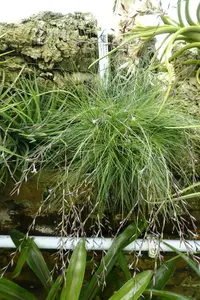
Tillandsia filifolia is a small epiphytic air plant from Central America and Mexico, where it grows on trees in warm, humid forests. It forms a fine, grassy rosette of thin, flexible leaves and produces a slender flower spike with delicate white to pale lilac blooms.
This species absorbs water and nutrients through specialized leaf scales rather than roots, so it does not grow in soil. Good air movement, bright filtered light, and regular misting or soaking are the main points to understand when learning how to care for Tillandsia filifolia.

Care Difficulty
Moderate Care

Light Preference
Bright Indirect Light

Water Requirements
Regular Water

Temperature Preference
Tropical / Frost Sensitive

Hardiness Zone
10–12

Soil Texture
Sandy, Rocky, Organic-rich

Soil pH
Acidic (5.5–6.5)

Soil Drainage
Well-drained

Fertilization
Light (every 4–6 weeks)
Scan your plant to receive care tips personalized for your specific plant
Available on iOS and Android
This species prefers bright, indirect light that mimics dappled forest canopy conditions.
This air plant absorbs water mainly through its leaves and needs thorough wetting followed by full drying.
This species prefers warm, stable conditions similar to tropical lowland climates.
This air plant relies on moderate to high humidity for stable growth.
This epiphytic species does not grow in regular potting soil but on a loose, airy support.
This species can be displayed in containers as long as the setup keeps the plant dry and well aerated.
This air plant benefits from very light, occasional feeding during active growth.
Pruning needs for Tillandsia filifolia are minimal and focus on hygiene rather than shaping.
This air plant is usually mounted or kept loose, so transplanting focuses on repositioning rather than root disturbance.
Propagation of Tillandsia filifolia is most successful through offsets rather than seed.
This species is frost sensitive and needs sheltered winter conditions in most climates.

Plant Health Check
Not sure what's wrong with your plant? Check your plant's health inside the app.
This species forms dense, spherical rosettes made of ultra-thin, filament-like leaves that can move slightly with air currents, increasing air contact for gas exchange and water uptake from humidity.
It is naturally found in humid, high-elevation cloud forests of Costa Rica and Mexico, where it grows as an epiphyte on trees, relying on frequent mists rather than soil for moisture and nutrients.
The plant produces slender flower spikes with small, tubular purple flowers, and like many tillandsias, the flowers are primarily pollinated by nocturnal moths attracted by scent rather than showy color.

Tillandsia filifolia often anchors itself in narrow tree crevices or on thin branches where leaf litter accumulates, allowing its fine roots to stabilize the plant while its leaves harvest almost all needed water and nutrients directly from the air.
Lack of bright, indirect light, insufficient air circulation, or inadequate nutrients from occasional foliar fertilizer can delay flowering. Plants often need to reach maturity first, and some clones simply bloom less frequently under indoor conditions.
Keep your plants happy and healthy with plant identification, disease detection, and easy care guidance.