Support epiphytic habits
Mount the plant on a rough cork slab or place the pot in a tight basket so the swollen caudex and roots can anchor securely, which better mimics its natural epiphytic lifestyle and stabilizes top growth over time.

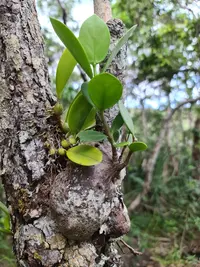
Hydnophytum moseleyanum, often called an ant plant, is a tropical epiphyte that naturally grows on trees in rainforests of Papua New Guinea and nearby regions. It forms a swollen, tuber-like caudex with internal chambers that can house ants in nature.
The plant produces upright, branching stems with simple green leaves, giving it a compact, sculptural look well suited to containers. Its slow to moderate growth and preference for stable, warm, humid conditions make it moderately challenging for beginners but very manageable for attentive growers.
To care for Hydnophytum moseleyanum, provide bright filtered light, evenly moist but not waterlogged substrate, and a loose, airy mix that drains well yet holds some moisture.

Care Difficulty
Moderate Care

Light Preference
Bright Indirect Light

Water Requirements
Moderate Water

Temperature Preference
Tropical / Frost Sensitive

Hardiness Zone
11–12

Soil Texture
Sandy, Loamy, Organic-rich

Soil pH
Acidic (5.5–6.5), Slightly acidic (6.5–7.0)

Soil Drainage
Moist but well-drained

Fertilization
Light (every 4–6 weeks)
Scan your plant to receive care tips personalized for your specific plant
Available on iOS and Android
This ant-plant prefers bright, gentle light that mimics filtered tropical sun.
This species prefers evenly moist conditions but reacts poorly to sitting in waterlogged soil.
This tropical epiphyte thrives in warm, stable conditions without cold drafts or temperature shocks.
This ant plant prefers moderately humid air but adapts if extremes are avoided.
This species needs a very airy, fast-draining mix that mimics loose, organic-rich epiphytic substrate.
This species is well suited to container culture due to its compact caudex and slow to moderate growth.
This epiphytic species benefits from light, targeted feeding during active growth in spring and summer.
This plant needs only light pruning to maintain a compact, healthy canopy above the caudex.
This species grows slowly and prefers infrequent repotting in a stable, airy substrate.
Hydnophytum moseleyanum is usually propagated from fresh seed under warm, stable indoor conditions.
This tropical ant plant is not frost hardy and needs warm, protected conditions in winter.

Plant Health Check
Not sure what's wrong with your plant? Check your plant's health inside the app.
This species develops a swollen, sponge-like caudex that is naturally hollowed by labyrinth-like chambers, which in the wild are commonly occupied by ant colonies. The internal walls of these chambers are lined with specialized warty structures that help absorb nutrients from ant waste and decaying organic material.
The outer surface of the caudex forms small, precise entrance holes that allow ants to move in and out while keeping the interior protected. These entry points align with chamber corridors inside the tuber, showing a high degree of structural adaptation to ant symbiosis.
In nature this species usually grows as an epiphyte on tree branches in lowland tropical rainforests of New Guinea and nearby regions. It anchors with a compact root system in moss, bark debris, and leaf litter, relying on captured organic matter and ant-derived nutrients rather than deep soil.

Hydnophytum moseleyanum was one of the early ant-plant species to be scientifically described in detail for its mutualistic relationship with ants, contributing to the classic concept of myrmecophytes, plants that offer living space to ants in exchange for protection and nutrient enrichment.
This species usually performs better indoors or in a sheltered greenhouse in most US climates, since it needs stable warmth, high humidity, and protection from cold and strong sun. Outdoors it is realistic only in frost‑free, very humid areas.
Keep your plants happy and healthy with plant identification, disease detection, and easy care guidance.