foxtail orchid Care (Rhynchostylis retusa)

foxtail orchid

About foxtail orchid

The foxtail orchid, Rhynchostylis retusa, is an epiphytic orchid that often grows on tree trunks and branches rather than in soil. It forms compact clumps of leathery, strap-shaped leaves and thick aerial roots.

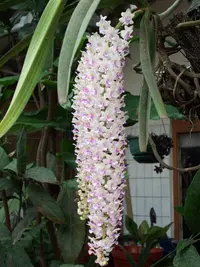
Its long, pendulous flower spikes are densely packed with small, fragrant blossoms, giving a brush-like or foxtail appearance. In nature, it occurs in warm, humid forests across parts of South and Southeast Asia.

This species prefers bright, filtered light, good air movement, and consistent moisture, which reflects its tree-dwelling habit. Understanding these natural conditions helps guide how to care for foxtail orchid at home.

Main Plant Requirements

Care Difficulty

Hard Care

Light Preference

Partial Shade

Water Requirements

Regular Water

Temperature Preference

Tropical / Frost Sensitive

Hardiness Zone

12–13

Soil Texture

Sandy, Rocky, Organic-rich

Soil pH

Acidic (5.5–6.5)

Soil Drainage

Well-drained

Fertilization

Moderate (every 2–4 weeks)

Get Personalized Care Plan

Scan your plant to receive care tips personalized for your specific plant

Available on iOS and Android

How to Care for the foxtail orchid

Rhynchostylis retusa needs bright, filtered light to flower well without leaf burn.

  • Provide 6–8 hours of bright, indirect light daily, such as dappled shade under a tree canopy or 30–50% shade cloth.
  • Allow gentle early morning sun but protect from strong midday and afternoon sun, which causes yellow, scorched patches on leaves.
  • In summer, move the foxtail orchid to slightly deeper shade; in winter, increase light exposure to prevent weak, elongated growth.

This epiphytic orchid prefers frequent moisture around the roots but no prolonged saturation.

  • Water when roots turn silvery and surfaces feel just dry, often every 1–3 days in warm weather, less often in cool seasons.
  • Ensure excellent drainage using a coarse orchid medium; standing water around roots leads to rot, mushy roots, and a sour smell.
  • Underwatering shows as wrinkled leaves and shriveled roots; overwatering shows as blackened, soft roots and yellowing lower leaves on Rhynchostylis retusa.

This orchid thrives in warm, humid conditions and reacts poorly to cold or sudden temperature swings.

  • Aim for 70–85°F (21–29°C) by day and 60–70°F (16–21°C) by night for best growth and flowering.
  • Avoid temperatures below 50°F (10°C); brief dips to 45°F (7°C) may be survived but can slow growth and damage roots.
  • In hot spells above 90°F (32°C), increase air movement and humidity while keeping the plant shaded to prevent heat stress and leaf scorch.

This orchid needs high, stable humidity to maintain healthy roots and flower spikes.

  • Aim for 60–80% humidity; use a hygrometer to avoid long periods below 50%.
  • It tolerates brief drier spells but prolonged dry air causes shriveling roots, limp leaves, and stalled growth.
  • Increase humidity with daily misting of roots, grouped plants, or a fan-assisted humidifier rather than leaving water standing under the foxtail orchid.

This species grows best mounted or in a very loose, airy orchid medium rather than compact soil.

  • Use chunky, organic-rich structure such as large-grade bark, charcoal, and a little sphagnum moss to hold moisture without compressing.
  • Ensure extremely fast drainage; water should run through in seconds and roots should never sit in collected water.
  • Keep pH slightly acidic to neutral, around 5.5–7.0, which suits epiphytic orchids like Rhynchostylis retusa.
  • Avoid dense loam, fine peat, or any mix that packs around roots, and add extra bark or coarse perlite to improve aeration if it feels heavy.

This orchid adapts well to containers, especially baskets or slatted pots that mimic its epiphytic habit.

  • Choose shallow, wide baskets or orchid pots that let roots spill out, which improves airflow and reduces rot risk.
  • Select rigid, heavy containers or hangers that keep the plant stable when flower spikes become long and weighty.
  • Use side-slotted or mesh containers so irrigation water exits quickly while roots still receive strong air circulation.

This epiphytic orchid benefits from light, regular feeding during its active growth but is sensitive to excess salts.

  • Use a balanced orchid fertilizer (around 20-20-20) at 1/4–1/2 strength in place of every 2nd or 3rd watering in spring and summer.
  • Apply as a dilute liquid to well-watered roots; avoid fertilizer on dry roots to reduce burn risk.
  • Reduce feeding sharply in fall and winter, giving only plain water or a very weak solution once a month.
  • For caring for foxtail orchid mounted on bark or in baskets, occasional use of a slow-release orchid fertilizer can supplement liquids.

Rhynchostylis retusa needs only minimal pruning focused on hygiene rather than shaping.

  • Best timing is after flowering, when spent flower spikes can be cut off at the base with sterile scissors.
  • Remove only dead, dried, or diseased roots and leaves, trimming back to healthy, firm tissue.
  • Avoid cutting live green roots or the central growth, as this can slow flowering and overall vigor.
  • Use clean, sharp tools and disinfect between plants to lower the risk of fungal and bacterial infections.

This orchid prefers to stay undisturbed and is usually grown in baskets or mounted rather than in deep pots.

  • Repot or remount every 2–3 years, or when roots overflow the basket, medium has broken down, or growth becomes slow.
  • Choose late spring, just before or after the main growth flush, to minimize transplant shock.
  • Gently tease roots free, remove decayed medium, and trim only dead, hollow roots while keeping healthy roots intact.
  • Secure the plant firmly in a slatted basket or on coarse bark, then keep humidity high and light slightly reduced for 1–2 weeks.

Rhynchostylis retusa is slow to propagate and is usually multiplied by division rather than from seed at home.

  • Best season for division is late spring, when new root tips start to grow and recovery is faster.
  • Select a mature clump with several growths, then divide so each section has at least 3–4 healthy leaves and strong roots.
  • Use sterile tools to separate sections and mount each division securely in a basket or on bark.
  • Maintain bright, filtered light, 70–80°F temperatures, and high humidity to support root establishment after division.

This warm-growing orchid is frost sensitive and needs sheltered conditions in regions with cool winters.

  • Move container plants indoors or into a heated greenhouse before temperatures drop below 55°F.
  • Provide bright, indirect light and good air circulation while keeping the root zone just slightly on the dry side.
  • Avoid cold drafts and sudden temperature drops that can damage leaves and roots.
  • In mild climates, outdoor plants under cover still require protection from near-freezing nights with extra insulation or relocation.

Care Tips

Basket mounting

Grow the plant in a slatted wooden or plastic basket with coarse orchid media so roots can hang freely and form longer, fuller flower spikes over time.

Cool-night trigger

Provide a 4–6 week period of slightly cooler, drier nights before the usual blooming season to help trigger stronger, more synchronized flowering when growing foxtail orchid.

Root inspection routine

Inspect exposed roots every 2–3 weeks and remove only clearly dead, hollow, or blackened sections with sterile tools to reduce rot risk while preserving healthy aerial roots.

Airflow positioning

Place the plant where it receives a gentle, constant air movement but no direct draft, which keeps thick roots dry enough between waterings and reduces fungal problems.

Support for spikes

Once flower spikes elongate, use soft ties or orchid clips to secure them to a thin stake or basket edge so the arching inflorescences develop evenly and avoid breakage.

Common Pests and Diseases

Scale insects

This pest attaches firmly to leaves, roots, and flower spikes, sucking sap and causing yellowing, shriveling roots, and weak flowering. Symptoms include sticky honeydew and sooty mold on leaves under heavily infested spikes.

Solution

Isolate the plant, then wipe leaves, roots, and spikes with cotton pads dipped in isopropyl alcohol, repeating weekly until no new insects appear. Improve air movement around the hanging plant, avoid overfertilizing with high nitrogen, and use a narrow-range horticultural oil or insecticidal soap on accessible surfaces, taking care not to drench the crown for foxtail orchid indoor care.

Mealybugs

These insects form white, cottony clusters in leaf axils, between tightly packed roots, and along flower spikes, where they suck sap and weaken the plant. Symptoms include distorted new growth, sticky honeydew, and poor spike development.

Solution

Remove visible colonies with a cotton swab dipped in isopropyl alcohol, then rinse the plant gently with lukewarm water, especially around leaf bases and aerial roots. Keep humidity moderate, increase air circulation around hanging baskets, inspect imported divisions or mounts carefully, and use insecticidal soap in repeated light applications if infestations persist.

Spider mites

This pest thrives on Rhynchostylis leaves in hot, dry conditions, causing fine speckling, dull leaf surfaces, and eventual bronzing. Symptoms include very fine webbing on the underside of leaves and along the midrib.

Solution

Increase ambient humidity to 50–70% while maintaining good airflow, and hose down foliage thoroughly, focusing on leaf undersides to dislodge mites. For persistent infestations, apply a miticidal soap or a labeled miticide in several cycles, keeping the plant out of direct sun while treated and avoiding wetting the crown late in the day.

Bacterial brown spot

This disease produces water-soaked, translucent patches on leaves that quickly turn brown to black and may have yellow halos. Symptoms include rapid expansion of soft, sunken lesions, especially in warm, stagnant, high-humidity conditions or after water remains trapped in leaf axils.

Solution

Immediately cut out affected leaf portions with a sterile blade, keeping cuts into healthy tissue, and discard all infected material. Keep water out of the leaf bases, ensure strong air circulation around hanging plants, water early in the day so foliage dries quickly, and if needed apply a copper-based bactericide carefully according to label, avoiding repeated heavy use that may stress roots.

Anthracnose leaf spot

This disease causes small, sunken brown lesions with darker borders on Rhynchostylis leaves that may merge into larger dead patches. Symptoms include slow but progressive spotting under conditions of poor air circulation and chronic leaf wetness, especially in dense orchid collections or shaded orchid houses.

Solution

Remove and discard spotted leaves or leaf sections, sterilizing cutting tools between cuts, and reduce overhead misting or any practice that keeps foliage wet for long periods. Improve airflow with fans, space plants so leaves do not touch, and apply an appropriate fungicide labeled for orchids in a few spaced treatments if conditions stay warm and humid.

Interesting Facts

Pendant flower cascades

This orchid produces long, densely packed inflorescences that can hang 30–60 cm, each bearing dozens of small, white, pink-spotted flowers arranged in a tight spiral along the spike, giving the characteristic foxtail appearance.

Fragrant nocturnal blooms

The flowers emit a sweet, noticeable scent that is often stronger in the evening and early morning, a trait thought to support moth and other nocturnal pollinators in its native habitats.

Specialized tree-dwelling roots

As an epiphyte, this species anchors itself to tree bark with thick, spongy aerial roots that absorb water and dissolved nutrients directly from rain, mist, and organic debris rather than from soil.

Botan icon

Did you know?

In parts of South and Southeast Asia, large, blooming clumps of this orchid are sometimes collected from the wild and displayed during regional festivals and ceremonies, where the long, drooping flower spikes are valued as ornamental symbols of abundance and good fortune.

FAQs about foxtail orchid

Lack of blooms usually comes from insufficient light, too-warm nights, or no slight winter rest. Provide bright filtered light, good air movement, regular feeding, and a small drop in night temperature to trigger flower spike formation.

Grow Healthy Plants with Botan Care

Keep your plants happy and healthy with plant identification, disease detection, and easy care guidance.

Botan plant care app — identify plants on mobile

Explore More Plants