Flush central tank
Every 4–6 weeks, pour lukewarm, low-mineral water through the central cup until it overflows to flush out salts and debris, then refill the cup with fresh water to reduce rot and mosquito issues when caring for Aechmea comata.

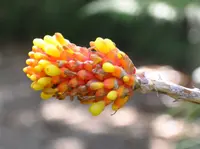
Aechmea comata is an epiphytic bromeliad, often grown as a compact ornamental for its striking rosette of arching leaves and colorful central bracts. It usually forms a tank-like center that can hold water, with foliage that ranges from green to slightly banded or mottled, depending on the form.
In nature, it occurs in parts of Brazil, typically growing on trees in warm, humid forests. Its slow growth, tolerance of indoor conditions, and modest root system make it relatively straightforward to care for Aechmea comata compared with many tropicals. It generally prefers bright, indirect light, good air movement, and a fast-draining mix suited to bromeliads.

Care Difficulty
Moderate Care

Light Preference
Bright Indirect Light

Water Requirements
Moderate Water

Temperature Preference
Tropical / Frost Sensitive

Hardiness Zone
10–12

Soil Texture
Sandy, Loamy, Organic-rich

Soil pH
Acidic (5.5–6.5), Slightly acidic (6.5–7.0)

Soil Drainage
Well-drained

Fertilization
Light (every 4–6 weeks)
Scan your plant to receive care tips personalized for your specific plant
Available on iOS and Android
This bromeliad thrives in bright, indirect light with some gentle direct sun.
This bromeliad prefers a lightly moist root zone and a filled central cup, but not waterlogged conditions.
This species prefers consistently warm, frost-free conditions to maintain healthy growth.
This bromeliad prefers moderate indoor humidity but tolerates short dry spells.
This epiphytic bromeliad needs a very airy, fast-draining mix rather than dense potting soil.
This species is well suited to container growing due to its compact but often top-heavy rosette form.
This bromeliad benefits from light, controlled feeding rather than heavy fertilization.
Pruning Aechmea comata is minimal and focuses on hygiene rather than shaping.
Repotting focuses on refreshing the mix and giving pups space rather than enlarging the pot frequently.
New plants are most reliably produced by dividing offsets rather than from seed.
This bromeliad is frost sensitive and needs protection in regions with cold winters.

Plant Health Check
Not sure what's wrong with your plant? Check your plant's health inside the app.
In its native southern Brazilian forests, this species often grows as an epiphyte on tree trunks, forming a tight leaf rosette that holds rainwater and organic debris, creating a small aquatic reservoir or tank.
The flowering spike shows a striking combination of yellow bracts and purple to violet petals, with subtle color changes as the flowers age and fruit begins to develop.
Although each individual flower is short-lived, the entire inflorescence can remain showy for several weeks to months, which is one reason it has become popular in cultivation and Aechmea comata plant care discussions.
This bromeliad usually flowers once when mature, then the rosette slowly declines while pups develop. Lack of bloom is often due to immaturity or stress; stable warmth, adequate nutrients, and consistent conditions support growing Aechmea comata to flowering size.
Keep your plants happy and healthy with plant identification, disease detection, and easy care guidance.