Early trellis training
Install a sturdy trellis, wire system, or fence before planting, then loosely tie new shoots with soft ties every 20–30 cm so the vine establishes an orderly, well-supported framework that is easier to prune and manage later.

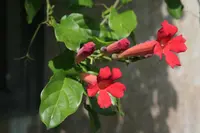
Mexican blood flower, Amphilophium buccinatorium, is a vigorous evergreen climber grown for its striking trumpet-shaped red to orange flowers and lush green foliage. It is typically trained on trellises, fences, or pergolas, where it forms a dense screen in mild to warm climates.
This species is native to Central and South America, where it grows in warm, frost-free areas. It is considered moderately easy to grow if given enough sun, support to climb, and well-drained soil.
Gardeners who learn how to care for Mexican blood flower usually focus on providing consistent moisture, protection from hard frost, and space for its strong, fast-growing vines.

Care Difficulty
Moderate Care

Light Preference
Full Sun

Water Requirements
Regular Water

Temperature Preference
Tropical / Frost Sensitive

Hardiness Zone
10–11

Soil Texture
Sandy, Loamy, Organic-rich

Soil pH
Acidic (5.5–6.5), Slightly acidic (6.5–7.0)

Soil Drainage
Moist but well-drained

Fertilization
Moderate (every 2–4 weeks)
Scan your plant to receive care tips personalized for your specific plant
Available on iOS and Android
This vigorous climber needs strong light to flower well over a long season.
This vine prefers evenly moist but not saturated soil, especially during active growth.
This subtropical climber grows best in warm, frost-free conditions outdoors.
This vigorous vine prefers moderately humid air but adapts to many outdoor conditions.
This species performs best in deep, well-drained, fertile soil that stays evenly moist but not saturated.
This vigorous climber can grow in containers if the pot is large, stable, and drains rapidly.
This vigorous climber benefits from moderate, targeted feeding to support flowering and leafy growth.
Pruning helps manage size and sustain heavy flowering on Amphilophium buccinatorium.
This fast-growing vine is usually planted in the ground, but young or container-grown plants sometimes need transplanting.
Amphilophium buccinatorium is commonly propagated from semi-ripe cuttings and sometimes from seed.
This subtropical vine is frost sensitive and needs protection in regions with cold winters.

Plant Health Check
Not sure what's wrong with your plant? Check your plant's health inside the app.
This species uses long, twining stems and tendrils to climb high into tree canopies, positioning its bright red tubular flowers where hummingbirds can easily find them.
The deep, narrow, red trumpet flowers are adapted to hummingbird bills and vision, so in its native range it is pollinated primarily by hummingbirds rather than by bees or other insects.
Native to warmer regions of Mexico and Central America, this vine is damaged by frost and often dies back to the base in cooler climates, then regrows from surviving roots when temperatures rise.

In frost-free climates, this species can reach more than 9 m in length and form dense, cascading curtains of foliage and flowers that function as living walls, providing shelter and nesting sites for small birds and other wildlife.
This species is a vigorous woody vine that climbs using tendrils. It prefers to grow up trellises, fences, or arbors rather than spreading along the ground, and can cover large structures when mature.
Keep your plants happy and healthy with plant identification, disease detection, and easy care guidance.