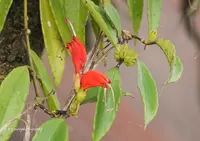
Macoubea guianensis Care

Macoubea guianensis

About Macoubea guianensis

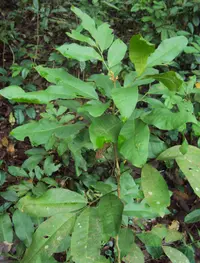
Macoubea guianensis is a tropical tree from the rainforests of northern South America, belonging to the Apocynaceae family. It is typically medium to large in size, with a straight trunk, dense crown, and leathery, glossy green leaves.

In its native habitat it grows in warm, humid lowland forests, often as part of mixed canopy vegetation. The species is adapted to consistently moist but well-drained soils and benefits from bright, filtered light, which can guide how to care for Macoubea guianensis in cultivation.

Its size, slow to moderate growth, and need for stable warmth and humidity make it more suitable for experienced growers or outdoor planting in frost-free climates than for casual indoor care.

Main Plant Requirements

Care Difficulty

Moderate Care

Light Preference

Partial Shade

Water Requirements

Moderate Water

Temperature Preference

Tropical / Frost Sensitive

Hardiness Zone

Unknown

Soil Texture

Loamy, Sandy, Organic-rich

Soil pH

Acidic (5.5–6.5), Slightly acidic (6.5–7.0)

Soil Drainage

Well-drained

Fertilization

Minimal (feed rarely)

Get Personalized Care Plan

Scan your plant to receive care tips personalized for your specific plant

Available on iOS and Android

How to Care for the Macoubea guianensis

This tropical canopy tree prefers bright, filtered light that mimics dappled forest sun.

  • Provide 4–6 hours of bright, indirect light daily, with morning sun and afternoon shade to prevent leaf scorch on Macoubea guianensis.
  • Allow light to pass through a light canopy or shade cloth; strong midday sun in open sites can burn foliage and dry young plants quickly.
  • In hot summers, increase shade to 50–70% cover, while in cooler or overcast seasons reduce shade slightly to maintain steady growth.

This species prefers steadily moist, well‑drained soil without prolonged drying or waterlogging.

  • Aim for soil that stays evenly moist to 5–8 cm depth; surface can dry slightly between rains or irrigations, but deeper layers should remain damp.
  • Use deep, slow watering so moisture reaches the root zone, and ensure excess water drains away to avoid standing water and root rot.
  • Reduce supplemental watering in cooler, rainy seasons; increase during hot, dry spells if leaves droop, curl, or feel limp, but cut back if soil smells sour or stems blacken.

This lowland tropical tree thrives in warm, frost‑free conditions year‑round.

  • Optimal growth occurs around 70–86°F (21–30°C), similar to humid tropical forest climates with only minor daily fluctuations.
  • Avoid temperatures below 55°F (13°C); brief dips to 45–50°F (7–10°C) may be survived but can slow growth and damage young tissue.
  • Protect from frost at all times, and during heat waves above 95°F (35°C) provide extra shade and soil moisture to prevent heat and drought stress.

This tropical tree prefers consistently high humidity to mimic its rainforest origin.

  • Aim for 60–80% humidity, as prolonged exposure below 50% often causes leaf edge browning and reduced growth.
  • It tolerates brief dry indoor air if soil moisture is stable, but chronic low humidity weakens new foliage.
  • Increase humidity with grouped plants, a room humidifier, or a wide pebble tray that allows evaporation around Macoubea guianensis.

This species needs deep, well-aerated, moisture-retentive but freely draining soil.

  • Use a loamy mix with 40–60% organic matter such as composted bark plus coarse sand to prevent waterlogging.
  • Ensure strong drainage; soggy, compacted substrates quickly damage the fine feeder roots and invite root rot.
  • Target a slightly acidic to neutral pH around 6.0–7.0, avoiding strongly alkaline substrates that limit nutrient uptake.
  • For container culture, blend compost, pine bark, and perlite to improve aeration while keeping steady, even moisture.

This large tree is challenging but can be grown in containers for juvenile stages or controlled-size specimens.

  • Choose a tall, heavy pot to counterbalance the developing woody canopy and reduce tipping in wind.
  • Select thick-walled clay or concrete containers outdoors to stabilize temperature and slightly reduce excess moisture retention.
  • Use a wide base container so the structural roots can spread laterally without circling tightly near the wall.

This tropical tree grows reasonably well in low-nutrient soils, so Macoubea guianensis benefits from modest, not heavy, feeding.

  • Use a balanced slow-release fertilizer (for example, 10-10-10 or 14-14-14) or a thin layer of well-rotted compost in spring.
  • Feed every 6–8 weeks during the warm growing season if growth or leaf color appears weak.
  • Apply at 1/2 the label rate for trees in the ground and water in thoroughly to limit root burn.
  • Stop feeding in late summer to early fall so new growth hardens before cooler conditions.

Pruning is mainly needed to maintain structure and remove problem wood on Macoubea guianensis rather than to control size.

  • Carry out structural pruning in late dry season or just before active growth starts, avoiding heavy cuts during peak growth.
  • Remove dead, diseased, crossing, or storm-damaged branches first to improve air flow and canopy safety.
  • Thin crowded interior shoots selectively instead of heading back main branches to preserve natural form.
  • Use sharp, clean bypass pruners or a pruning saw, making smooth cuts just outside the branch collar.

This species is usually grown in the ground, so care focuses on transplanting young trees rather than frequent repotting.

  • Transplant during warm, stable weather, ideally early rainy season, to reduce water stress and encourage root establishment.
  • Look for circling roots, stunted growth, or rapid drying of the potting mix as signals a container plant needs a larger space.
  • Move up only 1–2 pot sizes or into a planting hole 2–3× wider than the root ball, using well-drained, organic-rich soil.
  • Water deeply after planting, shade the canopy for 1–2 weeks if sun is intense, and keep soil evenly moist while new roots develop.

Propagation of Macoubea guianensis is usually done by seed and is considered slow, requiring warm, stable conditions.

  • Collect ripe seeds from healthy trees and sow them fresh, as viability drops with storage.
  • Sow in a sterile, well-drained mix, keep at 75–85°F, and maintain constant light moisture, not waterlogging.
  • Provide bright, indirect light and high humidity; germination may be slow and uneven over several weeks to months.
  • Label batches with source and date, discarding weak or diseased seedlings early to concentrate care on vigorous individuals.

This lowland tropical tree is frost sensitive and needs protection in climates with cool or freezing winters.

  • In regions with risk of frost, grow in large containers so plants can be moved indoors or into a heated greenhouse before nights drop below 50°F.
  • Provide bright light, reduced watering, and no or minimal feeding indoors during the coolest months.
  • For in-ground specimens in marginal climates, use a thick mulch layer 5–8 cm deep around the root zone, keeping it off the trunk.

Care Tips

Early structural pruning

In the first 2–3 years, selectively remove competing leaders and narrow branch crotches to develop a single strong trunk and well-spaced scaffold branches that can support the tree’s eventual size.

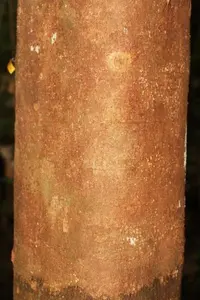
Wind protection setup

In exposed sites, install a sturdy stake or windbreak on the windward side for the first 1–2 years to reduce root rock and trunk bending while the root system anchors firmly.

Mulch for root stability

Apply a 5–8 cm layer of coarse organic mulch in a wide ring over the root zone, keeping it 5–8 cm away from the trunk, to moderate soil temperature and reduce surface root stress.

Root zone underplanting

Use low, shallow-rooted groundcovers rather than turf under the canopy to reduce competition for water and nutrients and to protect the surface feeder roots from mechanical damage.

Regular canopy inspections

Inspect the canopy at least twice a year for deadwood, crossing branches, and early signs of scale insects or sooty mold, so that caring for Macoubea guianensis includes prompt corrective pruning and targeted pest control before damage spreads.

Common Pests and Diseases

Leaf-chewing caterpillars

This pest feeds on tender foliage and young shoots, leaving irregular holes and ragged leaf edges on Macoubea guianensis trees in lowland rainforest and plantation settings. Symptoms include rapid defoliation of new growth during warm, humid periods.

Solution

Hand-pick visible caterpillars from reachable branches and prune heavily damaged shoots. For larger plants, encourage or protect natural predators such as birds, and if damage is repeated, use a targeted Bacillus thuringiensis (Bt) biological spray on young leaves, following label directions and avoiding application in very windy or rainy conditions.

Scale insects

These insects attach to stems, twigs, and leaf midribs, appearing as small, dome-shaped or flat bumps that excrete sticky honeydew. Symptoms include sooty mold growth on leaves, reduced vigor, and slow canopy development, especially in more sheltered, low-airflow planting sites.

Solution

Wipe or gently scrub affected bark and leaves with a soft cloth or brush dipped in mild soapy water, then rinse with clean water. For larger trees, apply a horticultural oil spray to thoroughly coat infested areas during cooler parts of the day, repeating after 7–14 days if needed while monitoring for natural enemies such as lady beetles and parasitoid wasps as part of broader Macoubea guianensis care instructions.

Thread blight

This disease is caused by filamentous fungi that form fine, whitish to brown threads across leaves and twigs in warm, wet forest or plantation conditions. Symptoms include leaves sticking together in clusters, localized twig dieback, and persistent web-like fungal strands on shaded inner branches.

Solution

Prune out affected twigs and leaf clusters, removing all visible fungal threads, and dispose of the material away from the planting area. Improve light penetration and air movement through selective thinning of the canopy, and avoid persistent overhead irrigation on small cultivated trees to reduce surface moisture on foliage.

Anthracnose leaf spots

This disease produces dark, irregular lesions on leaves, often with pale centers and yellow halos, which can coalesce and cause premature leaf drop. Symptoms include thinning foliage on lower and inner branches during prolonged wet or poorly ventilated conditions.

Solution

Remove and discard fallen and heavily spotted leaves to lower the local source of fungal spores. Increase airflow around the plant, avoid wetting leaves late in the day, and if the tree is in managed cultivation, a copper-based fungicide can be applied preventively at the start of prolonged wet periods according to label instructions.

Interesting Facts

Amazonian latex producer

This tree is a wild latex producer in lowland Amazonian forests, with a white, sticky sap that historically drew local interest as a potential rubber source, though it was never commercialized on a large scale like Hevea brasiliensis.

Large woody fruits

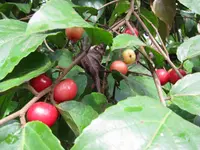
It forms sizable, woody capsules that take a long time to mature and split open, releasing relatively few but large seeds instead of many small ones, which is typical for several members of the Apocynaceae family.

Specialized forest habitat

The species naturally grows in humid terra firme rainforest, often on well-drained soils away from flood zones, and contributes to the mid- to upper-canopy layer in its native Guianan and Amazonian range.

FAQs about Macoubea guianensis

In suitable tropical or subtropical conditions, this tree can reach 8–15 m tall with a broad, rounded crown. In home gardens or managed plantings, it often stays smaller, around 4–8 m, depending on pruning and site quality.

Grow Healthy Plants with Botan Care

Keep your plants happy and healthy with plant identification, disease detection, and easy care guidance.

Botan plant care app — identify plants on mobile

Explore More Plants