


Use removable mounts
Attach plants to driftwood, cork, or wire with soft plant ties or florist wire rather than glue, so you can easily detach them for soaking, inspection, or rearranging as they produce pups.

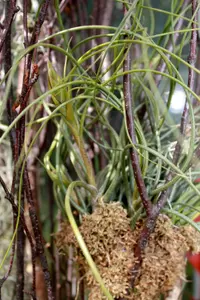
Tillandsia butzii, commonly called the Butzii air plant, is an epiphytic bromeliad that grows without conventional soil, anchoring to bark, rock, or other surfaces. It stores water and nutrients in its leaves rather than in roots.
This species has a narrow, speckled, often twisted base with long, fine leaves that curve or curl, giving it a distinctive, sculptural look. It naturally occurs in humid forests of Central America and Mexico, where it receives bright filtered light, frequent moisture, and good air movement.
These traits make it moderately easy to care for Butzii Air Plant if humidity and airflow are adequate and the plant is not kept constantly wet or in deep shade.

Care Difficulty
Moderate Care

Light Preference
Bright Indirect Light

Water Requirements
Moderate Water

Temperature Preference
Tropical / Frost Sensitive

Hardiness Zone
10–12

Soil Texture
Sandy, Rocky, Organic-rich

Soil pH
Acidic (5.5–6.5)

Soil Drainage
Well-drained

Fertilization
Light (every 4–6 weeks)
Scan your plant to receive care tips personalized for your specific plant
Available on iOS and Android
This epiphytic air plant performs best in bright, indirect light that mimics dappled forest sun.
This air plant depends on frequent, thorough wetting followed by rapid drying rather than constant moisture.
This species prefers warm, frost-free conditions that resemble its native tropical to subtropical habitats.
This species benefits from relatively high humidity to keep the leaves hydrated and functional.
Tillandsia butzii is an epiphyte and should never be planted in conventional potting soil.
This air plant can be grown in containers as long as the setup keeps the base dry and well ventilated.
This epiphytic Tillandsia benefits from light, diluted feeding during active growth but does not need heavy fertilization.
Tillandsia butzii needs only light grooming to keep the plant healthy and attractive.
This air plant is usually mounted rather than potted, so transplanting focuses on repositioning rather than root disturbance.
Propagation of Tillandsia butzii is most practical by removing offsets produced around the mother plant.
This tropical air plant is not frost hardy and needs indoor conditions in cold climates during winter.

Plant Health Check
Not sure what's wrong with your plant? Check your plant's health inside the app.
This species develops a swollen, mottled base with dark speckling that helps camouflage it among mossy, lichen-covered branches in its native cloud forests of Central America.
Unlike many stiff, gray desert tillandsias, this plant has long, curling, dark green leaves and a semi-mesic form adapted to the higher humidity and frequent mist of montane forests.
Mature plants produce an upright reddish inflorescence with tubular greenish to purple-tinged flowers that attract hummingbirds in its native range.

In its native habitats from Mexico to Panama, this species often grows as an epiphyte on trees near streams and waterfalls at mid to high elevations, taking advantage of moving air and frequent fog to capture moisture and nutrients from the air rather than from soil.
Blooming is often delayed by low light, inconsistent watering, or temperatures that stay too cool. Plants must also be mature before flowering. Provide bright indirect light, steady warmth, and regular moisture, then wait for the natural bloom cycle.
Keep your plants happy and healthy with plant identification, disease detection, and easy care guidance.

-1-200x133.webp)