Greenfly Orchid Care (Epidendrum conopseum)

Also known as: Bartram's Tree Orchid
Greenfly Orchid

About Greenfly Orchid

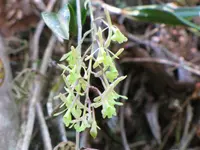
Epidendrum conopseum, commonly called greenfly orchid, is a small epiphytic orchid that usually grows on tree trunks and branches. It forms slender, upright stems with narrow leaves and produces delicate greenish flowers that may have a slight fragrance.

This species is native to the southeastern United States, where it lives in warm, humid forests, often on oaks and cypress. It is considered moderately easy for growers who can provide stable conditions and good air movement.

To care for Greenfly Orchid, growers typically provide bright filtered light, regular moisture with quick drying between waterings, and a loose, airy mount or coarse orchid mix that does not stay wet for long.

Main Plant Requirements

Care Difficulty

Moderate Care

Light Preference

Partial Sun

Water Requirements

Moderate Water

Temperature Preference

Warm Climate

Hardiness Zone

8–11

Soil Texture

Sandy, Rocky, Organic-rich

Soil pH

Acidic (5.5–6.5)

Soil Drainage

Well-drained

Fertilization

Light (every 4–6 weeks)

Get Personalized Care Plan

Scan your plant to receive care tips personalized for your specific plant

Available on iOS and Android

How to Care for the Greenfly Orchid

This epiphytic orchid prefers bright, filtered light similar to bright woodland edges.

  • Provide 3–5 hours of gentle morning sun with bright, dappled shade the rest of the day; avoid harsh, direct afternoon sun.
  • Tolerates light shade, but flowering of Greenfly Orchid declines if grown in dense shade with no sun flecks reaching the foliage.
  • Leaves should be medium green; pale, yellowed, or scorched leaves indicate excess sun, while very dark, limp foliage suggests insufficient light, especially in winter.

This orchid prefers frequent light moisture with fast drainage rather than heavy soaking.

  • Allow roots or mounting material to dry slightly between waterings; in warm weather, water when the surface feels just dry rather than waiting for it to stay dry for days.
  • In summer, increase frequency during hot, dry spells; in cooler months, reduce watering so the roots never sit wet for more than a few hours.
  • Shriveled pseudobulbs and limp leaves suggest underwatering, while blackened, mushy roots and a sour smell indicate overwatering or poor drainage around Epidendrum conopseum.

This species is a warm- to intermediate-growing orchid with notable cool tolerance outdoors.

  • Aim for 65–80°F (18–27°C) during active growth, with slight day–night variation supporting healthy development and flowering.
  • Tolerates short dips to about 40°F (4°C) if kept drier, but growth slows; protect from frost and prolonged exposure below 40°F (4°C).
  • Handles summer heat up to 90–95°F (32–35°C) if humidity is moderate and air moves freely; provide shade and extra airflow during hot, still periods.

This epiphytic orchid prefers moderately humid air but adapts fairly well to typical indoor conditions.

  • Aim for 50–70% humidity, with consistent levels rather than sharp daily swings.
  • Tolerates short spells near 35–40%, but leaf tips may brown and new roots may stall if air stays too dry.
  • Increase humidity with a pebble tray or grouped plants, avoiding frequent misting that can promote leaf spotting.

Epidendrum conopseum grows best in a very airy, fast-draining medium rather than dense potting soil.

  • Use a fine to medium orchid bark mix with added perlite and a small amount of sphagnum moss for moisture retention without compaction.
  • Aim for a slightly acidic to neutral pH around 5.5–7.0, which supports nutrient uptake and healthy root growth.
  • Ensure the mix dries quickly between waterings; water should pass through in seconds, not sit around the roots.
  • Avoid heavy peat-based or garden soils that stay wet, as these suffocate roots and raise the risk of rot.

This species is well suited to container culture, including baskets and mounted setups.

  • Choose a narrow but deep pot or basket that lets roots anchor firmly while keeping the plant slightly top-exposed for air flow.
  • Select a rigid, stable container material if the plant is mounted or grown tall, to prevent wobbling that can damage new roots.
  • Use a slatted basket or side holes near the lower pot walls to let air reach the root zone and excess water escape rapidly.

This epiphytic orchid benefits from light, consistent feeding during active growth to maintain healthy foliage and flowering.

  • Use a balanced orchid fertilizer (around 20-20-20) diluted to 1/4–1/2 strength in water.
  • Feed every 2–4 weeks in spring and summer, applying to well-watered roots to avoid burn.
  • Reduce or stop feeding in fall and winter when growth slows, especially for outdoor plants.
  • For caring for Greenfly Orchid mounted on bark or wood, consider occasional very weak liquid feed rather than slow-release pellets.

Epidendrum conopseum needs only light pruning to keep plants tidy and flowering well.

  • Best time is after main flowering flush in late spring or early summer.
  • Cut off spent flower spikes down to the first healthy node or to the pseudobulb base if fully dry.
  • Remove dead, damaged, or shriveled canes and leaves with clean, sharp scissors or pruners.
  • Limit pruning of green canes, since they store energy that supports future growth and blooms.

This species is often grown mounted or in small orchid baskets and dislikes frequent disturbance.

  • Repot or remount every 2–3 years, or when roots circle tightly, mix breaks down, or growth slows.
  • Plan work for early spring, just before new root and shoot growth begins.
  • Gently loosen roots, trim only dead or mushy ones, and place the plant in fresh, very free-draining orchid bark or on new mount material.
  • Water lightly for the first 1–2 weeks, keep humidity higher, and shade slightly to reduce transplant stress.

Propagation of Epidendrum conopseum is usually done vegetatively to preserve desirable traits.

  • Division is the most practical method, done in spring when repotting or remounting.
  • Separate clumps so each division has at least 3–4 healthy canes and a good root mass.
  • Attach divisions firmly to bark, cork, or a coarse orchid mix and maintain 60–80% humidity for rooting.
  • Seed propagation requires sterile lab conditions and is not practical for most home growers.

This orchid is among the more cold-tolerant North American epiphytic orchids but still needs thoughtful winter care in many regions.

  • In mild climates (down to about 20–25°F), established outdoor plants on trees often overwinter without extra protection.
  • In colder areas, grow Epidendrum conopseum in containers or on removable mounts and move indoors before hard frost.
  • Indoors, provide bright light, good air movement, and slightly cooler nights, and keep the medium barely moist.

Care Tips

Mounting Technique

Mount plants on cork bark or hardwood with a thin layer of long-fiber sphagnum only around the roots, then secure gently with fishing line or soft wire so roots can attach firmly without being strangled.

Airflow Management

Use a small oscillating fan on low near the plant to keep air moving around the roots and foliage, which reduces fungal problems and helps the roots dry predictably between waterings.

Calcium And Magnesium

Supplement a low-mineral fertilizer with a small amount of calcium-magnesium product 1–2 times per month, since epiphytic orchids often show leaf tip burn and poor root growth when calcium or magnesium is chronically low.

Outdoor Summering

In mild climates, hang mounted plants outdoors under bright, shifting shade in late spring and bring them back inside before nights drop below 50°F, which encourages stronger growth and more reliable blooming.

Bloom Spike Protection

Once flower spikes appear, avoid moving or rotating the plant and protect it from strong drafts or direct overhead watering, which can cause buds to abort or spikes to bend and break while caring for Greenfly Orchid.

Common Pests and Diseases

Scale insects

This pest feeds on sap along the slender pseudobulbs and leaf bases, often hiding in the tight sheaths of this epiphytic orchid. Symptoms include sticky honeydew, sooty mold growth, and yellowing or stunted foliage.

Solution

Remove heavily infested sheaths and wipe exposed stems and leaves with cotton pads dipped in isopropyl alcohol, repeating weekly until no new insects appear. Improve air movement around mounted plants and avoid excess nitrogen fertilization, which encourages soft, susceptible growth; for persistent outbreaks, use a narrow-range horticultural oil sprayed in the evening and rinse lightly the next morning.

Spider mites

These insects thrive on Epidendrum conopseum in warm, dry, still air, especially on plants grown indoors or in greenhouses. Symptoms include fine webbing, silvery stippling, and dull, rough-looking leaves that gradually yellow.

Solution

Increase humidity to 50–60% around the plants, rinse foliage thoroughly with a firm but gentle stream of water, and wipe leaf undersides to remove mites and eggs. For ongoing problems, apply an insecticidal soap or neem-based spray to both sides of leaves every 5–7 days for several cycles, while improving airflow and avoiding hot, direct sun immediately after treatment.

Orchid aphids

This pest concentrates on tender growth tips and flower spikes, sucking sap and distorting new leaves and buds. Sticky honeydew may attract ants and promote black sooty mold on exposed roots, leaves, and mounting material.

Solution

Pinch or cut off badly infested spikes, then wash the plant thoroughly under lukewarm water to dislodge aphids from growing tips and flower stems. Follow with spot treatment using insecticidal soap or a dilute neem solution, repeating as needed, and limit high-nitrogen feeding that produces very soft new shoots.

Bacterial brown spot

This disease causes water-soaked patches on the narrow leaves that quickly turn brown and sunken, sometimes spreading along the midrib toward the base. Symptoms include a soft, wet texture and possible yellow halo around the lesion, especially after warm, wet conditions or overhead misting in low airflow.

Solution

Immediately cut away affected leaf tissue with a sterile blade, trimming 0.5–1 cm into healthy tissue, and discard all infected material. Keep foliage dry, water early in the day at the roots or mount, increase air movement, and if new spots appear, use a copper-based bactericide labeled for orchids sparingly, as overuse can damage sensitive tissues.

Anthracnose leaf spot

This disease produces small tan to brown spots on older leaves that may enlarge and merge, often with darker margins and a slightly sunken center. Symptoms include slow-spreading lesions that appear after prolonged leaf wetness on plants grown in shaded, poorly ventilated spots or crowded mounts.

Solution

Remove and discard leaves with multiple or enlarging spots, then improve spacing and airflow so foliage dries within a few hours after watering. Avoid overhead watering late in the day and, if needed, use a fungicide labeled for anthracnose on orchids, applying lightly and only as often as the label allows while monitoring new growth for clean, unspotted leaves.

Interesting Facts

Only native epiphytic orchid

This species is widely regarded as the only orchid native to the continental United States that commonly grows as a true epiphyte, living on tree trunks and branches rather than rooted in soil.

No water storage organs

Unlike many epiphytic orchids, it lacks pseudobulbs (specialized storage stems), so it depends on frequent moisture and air movement in its habitat instead of stored water reserves.

Night‑scented flowers

The small greenish flowers emit a stronger scent in the evening and at night, an adaptation that helps attract nocturnal moth pollinators in its native pine and oak woodlands.

Botan icon

Did you know?

This orchid often grows on the bark of living bald cypress and live oak trees in the southeastern United States, tolerating seasonal flooding below while remaining safely anchored high above the water line.

FAQs about Greenfly Orchid

Lack of blooms usually comes from insufficient light, too-warm winter temperatures, or no slight seasonal rest. Provide bright, filtered light, cooler nights around 45–60°F in winter, and avoid heavy feeding late in the season to set spikes.

Grow Healthy Plants with Botan Care

Keep your plants happy and healthy with plant identification, disease detection, and easy care guidance.

Botan plant care app — identify plants on mobile

Explore More Plants