Root establishment support
Stake young palms with 2–3 sturdy posts and soft ties for the first 1–2 years to prevent rocking in wind, which helps the root system anchor deeply and reduces transplant stress.

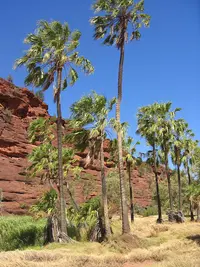
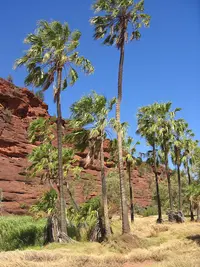
The Central Australian cabbage palm, Livistona mariae, is a fan palm native to desert gorges of central Australia. It forms a single sturdy trunk topped with a dense crown of large, pleated, fan-shaped leaves. Mature plants develop a tall, upright habit that gives a strong architectural look. Growth is generally slow to moderate, especially in containers or cooler climates. This species is adapted to heat and periodic drought, but it prefers access to steady moisture at the roots. It usually responds best to bright light, warm temperatures, and well-drained, gritty soil. With these conditions, it is relatively straightforward to care for Central Australian cabbage palm.

Care Difficulty
Moderate Care

Light Preference
Full Sun

Water Requirements
Moderate Water

Temperature Preference
Tropical / Frost Sensitive

Hardiness Zone
10–11

Soil Texture
Sandy, Loamy, Organic-rich

Soil pH
Slightly acidic (6.5–7.0), Neutral (7.0)

Soil Drainage
Well-drained

Fertilization
Minimal (feed rarely)
Scan your plant to receive care tips personalized for your specific plant
Available on iOS and Android
Livistona mariae prefers strong light that mimics open, bright savanna conditions without prolonged scorching.
Livistona mariae prefers evenly moist but not waterlogged soil, especially while establishing deep roots.
This palm thrives in warm to hot climates with brief tolerance of cool nights if protected from frost.
This species adapts to a wide humidity range but benefits from slightly raised moisture in the air indoors.
This palm prefers a deep, free-draining, sandy-loam style mix that still holds some moisture.
This palm can be grown in containers for many years if the pot supports its eventual height and weight.
Livistona mariae benefits from modest, consistent nutrition during active warm-season growth, especially in containers.
Pruning for Livistona mariae focuses on health and safety rather than reshaping the canopy.
This palm forms a strong root system and dislikes frequent disturbance, so repot or transplant only when necessary.
New plants of Livistona mariae are produced almost exclusively from seed, and the process is slow but reliable with stable conditions.
Winter care focuses on avoiding frost damage, since this species is adapted to warm, arid to semi-arid climates.

Plant Health Check
Not sure what's wrong with your plant? Check your plant's health inside the app.
In the wild this palm is naturally confined to permanent spring-fed waterholes in Central Australia’s Finke Gorge, where groundwater allows a tall, lush palm canopy to exist in an otherwise arid landscape.
Genetic and fossil evidence suggests this species is a relict from a time when central Australia supported wetter, more forested habitats, making today’s populations remnants of a once much wider distribution.
Young leaves often show a characteristic copper to bronze tint before turning green, a colouration that is far more pronounced in this species than in most closely related Livistona palms.

Radiocarbon dating of dead trunk material and size estimates indicate that individual Central Australian cabbage palms can reach ages of several hundred years, allowing single trees to act as long-term records of environmental change in an otherwise harsh desert region.
Yellowing fronds usually indicate natural aging, root stress, or nutrient imbalance, especially low magnesium or potassium. Check drainage, avoid overwatering, and use a palm-formula fertilizer. Remove only fully yellow, dry fronds to prevent unnecessary stress.
Keep your plants happy and healthy with plant identification, disease detection, and easy care guidance.