Basket choice
Use a slatted wooden or plastic basket with large openings and no liner so roots and flower spikes can exit freely and hang naturally below the plant.

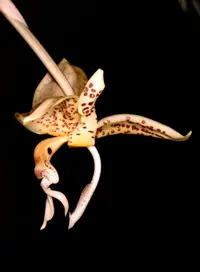
Stanhopea oculata is an epiphytic orchid that usually grows on trees, forming clumps of ribbed pseudobulbs and soft, pleated leaves. It produces striking, pendant flower spikes that hang downward, so the plant is often grown in baskets rather than pots.
In nature it occurs from Mexico to Central America, in humid forests with warm to intermediate temperatures and good air movement. Its large, short-lived flowers are strongly scented and appear from the underside of the plant.
This species can be considered moderate in difficulty because it dislikes drying out completely and needs consistent humidity and fresh air. Understanding how to care for Stanhopea oculata starts with providing bright, filtered light and evenly moist, airy media.

Care Difficulty
Hard Care

Light Preference
Partial Shade

Water Requirements
Regular Water

Temperature Preference
Tropical / Frost Sensitive

Hardiness Zone
11–12

Soil Texture
Peaty, Organic-rich, Loamy

Soil pH
Acidic (5.5–6.5)

Soil Drainage
Moist but well-drained

Fertilization
Moderate (every 2–4 weeks)
Scan your plant to receive care tips personalized for your specific plant
Available on iOS and Android
This orchid prefers bright, filtered light that mimics light under a forest canopy.
Watering should keep the roots moist but never stagnant.
This species prefers intermediate temperatures with a marked day–night drop.
This orchid needs consistently high humidity to thrive and flower reliably.
Stanhopea oculata prefers a very open, airy medium rather than conventional potting soil.
This species is well suited to container growing in hanging baskets or net pots.
This orchid benefits from light, consistent nutrition during its active growing season.
Pruning needs are minimal and focus on hygiene rather than shaping the plant.
Repotting focuses on refreshing the medium and maintaining space for pendant flower spikes.
Division is the standard method for increasing plants while maintaining the characteristics of the parent orchid.
This species is not frost hardy and needs cool, frost-free conditions during winter dormancy.

Plant Health Check
Not sure what's wrong with your plant? Check your plant's health inside the app.
This species produces its inflorescences downward through the basket or substrate, so the large, pendent flowers hang below the plant rather than above it, an adaptation to its epiphytic lifestyle on tree branches.
The flowers release a powerful, complex scent often described as a mix of spices, vanilla, and resinous notes, which intensifies during specific times of day to attract its natural pollinators.
In nature, this orchid is pollinated by male euglossine (orchid) bees that collect aromatic compounds from the flowers; the floral structure and scent chemistry are finely tuned to these bees’ behavior.

The lip and column of this orchid form a highly intricate, almost sculptural structure that guides visiting euglossine bees along a precise path, ensuring the pollinia attach to the bee’s body in a specific position that maximizes the chance of successful pollination on the next flower.
Lack of flowering usually comes from insufficient light, overly warm nights, or the plant not being mature enough. Crowded or decomposed basket mix, weak fertilization, or skipping a slightly cooler, drier rest period can also delay spikes.
Keep your plants happy and healthy with plant identification, disease detection, and easy care guidance.