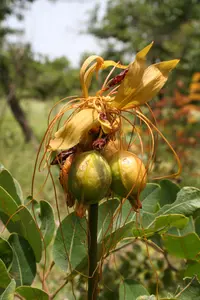
Stanhopea wardii Care

Stanhopea wardii

About Stanhopea wardii

Stanhopea wardii is an epiphytic orchid that typically grows on trees, forming hanging clumps of thick pseudobulbs and broad, pleated leaves. It is known for dramatic, short-lived flowers that emerge downward through the pot or basket, often with complex patterns and a strong fragrance.

This species occurs naturally in cloud forests of Central America, where it experiences bright filtered light, high humidity, and good air movement. Its need for open, well-drained media and consistent moisture makes it moderately challenging for beginners, but manageable for growers who study how to care for Stanhopea wardii.

Main Plant Requirements

Care Difficulty

Hard Care

Light Preference

Partial Shade

Water Requirements

Regular Water

Temperature Preference

Tropical / Frost Sensitive

Hardiness Zone

11–12

Soil Texture

Peaty, Organic-rich

Soil pH

Acidic (5.5–6.5)

Soil Drainage

Moist but well-drained

Fertilization

Moderate (every 2–4 weeks)

Get Personalized Care Plan

Scan your plant to receive care tips personalized for your specific plant

Available on iOS and Android

How to Care for the Stanhopea wardii

This orchid prefers bright, filtered light that mimics dappled forest shade.

  • Provide 6–8 hours of bright, indirect light daily, such as under 40–60% shade cloth or beneath high tree canopy.
  • Allow gentle early morning sun but protect from strong midday and afternoon sun, which can scorch leaves and dry buds.
  • In summer, increase shade and air movement; in winter, move Stanhopea wardii to the brightest frost-free spot to compensate for shorter days.

Watering should keep the roots evenly moist in growth but never stagnant.

  • During active growth, water when the top 2–3 cm of the medium feel barely dry, allowing water to flow freely through a coarse, fast-draining orchid mix.
  • Reduce watering in cooler months, letting the medium dry a little deeper while avoiding a hard, prolonged dry spell that shrivels pseudobulbs.
  • Watch for yellowing, soft bulbs or sour smell as signs of overwatering, and dull, wrinkled pseudobulbs or limp leaves as signs of underwatering.

This species prefers intermediate temperatures with a clear drop at night.

  • Aim for 65–80°F (18–27°C) by day and 55–65°F (13–18°C) by night for steady growth and reliable flowering.
  • Protect from frost; short exposures below 40°F (4°C) can damage leaves and roots, and prolonged cold will stall growth.
  • In hot spells above 85°F (29°C), increase shade, humidity, and air movement to prevent heat stress and bud blast in Stanhopea wardii.

This orchid needs consistently high humidity to bloom and maintain healthy foliage.

  • Aim for 60–80% humidity; below 50% often leads to poor flowering and leaf tip dieback.
  • Dry indoor air causes shriveled pseudobulbs, papery leaves, and stalled new growth.
  • Increase humidity with a nearby humidifier, grouped plants, and a wide pebble tray under but not touching the basket.

Stanhopea wardii thrives in a very open, airy medium rather than compact soil.

  • Use a coarse, organic-rich mix such as large bark, sphagnum moss, and a little perlite to keep structure loose.
  • Ensure extremely fast drainage so water runs through in seconds, preventing roots from sitting wet.
  • Aim for slightly acidic conditions around pH 5.5–6.5, which support nutrient uptake in orchid roots.
  • Avoid dense potting soil or fine peat that packs around the roots and restricts aeration and gas exchange.

This species is well suited to container growing in slatted baskets or very open pots.

  • Choose a shallow, wide basket so flower spikes can grow downward and emerge freely through gaps.
  • Secure the basket firmly or hang from a stable support to prevent movement that can damage developing spikes.
  • Select a breathable material such as wood or mesh that allows rapid drainage but still holds coarse medium in place.

Feeding supports flowering in Stanhopea wardii grown in baskets or mounts but should stay light and seasonal.

  • Use a balanced NPK orchid fertilizer at 1/4–1/2 strength, formulated for epiphytes, to avoid salt buildup on roots.
  • Feed every 2 weeks during active growth in spring–summer, coinciding with new root and pseudobulb development.
  • Rinse the medium with plain water between feedings to reduce fertilizer residue and maintain root health.
  • In autumn–winter, reduce feeding to monthly at very weak strength or pause entirely if growth has slowed.

Pruning needs are minimal and focus on hygiene rather than reshaping Stanhopea wardii.

  • Carry out light pruning after flowering flushes, when new growth is easiest to see.
  • Remove only dead, dried, or diseased leaves, flower spikes, and old sheaths using clean, sharp scissors or snips.
  • Avoid cutting healthy pseudobulbs, as these store energy and support future flowering and vegetative growth.
  • Disinfect tools before and after use with alcohol to limit transmission of fungal or bacterial problems.

Repotting Stanhopea wardii mainly means renewing its basket or mount and keeping room for downward-growing flower spikes.

  • Check for crowded pseudobulbs, roots escaping the basket, or slow growth as signs the plant needs a new setup.
  • Plan to refresh the basket and medium every 2–3 years in late winter–early spring, just before active growth resumes.
  • Use a slatted basket with coarse, fast-draining orchid mix, keeping openings clear so inflorescences can emerge downward.
  • Handle pseudobulbs gently, keep roots slightly moist, and shade the plant for 1–2 weeks after repotting to limit stress.

Division is the standard approach for increasing Stanhopea wardii plants in cultivation.

  • Divide in late winter–early spring when new roots start; this timing shortens recovery time.
  • Use a sterile, sharp knife or pruners to separate clumps into divisions of at least 4–5 healthy pseudobulbs each.
  • Place divisions in baskets with coarse orchid mix, keeping them stable so young roots attach firmly.
  • Maintain bright, filtered light, high humidity, and evenly moist but airy medium to encourage strong new growth.

Cool, frost-free conditions are essential for maintaining Stanhopea wardii through winter.

  • Keep plants above 50°F; prolonged exposure near freezing can damage pseudobulbs and roots.
  • Move baskets or mounts indoors or into a heated greenhouse in cold climates before night temperatures drop.
  • Provide bright, filtered light and good air circulation while slightly reducing watering to match slower growth.
  • Avoid cold drafts and sudden temperature swings that can stress the plant and weaken new growth.

Care Tips

Basket setup

Use a slatted wooden or plastic basket with large side and bottom gaps, lining only the sides (not the base) with coarse bark or plastic mesh so that emerging inflorescences can push through freely instead of being blocked or deformed.

Spike protection

Once new flower spikes appear beneath the basket, keep the pot raised on an open stand or bricks so spikes are not crushed by the bench surface and can hang straight down without obstruction.

Summer shading

In hot, bright summers, stretch 40–60% shade cloth above the plant or move it under high, open shade outdoors to reduce leaf scorch while still providing enough light for reliable blooming.

Air movement management

Position a small oscillating fan several feet away on a low setting to keep air moving around the hanging basket, which reduces fungal problems on thick leaves and around the moist root zone.

Seasonal mounting change

When dividing or repotting older plants, consider mounting divisions on cork or tree fern slabs hung at an angle, which allows spikes to emerge naturally and can make caring for Stanhopea wardii easier in tight growing spaces.

Common Pests and Diseases

Spider mites

This pest thrives on Stanhopea foliage in warm, dry air and can quickly damage the thin leaves and new growth. Symptoms include fine webbing, pale stippling, and a dull, dusty look on the leaf surfaces.

Solution

Increase humidity to 60–80%, hose or shower the plant thoroughly to wash off mites, and repeat every few days. If infestation persists, use a miticide or insecticidal soap labeled for orchids, applying to both leaf surfaces and basket rims while improving air movement to keep foliage drying quickly after watering.

Scale insects

These insects often settle along Stanhopea leaf midribs, sheaths, and on the basket or mount, feeding on sap and excreting sticky honeydew. Symptoms include yellowing patches, sticky residue, and sooty mold growing on the honeydew.

Solution

Manually remove visible scale with a cotton swab dipped in isopropyl alcohol, then wash the plant and basket structure with lukewarm water. For lingering populations, use a systemic or horticultural oil product suitable for orchids, repeating at label intervals and isolating the plant until new growth appears clean.

Mealybugs

This pest hides in leaf axils, under bracts, around flower spikes, and in the basket media, where it sucks sap and weakens the plant. Symptoms include white cottony clusters, distorted new growth, and sticky honeydew on leaves and supports.

Solution

Inspect leaf bases, sheaths, and basket crevices, then remove visible mealybugs with alcohol-dipped cotton swabs and rinse the plant thoroughly. For heavier infestations, apply an insecticidal soap or systemic insecticide labeled for orchids, and consider repotting or remounting to discard infested organic material while maintaining good air movement.

Bacterial soft rot

This disease often starts in retained water between Stanhopea leaves or around the pseudobulbs, especially in stagnant, warm conditions. Symptoms include rapidly spreading wet, foul-smelling lesions that turn leaves or pseudobulbs mushy.

Solution

Immediately cut out all affected tissue with a sterile blade, keeping cuts well into healthy, firm tissue, and discard all infected material. Dust cut surfaces with a bactericide or powdered cinnamon, increase air circulation, keep water out of leaf axils, and reduce overhead watering, especially during warm nights.

Fungal leaf spot

This disease develops when Stanhopea leaves stay wet for long periods in low air movement, such as in crowded shadehouse or indoor setups. Symptoms include small yellow or brown spots that may enlarge, darken, and merge, reducing photosynthetic area.

Solution

Remove and discard heavily spotted leaves, then adjust care to provide stronger airflow and avoid prolonged leaf wetness, especially at night. If new spots continue to appear, use a broad-spectrum fungicide labeled for orchids according to directions, and space plants so leaves dry within a few hours after watering as part of consistent Stanhopea wardii care instructions.

Interesting Facts

Upside-down flowering habit

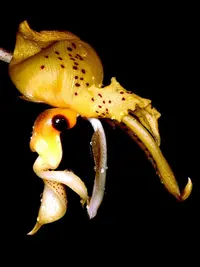
This species develops its inflorescences downward through the gaps of a basket or loose substrate, so the flowers naturally hang below the plant rather than above it.

Strong, complex fragrance

The large, yellow to golden flowers release a strong, sweet-spicy fragrance that is especially intense during the day and is thought to help guide specific pollinating insects to the flower.

Specialized pollination strategy

Like other Stanhopea species, it has a highly structured lip and column that create a slippery, guided path forcing visiting euglossine orchid bees to pass the pollinia, ensuring efficient pollination.

Botan icon

Did you know?

Stanhopea wardii was one of the early Stanhopea species described in the 19th century and quickly became notable in European orchid collections for its unusually large, pendant flowers that appear dramatically from the bottom of its basket rather than from the top like most commonly grown orchids.

FAQs about Stanhopea wardii

Lack of flowering is usually linked to insufficient light, overly warm nights, or failure to provide a slight winter rest. Crowded, older pseudobulbs bloom best, so avoid frequent dividing and keep the basket roomy but not oversized.

Grow Healthy Plants with Botan Care

Keep your plants happy and healthy with plant identification, disease detection, and easy care guidance.

Botan plant care app — identify plants on mobile

Explore More Plants