Epidendrum melinanthum Care

Epidendrum melinanthum

About Epidendrum melinanthum

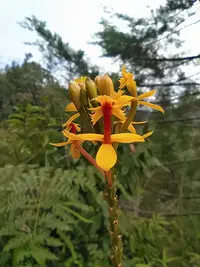
Epidendrum melinanthum is an epiphytic orchid, usually growing on trees rather than in soil. It forms slender, upright canes with narrow leaves and clusters of small, colorful flowers.

This species occurs in tropical regions of Central and South America, where it enjoys warm, humid mountain conditions with good air movement. Its relatively thin roots and canelike growth make it more sensitive to drying out and repotting stress than many common houseplants.

To care for Epidendrum melinanthum successfully, growers typically provide bright but filtered light, consistent moisture around the roots, and a very airy orchid substrate that never stays waterlogged.

Main Plant Requirements

Care Difficulty

Moderate Care

Light Preference

Partial Shade

Water Requirements

Moderate Water

Temperature Preference

Warm Climate

Hardiness Zone

Unknown

Soil Texture

Loamy, Organic-rich

Soil pH

Acidic (5.5–6.5)

Soil Drainage

Well-drained

Fertilization

Light (every 4–6 weeks)

Get Personalized Care Plan

Scan your plant to receive care tips personalized for your specific plant

Available on iOS and Android

How to Care for the Epidendrum melinanthum

This epiphytic orchid prefers bright, gentle light that mimics high tree-branch conditions.

  • Provide 6–8 hours of bright, filtered light per day, such as morning sun with light shade or dappled light through a sheer curtain or canopy.
  • Protect from strong midday and afternoon sun, which can cause yellowing or scorched patches on leaves; move to light shade if foliage pales or burns.
  • Tolerates bright partial shade, but if stems stretch, flowering decreases, or new growth is weak, increase light by giving earlier morning or late-afternoon sun.

This species prefers consistent moisture around its roots but cannot sit in stagnant, waterlogged media.

  • Water when the top 2–3 cm of bark or mix feels almost dry, using thorough soaking and then allowing excess to drain completely away from the roots.
  • In active growth and warm weather, watering may be needed every few days, while in cooler seasons or lower light, extend intervals and allow the medium to dry slightly more.
  • Epidendrum melinanthum shows thirst with wrinkling pseudobulbs or limp leaves; dark, soft roots or a sour smell signal overwatering and poor drainage.

This orchid grows best in intermediate to warm conditions with only mild temperature swings.

  • Aim for 65–80°F (18–27°C) during the day and 60–65°F (16–18°C) at night to support steady vegetative growth and flowering.
  • Short dips to 55°F (13°C) are usually tolerated, but sustained exposure below 50°F (10°C) slows growth and raises risk of cold damage, especially to new shoots.
  • In hot spells above 85°F (29°C), increase air movement and humidity, and shade slightly, as this plant does not handle extreme, dry heat or any frost.

This epiphytic orchid prefers moderately moist air but tolerates typical home humidity if not overheated.

  • Aim for 50–70% humidity; brief drops to 40% are usually tolerated if watering is consistent.
  • Watch for dry, pleated leaves and stalled new roots as signs that humidity is too low.
  • Increase humidity with a pebble tray, grouped plants, or a small fan-assisted humidifier, while keeping leaves well ventilated.

This species performs best in a loose, airy orchid substrate that keeps roots moist but never stagnant.

  • Use a mix of medium orchid bark, perlite, and a little sphagnum moss to provide structure, moisture retention, and aeration.
  • Ensure very fast drainage; water must run freely through the pot and not pool in a saucer.
  • Aim for slightly acidic to neutral conditions, around pH 5.5–7.0, which supports nutrient availability for Epidendrum melinanthum.
  • Avoid dense peat, garden soil, or mixes that compact, since these restrict oxygen around the roots and invite rot.

This orchid is well suited to container growing when root aeration and stability are prioritized.

  • Choose a relatively narrow but deep pot or basket that allows vertical root growth while preventing the plant from wobbling as it elongates.
  • Use a slotted or mesh orchid pot to enhance side airflow and faster drying of the bark-based medium between waterings.
  • If using lightweight plastic, place the pot inside a heavier cachepot to prevent tipping as canes lengthen and flower spikes develop.

Feeding supports steady growth and flowering of Epidendrum melinanthum in cultivation.

  • Use a balanced orchid fertilizer (around 20-20-20) or similar balanced NPK, diluted to 1/4–1/2 strength in water.
  • Apply fertilizer every 2–3 weeks during the active growing season when new roots and leaves appear.
  • Switch to monthly or less frequent feeding in fall and winter, or when growth slows noticeably.
  • Avoid fertilizer salts buildup by flushing the potting mix with clear water about once a month.

Pruning Epidendrum melinanthum is light and focused on hygiene and flower production.

  • Best timing is after a flowering cycle, when spent spikes begin to dry and new growth starts.
  • Remove dead, damaged, or leafless canes and fully spent flower spikes with clean, sharp scissors or pruners.
  • Thin congested stems slightly to improve air flow and light penetration around the plant base.
  • Avoid cutting green, healthy canes, since they store energy and support future flowering and growth.

Repotting maintains healthy roots and medium for this epiphytic orchid.

  • Plan to repot every 2–3 years or when roots circle the pot, medium breaks down, or growth slows.
  • Best time is late winter to early spring, just before strong new root growth begins.
  • Gently remove old bark from the roots, trim dead or mushy roots, and place the plant into fresh, free-draining orchid mix.
  • Water lightly for the first 1–2 weeks and keep humidity moderate to reduce transplant shock and support new root attachment.

Propagation of Epidendrum melinanthum is usually done vegetatively rather than from seed at home.

  • Divide mature clumps in late spring when active root growth is visible and temperatures are mild.
  • Ensure each division has at least 3–4 healthy canes and a good root mass for stable regrowth.
  • Pot divisions in fresh orchid bark, keep in bright, indirect light, and maintain high humidity around 60–70%.
  • Avoid heavy watering until new roots extend, then gradually resume a normal watering schedule.

This orchid needs protection from cold in most temperate climates.

  • Keep plants above 50–55°F, as Epidendrum melinanthum is not frost tolerant and suffers in freezing conditions.
  • Move container plants indoors or into a heated greenhouse before night temperatures drop near 50°F.
  • Provide bright, indirect light and slightly drier potting mix in winter while still preventing complete dryness.
  • Avoid cold drafts and place pots on an insulating surface to keep roots from chilling on cold windowsills or floors.

Care Tips

Segmented mounting

Mount the orchid on a slab or in an open basket and loosely secure new canes with soft ties as they elongate so each growth has space and light, which reduces rot and encourages even flowering when growing Epidendrum melinanthum.

Post-bloom grooming

After a flower spike finishes, leave it in place for several weeks to confirm it will not rebloom, then remove only dead or obviously dried sections to keep the plant tidy while preserving any active buds or eyes.

Root inspection routine

Every 4–6 months, gently lift the plant from its mount or basket to check that roots are firm and silvery-green, trimming only mushy or hollow roots and replacing any decomposed moss or bark to maintain strong aeration.

Airflow optimization

Position a small fan on a low setting to create gentle, constant air movement around the canes and roots, which helps dry the plant after watering and significantly lowers the risk of fungal spots and bacterial rot.

Targeted pest checks

Inspect stem nodes, flower sheaths, and root tips under bright light every 1–2 weeks so scale or mealybugs are found early and can be removed with cotton swabs dipped in isopropyl alcohol before they spread through the clump.

Common Pests and Diseases

Scale insects

This pest feeds on sap, often hiding along stems and leaf bases, leading to yellowing and reduced vigor. Symptoms include sticky honeydew on leaves and a thin layer of sooty mold on affected surfaces.

Solution

Isolate the plant, then gently remove visible scale with a cotton swab dipped in 70% isopropyl alcohol, focusing on stems and under leaf sheaths. Follow with 2–3 applications of a horticultural oil or insecticidal soap at 7–10 day intervals and improve air circulation and light to reduce reinfestation while growing Epidendrum melinanthum.

Spider mites

These insects thrive in warm, dry air and cause fine stippling, dull leaves, and delicate webbing on new growth and flower spikes. This pest can weaken plants quickly in heated indoor conditions or very dry growing spaces.

Solution

Rinse foliage thoroughly with lukewarm water, including the undersides of leaves and between pseudobulbs, to remove mites and webs. Maintain higher humidity, increase airflow with a small fan, and use insecticidal soap or a miticide labeled for orchids every 5–7 days for several cycles to break their life cycle.

Orchid aphids

These insects cluster on soft new growth and flower spikes, sucking sap and causing distortion, sticky honeydew, and poor flowering. This pest can also vector viral diseases between orchids when populations are not controlled.

Solution

Wash affected areas under a gentle stream of water, then wipe remaining insects with a soft cloth or cotton pad. If populations persist, apply insecticidal soap or a neem-based product to all green parts of the plant, repeating every 7–10 days, and remove heavily infested flower spikes if necessary.

Bacterial brown spot

This disease produces water-soaked, translucent spots on leaves that quickly turn brown and sunken, often starting at leaf tips or wounds. Symptoms include a foul smell and rapid expansion in warm, humid, stagnant air conditions.

Solution

Immediately remove affected leaf areas with a sterile blade, cutting well into healthy tissue, and discard all infected material. Keep foliage dry, reduce overhead watering, increase airflow, and apply a copper-based bactericide or a labeled orchid bactericide to remaining leaves according to product directions.

Fusarium wilt

This disease is caused by a fungus that invades through wounds, leading to stunted growth, wrinkled pseudobulbs, and yellowing leaves despite adequate watering. Symptoms include purple or pinkish vascular discoloration visible when rhizomes or roots are cut lengthwise.

Solution

Discard severely affected plants, as cure is unlikely once the vascular system is colonized. For mild or early cases, remove and destroy symptomatic pseudobulbs and roots, then repot into fresh, well-drained medium using sterilized tools and avoid reusing contaminated pots or media to protect future Epidendrum melinanthum care.」}]},

Interesting Facts

Cloud-forest specialist

This species is native to cool, moist cloud forests of southeastern Brazil, where it typically grows as an epiphyte on trees at mid to higher elevations with frequent mist and stable humidity.

Dark-lipped flowers

Its relatively small, pale greenish flowers have a characteristically darker, often brownish to purplish lip, which creates a strong visual contrast that aids in pollinator attraction.

Narrow, upright growth

Plants form slender, upright stems with narrow, grasslike leaves, giving a tufted, reedlike appearance that differs from many showier, broad-leaved orchids.

FAQs about Epidendrum melinanthum

Lack of flowers usually comes from insufficient light, too much nitrogen fertilizer, or no slight night temperature drop. Crowded roots can help, but severely pot-bound plants may decline. Stable conditions over several months are often needed before blooming.

Grow Healthy Plants with Botan Care

Keep your plants happy and healthy with plant identification, disease detection, and easy care guidance.

Botan plant care app — identify plants on mobile

Explore More Plants