Install sturdy support
Provide a tall trellis, wire panel, or fence with horizontal rungs spaced 15–20 cm apart so vines can climb securely and avoid stem breakage in wind.

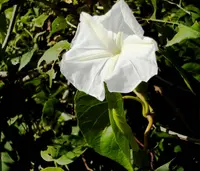
Beach moonflower (Ipomoea violacea) is a fast-growing tropical vine known for its large, pale, night-blooming flowers and twining growth habit. It is related to common morning glories but typically opens in the evening or at night.
In nature it occurs in coastal regions and sandy dunes of tropical and subtropical areas, where it scrambles over shrubs or along the ground. The plant prefers warm conditions, well-drained soil, and regular moisture but does not tolerate frost.
It grows quickly from seed and can be easy to manage in suitable climates, though it needs support to climb and enough space to spread. Understanding how to care for beach moonflower helps prevent it from becoming weak, leggy, or stressed.

Care Difficulty
Moderate Care

Light Preference
Full Sun

Water Requirements
Moderate Water

Temperature Preference
Tropical / Frost Sensitive

Hardiness Zone
10–12

Soil Texture
Sandy, Loamy, Organic-rich

Soil pH
Acidic (5.5–6.5), Slightly acidic (6.5–7.0)

Soil Drainage
Well-drained

Fertilization
Light (every 4–6 weeks)
Scan your plant to receive care tips personalized for your specific plant
Available on iOS and Android
Ipomoea violacea is a sun-loving vine that flowers best in strong, direct light.
This vine prefers consistently moist but not saturated soil, with brief drying between waterings.
This species prefers warm conditions and is sensitive to cold and frost.
This species grows well in average home humidity and does not usually need special moisture management.
This coastal vine prefers light, fast-draining soil that still holds moderate moisture.
This vine is well suited to container growing when given stable support and adequate root space.
Ipomoea violacea responds well to modest feeding during its warm-season growth, especially in containers.
Ipomoea violacea benefits from light, timely pruning to guide growth and encourage flowering.
This vigorous vine is usually grown as an annual but can be transplanted or shifted if roots become crowded.
Ipomoea violacea is most commonly propagated from seed under warm, bright conditions.
In most temperate climates Ipomoea violacea behaves as a frost-tender annual and does not survive prolonged freezing outdoors.

Plant Health Check
Not sure what's wrong with your plant? Check your plant's health inside the app.
This coastal vine naturally occurs on sandy beaches and dunes in tropical and subtropical regions, where its long stems help stabilize loose sand and tolerate high salt exposure.
Its white to pale lilac funnel-shaped flowers typically open in the evening or at night and close by morning, an adaptation that aligns flowering with nocturnal pollinators such as moths.
The plant produces hard, buoyant seeds that can float in seawater, allowing them to disperse along coastlines and colonize new beach habitats far from the parent plant.

This species has been used as a model organism in ethnobotanical and phytochemical research on tropical coastal plants, leading to detailed studies of its seed and alkaloid chemistry compared with related morning glories.
Lack of blooms usually comes from insufficient light, too much nitrogen fertilizer, or the plant being immature. Ensure strong sun, avoid high-nitrogen feeds, and do not overprune young vines, as flower buds form on new growth.
Keep your plants happy and healthy with plant identification, disease detection, and easy care guidance.