Ball moss Care (Tillandsia recurvata)

Also known as: small ballmoss
Ball moss

About Ball moss

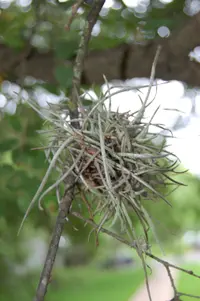
Ball moss, Tillandsia recurvata, is a small epiphytic bromeliad that naturally anchors to tree branches, fences, and power lines without taking nutrients from its host. It forms dense, round clumps of thin, gray-green, curling leaves that absorb water and nutrients directly from the air and rain.

This species is native to warm regions of the southern United States, Mexico, Central America, and parts of South America. It is generally tough and low-maintenance, which makes it easy to care for Ball moss in suitable light and humidity.

Ball moss prefers bright, indirect light, good air circulation, and regular moisture on its leaves rather than traditional soil growing conditions.

Main Plant Requirements

Care Difficulty

Easy Care

Light Preference

Full Sun

Water Requirements

Low Water

Temperature Preference

Warm Climate

Hardiness Zone

8–11

Soil Texture

Rocky, Sandy

Soil pH

Acidic (5.5–6.5), Slightly acidic (6.5–7.0)

Soil Drainage

Well-drained

Fertilization

Minimal (feed rarely)

Get Personalized Care Plan

Scan your plant to receive care tips personalized for your specific plant

Available on iOS and Android

How to Care for the Ball moss

Tillandsia recurvata thrives in bright, indirect light with some direct sun exposure, similar to open woodland edges.

  • Aim for 4–6 hours of bright light daily, ideally with gentle morning sun and filtered or dappled light the rest of the day.
  • Tolerates partial shade, but dense shade slows growth and can cause sparse, stretched clumps, especially in Ball moss growing on interior tree branches.
  • Avoid harsh, all-day summer afternoon sun, which can scorch foliage; provide light shade or a more sheltered exposure in the hottest months.

This epiphytic air plant absorbs moisture through its leaves and is adapted to brief wetting followed by thorough drying.

  • In humid climates, rely mainly on natural rainfall; in drier periods, mist or hose plants until fully wet, then allow complete drying within 4–6 hours.
  • Signs of underwatering include tightly curled, brittle leaves, while soft, browning bases indicate excess moisture trapped too long.
  • During cool, overcast seasons, reduce supplemental watering and avoid frequent soaking so the plant never stays wet overnight in stagnant air.

This species is adapted to warm, variable climates but still has clear limits for safe temperature exposure.

  • Optimal growth occurs around 65–85°F (18–29°C), especially with good air movement and periodic drying between wet periods.
  • Tolerates brief heat up to about 100°F (38°C) if humidity and airflow are high; prolonged extreme heat with stagnant air can desiccate leaves.
  • Minimum tolerance is around 25–28°F (-4 to -2°C) for short events; repeated hard frosts or freezing winds can damage foliage and reduce vigor over time.

This epiphytic air plant prefers moderate humidity but adapts to drier indoor air if watered correctly.

  • Aim for 40–60% humidity; mist lightly 2–3 times a week in dry homes while keeping foliage able to dry within a few hours.
  • Dry, tightly curled leaves and browning tips indicate chronic low humidity or underwatering stress in Ball moss.
  • Increase humidity by grouping air plants, placing near (not above) a humidifier, or using a shallow pebble tray without letting the plant sit in water.

Tillandsia recurvata does not require soil and should be mounted or placed on a non-soil surface.

  • Avoid potting mixes, compost, and any dense or moisture-holding substrate; these trap water around the plant base and cause rot.
  • Mount the plant on cork, driftwood, or wire, allowing air to circulate freely around all sides of the foliage and base.
  • If displayed in a container or glass vessel, keep it loose and elevated on inert materials such as pebbles, gravel, or coarse bark, not buried.
  • Ensure any decorative filler drains and dries rapidly after misting or soaking so the plant is never left in standing water.

This species can be displayed in containers, but the container acts only as a support rather than a traditional pot.

  • Use shallow, open containers so air circulates freely around the plant and moisture evaporates quickly after watering.
  • Raise the plant on small stones, shells, or wire stands so the base never rests in pooled water at the bottom of the container.
  • Choose heavier or wider-bottomed dishes for multiple plants to prevent tipping as clumps become larger and more top-heavy.

Tillandsia recurvata needs only light, diluted feeding when actively growing, especially in indoor or cultivated settings.

  • Use a balanced, water-soluble air plant fertilizer or very dilute balanced NPK at 1/4–1/2 strength.
  • Mist or soak with fertilizer solution every 4–6 weeks during spring–summer, after normal watering.
  • Skip or reduce feeding to 1 light application in midwinter, as growth slows.
  • When caring for Ball moss outdoors on trees, usually avoid fertilizing, since it absorbs enough nutrients from rain and dust.

Pruning Tillandsia recurvata is optional but helps maintain a neat, compact clump and remove dead material.

  • Best time is late winter to early spring, before strong new growth begins.
  • Use clean, sharp scissors to trim away dead, brown, or clearly damaged tufts only.
  • Thin out very crowded clusters by cutting whole rosettes at the base to improve air flow and light penetration.
  • Avoid cutting healthy green tissue heavily, since this can reduce flowering and overall vigor.

Tillandsia recurvata usually grows attached to bark, wire, or other supports, so transplanting focuses on repositioning clumps rather than root work.

  • Move or remount plants in spring, when temperatures are mild and growth is starting.
  • Transplant when clumps become too dense, shade each other, or outgrow their mounting space.
  • Gently detach tufts from the old support, keeping base tissues intact, and tie or glue them lightly to a new, rough surface.
  • Mist well after mounting and keep in bright, indirect light for 1–2 weeks to reduce stress and help plants re-anchor.

Propagation of Tillandsia recurvata is commonly done by separating offsets rather than using seed in home conditions.

  • Best season for division is spring to early summer, when plants are actively growing.
  • Wait until offsets reach about 1/3–1/2 the size of the parent before separation.
  • Gently twist or cut offsets from the base and attach them to a new mount using soft wire, twine, or non-toxic glue.
  • Provide bright, indirect light, good air movement, and 2–3 mistings per week to support establishment.

Tillandsia recurvata tolerates light frosts but benefits from simple winter precautions in colder climates.

  • In regions below about 25°F, move mounted plants indoors or into an unheated but frost-free space.
  • Place indoors in bright light with good air movement, away from heating vents and very dry air.
  • Reduce watering slightly in winter, allowing plants to dry fully between misting or brief soaking.

Care Tips

Optimize mounting surfaces

Attach plants to rough, untreated bark or natural cork rather than smooth branches or plastic so the tiny holdfasts can anchor securely and resist wind or handling over time.

Space for air flow

When clustering plants, leave at least 2–3 cm between individuals so air can move freely around each clump, which reduces rot risk and keeps foliage cleaner and more photosynthetically efficient.

Routine debris removal

Every few months, gently shake or blow off accumulated dust, spider webs, or leaf litter from the foliage, since clean leaf surfaces absorb light and water more effectively in long-term Ball moss indoor care.

Storm and wind protection

In windy or storm‑prone areas, secure plants with a discreet, soft wire or biodegradable twine loop so they are not dislodged from host branches or mounting boards during gusts.

Host tree management

If many plants crowd a single branch, thin a portion and lightly prune the host tree canopy to maintain good light penetration and airflow, which supports both the host tree and the remaining clumps.

Common Pests and Diseases

Scale insects

This pest attaches to the leaf surface and sheath bases, sucking sap and weakening the plant over time. Symptoms include yellowing, slowed growth, sticky honeydew, and small brown or tan bumps on the leaves.

Solution

Remove affected plants from direct contact with others, then manually wipe or scrub the insects off under a strong stream of water or with a cotton swab dipped in 70% isopropyl alcohol. Improve air movement around clumps and repeat inspections weekly until no new insects appear; in severe outdoor infestations, a light application of horticultural soap on a dry day can be used and then thoroughly rinsed after a few hours.

Mealybugs

These insects hide in leaf bases and inner whorls, leaving white, cottony masses and sticky residue. Symptoms include distorted new growth, gradual decline, and sooty mold developing on honeydew deposits.

Solution

Isolate the affected plant, then flush leaf bases and clump interiors thoroughly with a strong but controlled stream of water. For persistent pockets, use a cotton swab or small brush dipped in 70% isopropyl alcohol to reach into crevices, allow the plant to dry fully, and increase air circulation and light to discourage reinfestation.

Spider mites

This pest thrives in hot, very dry conditions and feeds on leaf surfaces, causing fine stippling and a dull, grayish cast. Symptoms include very fine webbing between leaves and a rough, sandpaper-like feel to the foliage.

Solution

Rinse the entire plant under a firm stream of lukewarm water, focusing on the undersides of leaves and tight leaf curls, then let it dry quickly in bright, airy conditions. For repeated problems, slightly raise ambient humidity, increase airflow, and use insecticidal soap labeled for mites with careful, light applications followed by thorough rinsing after it dries.

Leaf spot fungi

This disease produces small, dark or brown spots that can merge into irregular patches, especially on older or crowded clumps. Symptoms include localized tissue collapse and a thin, papery texture in affected areas, often following prolonged leaf wetness and poor air movement.

Solution

Remove and discard heavily spotted leaves and any dead material trapped within the clump, then place the plant in a brighter, well-ventilated location so it dries within a few hours after misting or rain. Reduce overhead wetting, space plants so air can move freely, and in persistent outdoor cases consider a light application of a broad-spectrum fungicide labeled for ornamental foliage, followed by improved drying conditions.

Soft rot (bacterial)

This disease starts in the tightly packed center of the rosette or in dense clumps, causing soft, water-soaked, dark tissue with a foul odor. Symptoms include rapid collapse of the plant base while outer leaves may still look relatively normal at first.

Solution

Immediately remove and discard any affected plants or rosettes, cutting away adjacent material that feels soft or smells sour, and keep only firm, healthy segments. Avoid soaking the plant center, water early in the day so it dries quickly, improve airflow and spacing, and disinfect any cutting tools with 70% isopropyl alcohol between plants to limit spread.

Interesting Facts

Not A True Parasite

Ball moss attaches to tree branches only for support and absorbs water and nutrients from the air and rain rather than from the host tissue, so it is classified as an epiphyte, not a parasite. It usually does not harm healthy trees but can become dense enough to shade twigs in stressed trees.

Wind-Driven Seed Dispersal

The plant produces numerous tiny, tufted seeds that are easily carried by wind and often lodge in rough bark or on utility lines. These seeds germinate on exposed surfaces where moisture and light are sufficient, leading to the familiar clustered growths along branches and wires.

High Light And Drought Tolerance

Its narrow, recurved leaves are covered with dense trichomes, which are tiny scales that reflect intense sunlight and rapidly absorb water. This adaptation allows the species to survive in exposed, dry canopy conditions that would quickly desiccate many other epiphytes.

Botan icon

Did you know?

In parts of the southern United States and Mexico, dense colonization of ball moss on power and communication lines has made it a minor management concern for utilities, leading to periodic mechanical removal to prevent excessive weight and moisture retention on cables.

FAQs about Ball moss

Lack of blooms often comes from low light, stale air, or insufficient temperature swings between day and night. Provide brighter indirect light, good airflow, and a mild day–night temperature difference to encourage flowering over time.

Grow Healthy Plants with Botan Care

Keep your plants happy and healthy with plant identification, disease detection, and easy care guidance.

Botan plant care app — identify plants on mobile

Explore More Plants