Spanish moss Care (Tillandsia usneoides)

Spanish moss

About Spanish moss

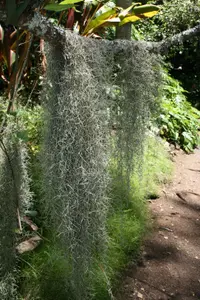
Spanish moss, Tillandsia usneoides, is an epiphytic bromeliad that hangs in long, threadlike strands from trees rather than rooting in soil. It naturally occurs in warm, humid regions of the southeastern United States, Central America, and parts of South America.

The plant has fine, gray-green leaves that trap water and nutrients from rain, air, and debris. This growth habit makes it relatively easy to move and display, but also sensitive to very dry indoor air.

It prefers bright, filtered light, good air movement, and regular moisture on its leaves, so understanding how to care for Spanish moss mostly involves managing humidity and airflow rather than soil or pots.

Main Plant Requirements

Care Difficulty

Moderate Care

Light Preference

Partial Shade

Water Requirements

Regular Water

Temperature Preference

Warm Climate

Hardiness Zone

8–11

Soil Texture

Organic-rich, Loamy

Soil pH

Acidic (5.5–6.5), Slightly acidic (6.5–7.0)

Soil Drainage

Well-drained

Fertilization

Minimal (feed rarely)

Get Personalized Care Plan

Scan your plant to receive care tips personalized for your specific plant

Available on iOS and Android

How to Care for the Spanish moss

This epiphytic air plant thrives in bright, filtered light that mimics light-dappled tree canopies.

  • Provide 4–6 hours of bright, indirect light daily; morning sun with afternoon shade suits Spanish moss in most climates.
  • Outdoors, hang it under high, open shade such as tree branches, shade cloth, or on the bright side of a porch, avoiding harsh midday sun.
  • If strands bleach, crisp, or feel hot to the touch, reduce sun exposure; if they lengthen but turn dull and sparse, increase light gradually.

This species absorbs water through its leaves and needs frequent wetting followed by fast drying.

  • Mist or dunk thoroughly until dripping, then allow to dry within 2–3 hours; in warm, dry weather this may mean watering once a day, in humid or cool periods every 2–4 days.
  • Signs of underwatering include stiff, curling, or brittle strands; silvery color alone is normal, but brown tips spreading along strands signal chronic dryness.
  • Overwatering shows as limp, dark, or foul-smelling sections that stay wet for many hours; increase airflow and reduce frequency to allow Tillandsia usneoides to dry between soakings.

This air plant prefers mild, frost-free conditions with good airflow.

  • Ideal growth occurs around 65–80°F (18–27°C), similar to many warm-temperate and subtropical climates.
  • Short dips to about 25–28°F (-4 to -2°C) may be survived when dry and sheltered, but repeated or prolonged freezes damage tissues.
  • It tolerates heat up to about 95°F (35°C) if humidity and air movement are high; in hot, dry spells, provide extra misting and some afternoon shade to limit stress.

This epiphytic air plant needs consistently high humidity to stay hydrated and photosynthesize well.

  • Aim for 60–80% humidity; it survives brief dips to 40% if watering frequency increases.
  • Crisping, thinning, or browning of strands indicates chronic air dryness and inadequate moisture uptake.
  • To increase humidity, mist daily in dry rooms, group plants closely, or run a nearby cool-mist humidifier; caring for Spanish moss indoors often requires both misting and periodic soaking.

Tillandsia usneoides is an air plant that does not root into soil and should never be planted in a conventional potting mix.

  • Keep it attached to bark, wire, or a mount so air flows freely around all sides instead of packing it into any substrate.
  • Avoid peat-based potting soil, compost, or dense organic media, which trap moisture and cause rot of the leaf bases and stem joints.
  • If displayed over soil in a container arrangement, use a very coarse, dry top layer such as orchid bark, pumice, or large perlite to prevent prolonged surface dampness.
  • Where extra support is needed in a decorative bowl, use dry, chunky materials (bark, lava rock, expanded clay pellets) that stay airy and do not hold constant moisture against the plant.

This species can be displayed in containers, but the vessel is only a support and must not hold standing water around the plant.

  • Use open or slatted containers such as wire baskets so water drains immediately and air movement remains high through the foliage.
  • If using a solid bowl, keep the plant elevated on a layer of dry stones or clay pellets so it dries fully after misting or soaking.
  • Choose heavier or wider containers for outdoor use to prevent wind from tipping over the arrangement as the hanging foliage lengthens.

This epiphytic air plant needs only light feeding, since many wild clumps grow well with no fertilizer.

  • Use a very dilute (1/4-strength) balanced NPK air-plant or orchid fertilizer in water, avoiding urea-based forms.
  • Mist or soak with fertilizer solution every 4–6 weeks during spring–summer only, then rinse with plain water.
  • Suspend feeding in fall–winter when growth slows, especially in cooler or lower-light conditions.
  • When caring for Spanish moss indoors, reduce frequency further if tips brown or algae builds up on strands.

Pruning is mainly used to tidy and size-manage Tillandsia usneoides rather than to improve flowering.

  • Best time is late winter to early spring, before strongest growth begins.
  • Use clean scissors to remove dead, brown, or heavily damaged strands and any tangled debris.
  • Shorten overly long or crowded sections to improve air flow and create a fuller, more balanced curtain.
  • Avoid cutting into fresh, green growing tips excessively, as this can slow extension growth.

This air plant has no true roots in soil, so transplanting focuses on repositioning clumps instead of traditional repotting.

  • Transplant when growth becomes too dense, light reaches the strands poorly, or air circulation is restricted.
  • Best season is spring to early summer, when temperatures are mild and humidity is higher.
  • Typical frequency is every 2–3 years, or whenever clumps outgrow their support or look shaded and sparse.
  • Gently lift and separate sections, rehang on a new branch, wire frame, or mount, then mist thoroughly to reduce stress.

Propagation of this species relies mainly on division of natural clumps rather than seed in home settings.

  • Separate side branches or sections of the hanging mat once they reach 10–15 cm, keeping each piece loosely intact.
  • Perform division in spring–summer when warmth, humidity, and light are favorable for new growth.
  • Hang new pieces on wire, wood, or tree branches where they receive bright, indirect light and good air movement.
  • Mist lightly for the first 1–2 weeks, then transition to the normal soaking or misting schedule as growth resumes.

Cold sensitivity means winter care is important in regions with frost or prolonged low temperatures.

  • This species is damaged below about 26–28°F, especially during long freezes or drying winds.
  • Move plants grown on portable mounts or in containers indoors or to a sheltered porch before hard frost.
  • Outdoors in mild climates, place clumps in locations with overhead canopy to buffer radiation frost and wind.
  • Reduce watering in cool conditions so strands dry within a few hours, limiting cold-related rot.

Care Tips

Layered Drifts

Drape long strands over a wide, airy support such as a wooden trellis or wire frame so inner layers can dry between mistings and avoid rotting in dense clumps.

Periodic Thinning

Every few months, gently pull apart and remove older, brown, compacted tangles so air can reach younger strands and the whole mass stays lighter and healthier.

Rotate Hanging Spots

Shift the bundle to a new hook or branch every few weeks to balance light and airflow exposure, especially if one side of the plant stays against a wall or trunk.

Anchor Against Wind

Outdoors in breezy areas, loop a few inconspicuous ties or soft wire around main strands and the support so strong wind does not strip the plant away or cause mechanical damage.

Hygiene For Mounts

When caring for Spanish moss on artificial mounts, periodically rinse or replace fishing line, wires, or hooks to reduce salt, dust, and algae buildup that can interfere with air movement around the plant.

Common Pests and Diseases

Spanish moss chiggers

These insects are tiny mite-like pests that may shelter in the dense strands and can bite humans but do not seriously damage the plant. Symptoms include skin irritation after handling wild-collected Spanish moss, especially from trees in warm, humid areas.

Solution

To reduce chiggers, thoroughly soak and rinse newly collected moss in a bucket of water, then dry it completely in bright, airy conditions before bringing it indoors. For ongoing Spanish moss indoor care, regularly dunk the plant in clean water and allow it to dry quickly, and discard heavily infested clumps instead of treating them chemically.

Mealybugs

This pest forms white, cottony clusters along the strands, feeding on plant sap and weakening growth over time. Symptoms include sticky residue and slow decline of affected sections.

Solution

Isolate the plant, then submerge the moss in lukewarm water for 20–30 minutes and gently massage the strands to dislodge insects. Follow with spot treatment using cotton swabs dipped in 70% isopropyl alcohol and repeat weekly until no new mealybugs appear, maintaining strong air movement to discourage reinfestation.

Scale insects

These insects appear as small, tan to brown bumps attached to the strands and can cause yellowing and thinning of the moss over time. This pest hides in dense clumps, making early detection difficult.

Solution

Manually remove affected sections by trimming and discarding heavily infested clumps, then rinse remaining moss thoroughly under running water. Improve light and airflow, inspect regularly, and if needed, repeat soaking and gentle brushing with a soft toothbrush to remove remaining scales rather than relying on oil-based sprays, which can suffocate the plant.

Sooty mold

This disease is a black, powdery fungal growth that develops on the surface of strands where sap-sucking insects have left honeydew. Symptoms include dark, dirty-looking patches that reduce light reaching the plant tissues.

Solution

Address the underlying insect problem first, then rinse or soak the moss and gently rub strands between fingers to remove the mold film. Ensure excellent airflow and bright, indirect light so the plant dries quickly after misting or soaking, which limits new fungal growth.

Interesting Facts

Not a true moss

Despite its name, Spanish moss is not a moss but an epiphytic bromeliad that belongs to the same family as pineapples. It has no true roots and anchors itself loosely to branches while absorbing water and nutrients directly through its leaves.

Silver scales as sunscreen

Its leaves are covered with tiny, silvery trichomes that act like scales, reflecting intense light and rapidly taking up water from rain and fog. These trichomes help the plant survive in full sun and brief drought on exposed tree branches.

Wildlife apartment complex

Natural clumps of Spanish moss create shelter and nesting material for many species, including warblers, bats, frogs, and spiders in the southeastern United States. The dense tangles moderate temperature and humidity, forming a small microhabitat high in the tree canopy.

Botan icon

Did you know?

In coastal and humid parts of the southeastern United States, Spanish moss can spread so extensively on some trees that it noticeably reduces light reaching the inner canopy, which can slow the host tree’s growth without directly parasitizing it.

FAQs about Spanish moss

This species flowers sparsely and often at maturity only, so blooming may be subtle or absent. Low light, very dry air, or chronic stress reduce flowering. Provide stable warmth, good air flow, and time rather than forcing blooms.

Grow Healthy Plants with Botan Care

Keep your plants happy and healthy with plant identification, disease detection, and easy care guidance.

Botan plant care app — identify plants on mobile

Explore More Plants