


Tank water management
Rinse and refill the central cup every 1–2 weeks with fresh, low-mineral water to prevent salt buildup, rot, and mosquito larvae in this bromeliad’s tank.

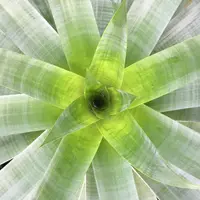
Vriesea incurvata is a rosette-forming bromeliad from the Atlantic Forest of Brazil, valued for its striking foliage and colorful, upright flower spikes. The leaves are often arching and banded or flushed with warm tones, creating a compact, fountain-like shape suitable for indoor displays.
This species is epiphytic in nature, meaning it often grows on trees rather than in deep soil, and stores water in its central tank of overlapping leaves. Its slow growth, modest root system, and tolerance of typical indoor humidity make it relatively straightforward for those learning how to care for Bromeliad.
It generally prefers bright, indirect light, a free-draining potting mix, and consistently moist but not waterlogged conditions in its central cup.

Care Difficulty
Moderate Care

Light Preference
Bright Indirect Light

Water Requirements
Moderate Water

Temperature Preference
Tropical / Frost Sensitive

Hardiness Zone
10–12

Soil Texture
Loamy, Peaty, Organic-rich

Soil pH
Acidic (5.5–6.5)

Soil Drainage
Moist but well-drained

Fertilization
Light (every 4–6 weeks)
Scan your plant to receive care tips personalized for your specific plant
Available on iOS and Android
Vriesea incurvata prefers bright, indirect light that mimics dappled forest conditions.
Watering for this species focuses on a moist but not waterlogged root zone and a clean central cup.
This species favors warm, stable temperatures similar to a frost-free subtropical climate.
This species prefers moderately humid air but copes with typical indoor conditions if not kept too dry.
Vriesea incurvata grows best in a very airy, fast-draining, organic-rich mix that mimics epiphytic conditions.
This species is well suited to container growing due to its compact root system and rosette habit.
This bromeliad benefits from light, precise feeding rather than heavy fertilization.
Pruning needs for Vriesea incurvata are minimal and mainly focused on hygiene and pup management.
Container-grown plants benefit from occasional repotting to refresh their loose, airy medium.
Division of offsets is the most reliable propagation method for this species.
This tropical species is frost-sensitive and needs mild, stable conditions in winter.

Plant Health Check
Not sure what's wrong with your plant? Check your plant's health inside the app.
This species forms a tight leaf rosette that holds water in a central tank, creating a tiny aquatic habitat used by insects and small invertebrates in its native Atlantic Forest of Brazil.
It naturally grows as an epiphyte on trees in warm, humid coastal forests of southern and southeastern Brazil, anchoring to bark rather than rooting in soil.
Its upright inflorescence carries broad, colorful bracts that can shift through yellow, orange, and red tones, with color intensity strongly influenced by light exposure in the canopy.

This species is part of a flora that has adapted to the highly threatened Atlantic Forest biome, and wild populations are affected by ongoing habitat fragmentation and deforestation in its limited native range.
This species usually blooms only once, then slowly declines while producing offsets (pups). Lack of maturity, insufficient light, or major stress can delay flowering, but a plant that has already bloomed will not rebloom from the same rosette.
Keep your plants happy and healthy with plant identification, disease detection, and easy care guidance.


Fancy-leaf Caladium
Caladium 'Carolyn Whorton'
Plectranthus
Plectranthus argentatus 'Silver Shield'
Little Pickles
Crassothonna capensis
Tillandsia turneri
Tillandsia turneri
Golden Pothos
Epipremnum aureum 'Marble Queen'
Peperomia
Peperomia caperata 'Emerald Ripple'
scalloped laceleaf
Anthurium crenatum
miracle fruit
Synsepalum dulcificum