
white fir Identification (Abies concolor)

Recognize white fir by its long, flat needles, usually 1.5 to 3 inches (4 to 8 cm) long, that curve upward and often spread from both sides of the twig. The needles attach singly and show two pale bands underneath.

Also check the narrow, spire-like crown and smooth, gray bark on younger trees.

Abies concolor Identification

Check Your Plant ID

Take a photo and use Botan to confirm your plant identification.

Clear images work best. Avoid photos taken too close or too far away

  • 1 free identification
  • No sign-up
  • 30,000+ plants in database

Use these visible traits to check for Abies concolor.

  • Needles are flat, soft, and usually 1.5-3 inches (4-8 cm) long.
  • Leaves curve upward and often spread from both sides of the twig, giving a combed, upswept look.
  • Foliage is often blue-green to silvery, with twig sections looking dense but not prickly.
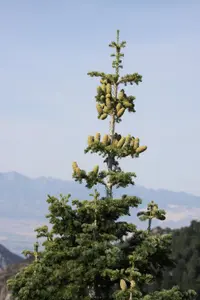
  • Crown is narrow and conical, with layered horizontal branches and a straight central trunk.
  • Cones stand upright on upper branches, cylindrical, and about 3-5 inches (8-13 cm) long.

Check several branches, since needle spacing and color can vary across the tree.

Abies concolor shows useful age-related changes in crown shape, branching, bark, and cones.

  • Seedling: Seedlings carry a small tuft of flat, soft needles on a single upright stem, with sparse side branching and a narrow, delicate outline.
  • Young plant: Young plants form a dense, symmetrical cone. Needles are longer and more numerous, often spreading outward from twigs and curving slightly upward.
  • Mature plant: Mature trees develop a tall spire to 30-50 feet (9-15 m) or more, broader horizontal branches, and thicker gray bark broken into furrows.
  • Fruiting stage: Cone-bearing trees show upright cylindrical cones near upper branches, 3-5 inches (8-13 cm) long, adding a conspicuous vertical element absent earlier.

White fir has several named selections with stable, easy-to-see differences in color or habit.

  • Abies concolor 'Candicans': Needles are distinctly brighter silvery blue than the typical blue-green form, often giving the whole crown a pale, frosted look.
  • Abies concolor 'Compacta': A dwarf form with a dense, rounded habit, usually staying far shorter and broader than the species at the same age.
  • Abies concolor 'Violacea': Foliage is strongly glaucous, meaning coated with a waxy bloom, so needles appear intense blue to blue-silver.
  • Abies concolor 'Pendula': Branches and leader hang downward, creating a strongly weeping outline instead of the usual upright, conical crown.

Abies concolor stays evergreen, so the blue-green to silvery needles remain visible year-round. In winter, the strong tiered branching and pointed resinous buds are easier to see against the persistent foliage. In spring, pollen cones and upright seed cones may appear, adding a short-lived identification clue. By late summer into fall, the upright cones mature and then break apart on the tree, often leaving only the central spike-like axis.

Several conifers are regularly mistaken for white fir.

grand fir(Abies grandis)

Similar in outline and soft needles. Grand fir usually has flatter sprays, with two-ranked needles that vary more in length; white fir more often shows evenly spaced, upswept needles around the twig.

subalpine fir(Abies lasiocarpa)

Often confused because both can look blue-green and narrow-crowned. Subalpine fir usually has shorter needles, often 3/4-1 1/4 inches (2-3 cm), and a denser, spire-like crown; white fir typically has longer, more curved needles.

Abies concolor is native to the mountains of the western United States and northern Mexico, from the southern Rocky Mountains to California and Arizona. It grows in montane conifer forests, often on dry slopes and canyon sides, roughly 4,000 to 11,000 feet (1,200 to 3,350 m). In the wild, a fir from this inland western, high-elevation setting is more likely to be Abies concolor than firs native to wetter coastal or far northern habitats.

Confirm It from a Photo

Use Botan to identify or verify the plant in your photo when you want a quicker, more confident answer.

FAQ

Yes. Identifying white fir usually relies on its long, soft, blue-green needles, often 1.5 to 3 inches (4 to 8 cm) long, that curve upward and can occur around the twig, plus smooth gray bark on younger trees.

More Plant Identification Guides

One Photo. More About Your Plant.

Identify a plant from a photo with Botan, then get its profile, care information, and common problems.

Botan app identifying a plant from a photo
Best Fertilizer for Vegetable Gardens – What to Use for Each Plant

11 min read · 20 Jul 2026

Best Fertilizer for Vegetable Gardens – What to Use for Each Plant

Here, you’ll find the right fertilizer formula for vegetables in your garden. Learn how to adjust feeding correctly throughout the growing cycle, spot nutrient deficiencies by their symptoms, and keep your plants healthy and prolific.

Plant Recommendations
Best Fertilizer for Vegetable Gardens – What to Use for Each Plant
13 Best Front Yard Trees for Every Home and Yard

12 min read · 7 Aug 2026

13 Best Front Yard Trees for Every Home and Yard

A front yard tree can stay for decades. Therefore, choosing one deserves serious consideration. Here are 13 trees that have proven themselves, sorted by their purpose. You'll also find five species to avoid and basic planting information.

Plant Recommendations
13 Best Front Yard Trees for Every Home and Yard
How to Plant Pumpkin Seeds for a Fall Harvest and Grow Your Own Patch

7 min read · 4 Nov 2026

How to Plant Pumpkin Seeds for a Fall Harvest and Grow Your Own Patch

A backyard pumpkin patch starts months before the first leaves turn: the harvest that ends up on the porch in October is decided by what a gardener does in late spring.

Beginner Guides
How to Plant Pumpkin Seeds for a Fall Harvest and Grow Your Own Patch