




Giant Sequoia Identification (Sequoiadendron giganteum)

Recognize Giant Sequoia by its massive, straight trunk, thick reddish-brown fibrous bark, and short awl-shaped leaves that spiral tightly around the shoots.

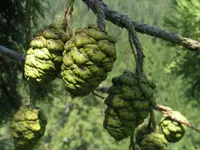
Mature trees also carry woody egg-shaped cones about 2 to 3 inches (5 to 8 cm) long, hanging near branch tips.

Sequoiadendron giganteum Identification

Identify a Plant by Photo

Check your plant ID by uploading a clear photo to Botan.

Clear images work best. Avoid photos taken too close or too far away

  • 1 free identification
  • No sign-up
  • 30,000+ plants in database

Check the overall form and foliage of Sequoiadendron giganteum first.

  • Tall, straight trunk with a broad, conical crown in full view.
  • Bark is very thick, reddish brown, fibrous, and deeply furrowed.
  • Leaves are awl-shaped, stiff, and overlap tightly around the twig.
  • Individual leaves are about 1/8 to 1/4 inch (3-6 mm) long.
  • Woody cones are egg-shaped, hanging, and about 2 to 3 inches (5-8 cm) long.

Cones and tightly packed scale-like leaves are especially useful on reachable branches.

Sequoiadendron giganteum shows clear age-related changes in foliage, branching, bark, and cones.

  • Seedling: Seedlings carry short, awl-like leaves that project outward around the stem, giving a prickly, radial look unlike the tighter, appressed foliage of older plants.
  • Juvenile plant: Juvenile plants keep a dense, narrow, strongly conical outline with branches close to the ground; leaves remain sharper and more spreading than on mature crown shoots.
  • Mature plant: Mature trees develop massive cinnamon bark, often 12-24 inches (30-60 cm) thick, and a towering trunk with the lower limbs shed, leaving a high crown.
  • Fruiting stage: Cone-bearing branches show persistent, egg-shaped woody cones about 2-3 inches (5-8 cm) long, held upright among scale-like adult foliage rather than the juvenile spiky leaves.

Sequoiadendron giganteum stays evergreen year-round, so there is no leaf-drop season that changes its outline. That limits strong seasonal identification clues. The clearest change is in seed cones. They become more noticeable as they mature and persist on the branches for years, so a tree may show both green younger cones and older brown cones at the same time.

A few large conifers are regularly mistaken for Sequoiadendron giganteum.

coast redwood(Sequoia sempervirens)

Both are towering evergreens with reddish bark. Coast redwood usually has flatter, two-ranked needles on many shoots, while giant sequoia has awl-like leaves that wrap around the twig. Mature coast redwood bark is also more fibrous and stringy.

dawn redwood(Metasequoia glyptostroboides)

Young trees can look similar in outline and soft green foliage. Dawn redwood has opposite leaves arranged in flat sprays and drops them in fall. Giant sequoia keeps scale-like to awl-like leaves year-round and does not make flat deciduous sprays.

Native to a narrow belt on the western slope of California’s Sierra Nevada. Wild groves occur at about 4,600 to 7,050 feet (1,400 to 2,150 m), which is a useful clue because truly native trees are geographically restricted. It grows in mixed conifer forest, usually in moist mountain settings such as canyons and slopes. In the wild, finding a giant conifer outside this Sierra Nevada belt points away from Sequoiadendron giganteum as a native identification.

Scan. Check. Confirm.

Use Botan to identify or verify a plant from a photo, which helps avoid mix-ups before you label it or compare references.

FAQ

The bark is thick, fibrous, and deeply furrowed, usually cinnamon-red to reddish brown. On older trunks it can become very soft and stringy in texture, an important clue when identifying Giant Sequoia in the field.

More Plant Identification Guides

From Plant ID to Plant Info

Identify a plant from a photo with Botan, then get plant details, care information, and common problems for that species.

Botan app identifying a plant from a photo
Best Bedroom Plants – Top 10 to Grow in Your Space

8 min read · 8 Jul 2026

Best Bedroom Plants – Top 10 to Grow in Your Space

Discover the top 10 houseplants that are suitable for growing in your bedroom. Compare their light and water needs, pet safety, and benefits. Find out where best to place greenery in your relaxation space and what species to avoid.

Plant Recommendations

Best Bedroom Plants – Top 10 to Grow in Your Space
When to Harvest Carrots: Timing, Signs, and How to Pick Them

6 min read · 23 Oct 2026

When to Harvest Carrots: Timing, Signs, and How to Pick Them

Carrots are usually ready 60-80 days after sowing them in the soil, depending on the variety. Learn how to recognize maturity signs, choose the right harvest season, pull carrots without damaging them, and store roots after picking.

Plant Care
When to Harvest Carrots: Timing, Signs, and How to Pick Them
20 Funny Plant Names That Make You Laugh

8 min read · 16 Oct 2026

20 Funny Plant Names That Make You Laugh

Some plants carry names that sound like jokes. This guide explains the origins of 20 funny plant names. You will also see which of these plants you can grow at home.

Plant Recommendations
20 Funny Plant Names That Make You Laugh