
blue spruce Identification (Picea pungens)

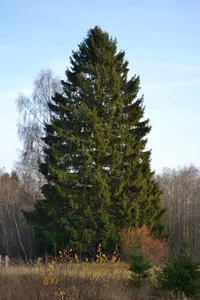
Recognize blue spruce by its stiff, sharply pointed needles borne singly all around the twig, usually 1 to 1.25 inches (2.5 to 3 cm) long.

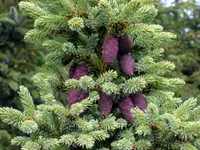
It forms a dense, narrow-pyramidal crown with strong horizontal branches and hanging cylindrical cones about 2 to 4 inches (5 to 10 cm) long.

Picea pungens Identification

Identify Your Plant with Botan

Check your plant ID by uploading a clear photo to Botan.

Clear images work best. Avoid photos taken too close or too far away

Check the tree’s form, needles, and cones from a short distance first.

  • Broadly pyramidal evergreen with a straight central trunk and layered, horizontal branches.
  • Needles are stiff, sharply pointed, and borne singly all around the twig, giving twigs a bristly look.
  • Individual needles are usually about 3/4-1 1/4 inches (2-3 cm) long and often blue-green to silvery blue.
  • Seed cones hang downward, slender-cylindrical, and are roughly 2-4 inches (5-10 cm) long with thin, flexible scales.

Look closely at the twig: the very sharp, radially attached needles are especially useful.

Picea pungens shows clear age-related changes in form, branching, bark, and cone production.

  • Seedling: Seedlings have a slender upright stem with sparse early branching and short, sharp needles carried singly, giving a narrow, delicate outline unlike older plants.
  • Young plant: Young plants develop a dense, symmetrical conical crown. Needles become stiffer and more crowded, often 3/4 to 1 1/4 inches (2-3 cm) long around twigs.
  • Mature plant: Mature plants show a strong central trunk, layered horizontal branches, and furrowed gray-brown bark. The crown broadens while retaining a tall pyramidal form.
  • Fruiting stage: Cone-bearing branches display pendent cylindrical seed cones near outer branchlets, usually light brown at maturity, adding a visible reproductive feature absent on juvenile trees.

Blue spruce has several cultivars with stable, easy-to-see differences in color and shape.

  • 'Glauca Globosa': A dwarf, rounded form, usually staying under 5 feet (1.5 m) tall, with dense silver-blue needles.
  • 'Hoopsii': Shows very intense silvery blue needles, often bluer than the typical species, on a broad pyramidal tree.
  • 'Pendula': Has strongly weeping branches and a narrow, irregular outline instead of the usual upright pyramid.
  • 'Fat Albert': Forms a dense, symmetrical broad pyramid with stiff blue needles and a fuller outline than typical seedlings.

In spring, Picea pungens shows fresh, softer new needles at branch tips, often a lighter blue-green or silvery blue than older foliage. By late summer into fall, pendent cylindrical cones mature from green or reddish to light brown and may hang on the tree for a time. In winter, the dense layered branching and stiff blue needles remain visible.

Several conifers are regularly mistaken for blue spruce.

white spruce(Picea glauca)

Often sold in a similar narrow pyramid shape. White spruce needles are usually softer and less sharply pointed, and most are green to blue-green rather than strongly silvery blue.

Engelmann spruce(Picea engelmannii)

This species can also have blue-gray needles. Its branchlets tend to droop more, giving a softer outline, while the stiff, horizontal branching of Picea pungens looks more rigid.

Colorado fir(Abies concolor)

Blue forms can look similar at a glance. Fir needles are flat and usually arranged in two ranks or swept upward, not attached all around the twig like spruce needles.

Picea pungens is native to the central and southern Rocky Mountains of the western United States, especially Colorado, Utah, Wyoming, New Mexico, and Arizona. In the wild it grows along streams, in mountain valleys, and on cool slopes, usually at about 6,000-10,000 feet (1,800-3,000 m). That setting helps with identification because naturally occurring trees outside the Rocky Mountain region are usually planted rather than native.

  • Sharp needles: The stiff, pointed needles can prick skin on contact and may irritate the mouth if chewed. This is a mechanical injury risk for humans and pets, especially children and dogs.
  • Tree handling: Branches and needles are rigid and sharp enough to scratch eyes and skin during pruning, carrying, or close contact. The concern is contact injury rather than plant poisoning.

Check Your Plant ID

Upload a photo to Botan to identify it or verify your first guess before you label or buy the plant.

FAQ

Yes. Seed cones are useful in Picea pungens identification because they are papery, hang down, and have wavy-edged scales. This plant does not make pods, so true cones help confirm it is a spruce.

Everything About blue spruce

More Plant Identification Guides

Identify Your Plant and Learn More

Upload a photo to Botan to identify it, then get plant details, care information, and common problems for that species.

Botan app identifying a plant from a photo
Top 15 Plants That Don’t Need Sunlight

8 min read · 17 Sept 2026

Top 15 Plants That Don’t Need Sunlight

Some plants thrive in dim rooms, shaded corners, and places with indirect light. In this guide, you’ll explore the top 15 species best suited to low-light conditions and how to care for them.

Plant Recommendations

Top 15 Plants That Don’t Need Sunlight
How Fast Does Bamboo Grow Per Day, Month, and Year

10 min read · 7 Jul 2026

How Fast Does Bamboo Grow Per Day, Month, and Year

Bamboo grows extremely fast: some species can reach 5-6 m in just 3-4 months under the right conditions. This guide explains how much bamboo can grow per day, week, and year, and what affects its growth rate.

Plant Recommendations
How Fast Does Bamboo Grow Per Day, Month, and Year
15 Best Scary Halloween Plants and Fungi for a Spooky Garden

8 min read · 9 Oct 2026

15 Best Scary Halloween Plants and Fungi for a Spooky Garden

Want a garden that looks eerie in October? Here are 15 Halloween plants and fungi, from carnivorous traps to bleeding mushrooms. For each species, we cover its appearance, care requirements, and potential uses in your landscape.

Plant Recommendations
15 Best Scary Halloween Plants and Fungi for a Spooky Garden