


deodar cedar Identification (Cedrus deodara)

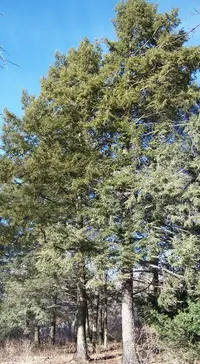
Recognize deodar cedar by its strongly drooping leader and branch tips, long blue-green needles borne in dense rosettes on short shoots, and broad, tiered branching that forms a distinctly pyramidal crown.

Mature trees also show a straight central trunk and needles about 1 to 2 inches (2.5 to 5 cm) long.

Cedrus deodara Identification

Identify Your Plant with Botan

Take or upload a photo to confirm your plant ID with Botan.

Clear images work best. Avoid photos taken too close or too far away

  • 1 free identification
  • No sign-up
  • 30,000+ plants in database

Check the overall form and needle arrangement of Cedrus deodara.

  • Broadly pyramidal tree with a strong central trunk and a soft, drooping leader at the top.
  • Branch tips and many side branchlets hang downward, giving the crown a layered, pendulous look.
  • Needles are slender, about 1-2 inches (2.5-5 cm) long, borne singly on new shoots and in dense clusters on short spur shoots.
  • Upright barrel-shaped cones sit on upper branches and are about 3-5 inches (7.5-13 cm) long.

The drooping top and clustered needles are especially useful from a distance.

Cedrus deodara shows clear age-related changes in form, branching, bark, and cones.

  • Seedling: Seedlings have a single upright stem with soft, slender needles borne singly, not yet crowded into dense spur clusters seen later.
  • Young plant: Young plants form a narrow, strongly pyramidal outline with layered branches and a distinctly drooping leader; needles begin appearing in rosettes on short shoots.
  • Mature plant: Mature trees develop a broad crown, sweeping horizontal limbs, and thicker dark gray bark broken into ridges; branch tips hang more noticeably than on young plants.
  • Fruiting stage: Fruiting trees carry upright barrel-shaped cones, about 3-5 inches (8-13 cm) long, perched on upper branches rather than hanging below them.

Several named selections of Cedrus deodara are easy to separate by habit and needle color.

  • 'Aurea': New growth is golden yellow to yellow-green, especially in spring, instead of the usual blue-green needles.
  • 'Feelin' Blue': A strongly weeping, ground-hugging form that often stays under 2 feet (0.6 m) tall but can spread several feet wide.
  • 'Pendula': Branches and the leader droop markedly, creating a narrow, cascading tree rather than the broad pyramidal typical form.
  • 'Karl Fuchs': Needles are distinctly silvery blue, giving the whole crown a cooler color than standard deodar cedar.

Cedrus deodara stays needled year-round, so it does not develop bare winter branches. The main seasonal clue is its cones, which become noticeable as they mature from late summer into fall, standing upright on the branches. New growth in spring appears softer and lighter green at the shoot tips. That fresh flush contrasts with the older blue-green needles and can help confirm the species from a distance.

A few conifers are regularly mistaken for deodar cedar.

Atlas cedar(Cedrus atlantica)

Often confused because both are true cedars with needle clusters and layered branches. Atlas cedar usually has stiffer, more upright branch tips. Its needles are often shorter and more blue-gray than the softer, longer, greener needles of Cedrus deodara.

Himalayan pine(Pinus wallichiana)

It can suggest a similar soft, drooping outline from a distance. The quickest check is the needles: this pine has bundles of 5 long needles, while Cedrus deodara carries many needles in dense rosettes on short shoots.

Cedrus deodara is native to the western Himalaya, from eastern Afghanistan through northern Pakistan and India into western Nepal. It occurs in mountain forests, often on slopes and ridges, at about 4,900 to 10,500 feet (1,500 to 3,200 m). This range helps with identification because a true wild tree outside the Himalayan montane zone is unlikely. In habitat, finding it as part of conifer forest in high mountain landscapes is a useful clue.

Check Your Plant ID

Use Botan to identify or confirm the plant from a photo, which helps avoid mix-ups before you label, buy, or plant it.

FAQ

Yes. This conifer makes upright, barrel-shaped cones rather than pods. Mature cones sit on upper branches and, with long drooping branch tips and soft blue-green needles in clusters, support deodar cedar identification.

More Plant Identification Guides

Scan Your Plant. Get the Details.

Identify a plant from a photo with Botan, then view species-specific care information, plant details, and common problems.

Botan app identifying a plant from a photo
Rice Water for Plants – Which Plants Love It and How to Make It

8 min read · 14 Jul 2026

Rice Water for Plants – Which Plants Love It and How to Make It

Rice water can be an ideal DIY solution for orchids, roses, or fruiting plants. It supports growth, leaf count, and height. We’ll share how to make and apply it correctly for your plant.

Plant Care

Rice Water for Plants – Which Plants Love It and How to Make It
Banana Peel Water for Plants: 5 Things to Know Before Trying It

5 min read · 9 Jul 2026

Banana Peel Water for Plants: 5 Things to Know Before Trying It

Banana water can provide potassium and some nutrients that may support plant growth, but it is not a universal fix. Use it carefully and only when the plant actually shows signs of nutrient deficiency rather than as a routine treatment.

Plant Care
Banana Peel Water for Plants: 5 Things to Know Before Trying It
Best Time to Plant Grass Seed: When to Seed Your Lawn

6 min read · 19 Nov 2026

Best Time to Plant Grass Seed: When to Seed Your Lawn

The best time to plant grass seed depends on your climate and grass type. Cool-season lawns establish best in late summer or early fall, while warm-season grasses perform best once soil warms in late spring or early summer.

Plant Care
Best Time to Plant Grass Seed: When to Seed Your Lawn