

Subalpine Fir Identification (Abies lasiocarpa)

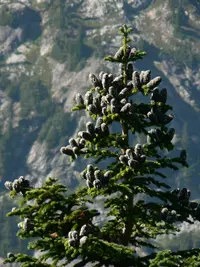
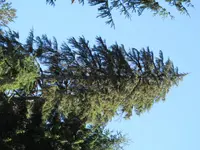
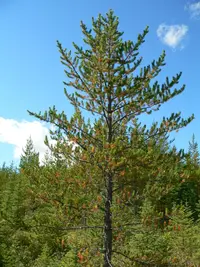
Recognize Subalpine Fir by its narrow, spire-like crown, smooth gray bark on young trunks, and short, flattened needles that usually curve upward around the twig.

Needles are about 3/4 to 1 1/4 inches (2-3 cm) long, with two pale bands beneath, and upright seed cones sit near the top branches.

Abies lasiocarpa Identification

Is This Subalpine Fir?

Take a photo and use Botan to confirm your plant identification.

Clear images work best. Avoid photos taken too close or too far away

Check the overall shape, needles, bark, and cones first.

  • Usually a very narrow, spire-like evergreen, often 60 to 100 feet (18 to 30 m) tall.
  • Needles are short, about 3/4 to 1 1/4 inches (2 to 3 cm), flat, and crowded along the twig.
  • Each needle often curves upward, making the upper side of the twig look brushlike.
  • Cones stand upright on upper branches and are cylindrical, about 2 to 4 inches (5 to 10 cm) long.

Bark is usually smooth and gray on younger trunks.

Abies lasiocarpa shows clear age-related form changes that can help confirm identification.

  • Seedling: Seedlings carry soft, flat needles on a slim upright stem, with the first side branches sparse and the outline narrow compared with later stages.
  • Young plant: Young plants develop a dense, sharp spire shape, with short horizontal branches and bluish to blue-green needles about 1 inch (2.5 cm) long.
  • Mature plant: Mature trees keep a very narrow, tapered crown, but the trunk becomes obvious and lower branches often droop slightly before turning upward at the tips.
  • Fruiting stage: Fruiting stage is marked by upright cylindrical cones near the upper crown, typically dark purple when fresh and around 2 to 4 inches (5 to 10 cm) long.

Several named forms of Abies lasiocarpa are distinct enough to recognize by habit and needle color.

  • var. arizonica: Commonly shows thicker, strongly blue-white needles from a heavy waxy coating, giving the whole crown a brighter silvery cast than the typical form.
  • 'Compacta': A dwarf, dense form that stays much smaller, often broad-conical to rounded rather than developing the taller, narrower outline of the species.
  • 'Argentea': Needles appear more intensely silvery blue than typical plants, with a paler overall crown color visible from a distance.

Subalpine Fir stays evergreen, so the clearest seasonal clues are its cones and buds rather than leaf drop. In late spring to early summer, pollen cones and upright seed cones become visible near the upper branches. By late summer into fall, seed cones mature to purple to dark brown and begin to break apart on the tree. In winter, tight pointed buds and the narrow spire-like crown stand out clearly.

Several western conifers can be mistaken for Subalpine Fir at a glance.

Pacific silver fir(Abies amabilis)

Both have flat needles and upright cones. Pacific silver fir usually has a more comb-like needle arrangement and larger cones, while branchlets are less bottlebrush-like.

corkbark fir(Abies arizonica)

Often confused because it is closely related and similarly blue-gray. Corkbark fir has thicker, corky white bark on young trunks and typically stouter twigs.

Engelmann spruce(Picea engelmannii)

Similar narrow crown in mountain forests. Engelmann spruce needles are four-sided and sharp, attached on small pegs; fir needles are flatter, softer, and lack pegs.

Native to western North America, Abies lasiocarpa ranges from Alaska and Yukon south through the Rocky Mountains to Arizona and New Mexico. It is most typical of high-elevation forests. It usually grows in subalpine and upper montane woods, often near treeline, on cool slopes and sheltered basins. Finding a true fir in these cold mountain settings helps narrow identification, especially above about 5,000 feet (1,500 m) and much higher farther south.

Confirm It from a Photo

Use Botan to identify or verify the plant from an image, helping avoid mix-ups with similar species.

FAQ

The best field mark is the narrow, spire-like crown with short, blue-green needles that often curve upward, plus smooth gray bark bearing resin blisters. On seed-bearing branches, upright purple cones add a strong Subalpine Fir identification clue.

More Plant Identification Guides

One Photo. More About Your Plant.

Identify it with Botan from a photo, then review plant details, care information, and common problems for that species.

Botan app identifying a plant from a photo
Best Water for Plants – How to Choose the Right Type

7 min read · 13 Aug 2026

Best Water for Plants – How to Choose the Right Type

Rainwater, filtered, distilled, and tap water affect plants differently. Learn which types support healthy growth and which cause slow damage. Match each to your plants and discover how to easily improve tap water quality.

Plant Care
Best Water for Plants – How to Choose the Right Type
8 Glow-in-the-Dark Plants and Fungi That Really Exist

8 min read · 6 Nov 2026

8 Glow-in-the-Dark Plants and Fungi That Really Exist

Plants that glow in the dusk really exist. Some of them produce their own light, while others need UV exposure or special treatments. Explore eight fascinating examples, including glowing petunias, bioluminescent mushrooms, fluorescent flowers, and experimental succulents.

Plant Recommendations
8 Glow-in-the-Dark Plants and Fungi That Really Exist
Best Fertilizer for Grass in Summer: How to Choose the Right One

6 min read · 18 Aug 2026

Best Fertilizer for Grass in Summer: How to Choose the Right One

The right fertilizer in summer can make a lawn thrive. The wrong one can damage it. Here, you’ll learn the best NPK ratios by grass type, when and how to apply your formula, and how to recognize the signs of over- or under-fertilizing.

Plant Care
Best Fertilizer for Grass in Summer: How to Choose the Right One