
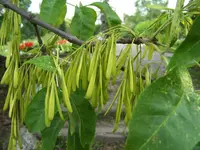
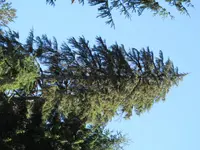


eastern hemlock Identification (Tsuga canadensis)

Recognize eastern hemlock by its short, flat needles set singly in two ranks, each needle with two white bands beneath.

Look for slender, drooping branchlets and many small, hanging cones about 3/4 to 1 inch (2 to 2.5 cm) long on a narrow, pyramidal evergreen tree.

Tsuga canadensis Identification

Identify Your Plant with Botan

Upload a clear photo to check your plant identification with Botan.

Clear images work best. Avoid photos taken too close or too far away

Check the branch tips, needles, and cones first.

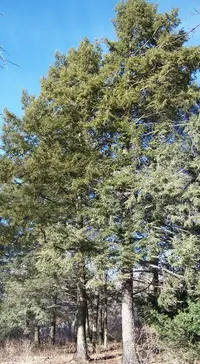
  • Crown is narrow and conical, often with a drooping leader and graceful, horizontal branchlets.
  • Needles are flat, soft, and short, about 1/4-3/4 inch (6-18 mm) long, attached singly.
  • Needles mostly line two sides of the twig, giving many branchlets a flattened, feathery look.
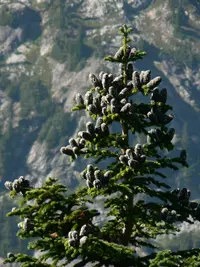
  • Cones are small, oval, and hanging, usually about 1/2-1 inch (1.3-2.5 cm) long.

Look for the combined effect of soft, two-ranked needles and small dangling cones.

Tsuga canadensis shows useful visual changes from seedling form to cone-bearing mature trees.

  • Seedling: Seedlings have a thin upright stem with short side branches and soft, flattened needles spaced more openly than on older plants.
  • Young plant: Young plants form a narrow, pyramidal outline with increasingly layered branches and a distinct drooping leader, the hanging main shoot at the top.
  • Mature plant: Mature trees become broadly conical to irregular, often 40-70 feet (12-21 m) tall, with strongly horizontal limbs and many fine, pendulous branchlets.
  • Fruiting stage: Cone-bearing branches show many small, dangling seed cones near twig tips, about 3/4 inch (2 cm) long, adding a visibly textured, ornamented look.

Several eastern hemlock selections are easy to separate by growth form or needle color.

  • Tsuga canadensis 'Pendula': A strongly weeping form, with arching branches and drooping branchlets that create a cascading outline instead of the typical pyramidal crown.
  • Tsuga canadensis 'Sargentii': Broad, mounded, and low-spreading, often much wider than tall, with branchlets that hang downward around the edges.
  • Tsuga canadensis 'Jeddeloh': A dwarf bird's-nest form, usually under 3 feet (0.9 m) tall, with a dense circular mound and a noticeable central depression.
  • Tsuga canadensis 'Aurea': New growth emerges yellow to golden, then softens greener later, unlike the species' usual dark green foliage.

Tsuga canadensis stays green year-round, so winter recognition depends on structure rather than leaf drop. In cold months, the fine, layered branchlets and many small, hanging cones are often easier to notice. New light green needles appear in spring at shoot tips, briefly giving the crown a softer, brighter look than older foliage.

A few conifers are regularly mistaken for eastern hemlock.

Carolina hemlock(Tsuga caroliniana)

Both have flat, short needles and small hanging cones. Carolina hemlock usually has stiffer, darker needles that radiate more around the twig, not mostly in two flat rows; its cones are also a bit longer, often about 1–1.5 inches (2.5–4 cm).

northern white cedar(Thuja occidentalis)

Young plants can seem similar from a distance because both are fine-textured evergreens. Thuja occidentalis has scale-like leaves pressed to flattened sprays, not single soft needles on slender twigs.

Tsuga canadensis is native to eastern North America, from Nova Scotia and southern Quebec west to Minnesota and south through the Appalachian Mountains to northern Georgia and Alabama. It is most often found in cool, moist forests, especially shaded ravines, north-facing slopes, stream valleys, and mixed hardwood-conifer woods. Seeing it in these sheltered inland habitats helps separate it from other eastern conifers that are more common on dry uplands or open sites.

Confirm the Species with Botan

Use a photo to identify it or verify your result before you label, buy, or plant with more confidence.

FAQ

The needles are attached singly along the twig, but many twist at the base so they appear in two flat rows. This flattened spray is a useful clue when identifying eastern hemlock.

More Plant Identification Guides

Scan Your Plant. Get the Details.

Identify a plant from a photo, then get plant details, care information, and common problems matched to the result.

Botan app identifying a plant from a photo
Frozen vs Fresh Vegetable Nutrients: Which Option Is Healthier?

6 min read · 8 Sept 2026

Frozen vs Fresh Vegetable Nutrients: Which Option Is Healthier?

Frozen and fresh vegetables are nutritionally comparable: frozen produce often retains vitamins just as well as fresh and may sometimes contain more. Here’s how blanching and storage affect nutrients—and when to choose each.

Plant Recommendations

Frozen vs Fresh Vegetable Nutrients: Which Option Is Healthier?
When to Plant Hydrangeas: Best Time by Season and Type

6 min read · 30 Oct 2026

When to Plant Hydrangeas: Best Time by Season and Type

Hydrangeas grow best when you plant them in cool weather. This guide explains when to plant hydrangeas in your area, compares fall and spring planting seasons, and shows the right steps for each type.

Beginner Guides
When to Plant Hydrangeas: Best Time by Season and Type
Best Time to Mow Lawn – A Complete Guide

5 min read · 10 Aug 2026

Best Time to Mow Lawn – A Complete Guide

Explore when to mow your lawn for its health and a pleasant green color. Find out the best time for this task during the summer heat, and follow practical tips for correctly cutting the grass, and learn common mistakes to avoid.

Plant Care
Best Time to Mow Lawn – A Complete Guide