

green ash Identification (Fraxinus pennsylvanica)

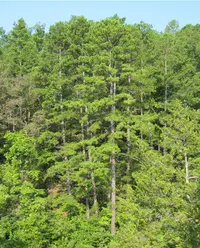
Recognize green ash by its opposite, pinnately compound leaves with 5 to 9 leaflets, usually with short stalks, and by its upright, single-trunk form that often reaches 50 to 70 feet (15 to 21 m).

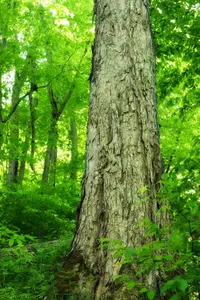
Twigs are stout and opposite, and the bark develops firm, interlacing ridges with shallow furrows.

Fraxinus pennsylvanica Identification

Identify Your Plant with Botan

Take a photo and use Botan to confirm your plant identification.

Clear images work best. Avoid photos taken too close or too far away

Use these visible traits to check for green ash.

  • Leaves are opposite on the twig and compound, usually with 5-9 leaflets.
  • Each leaf is about 8-12 inches (20-30 cm) long, with lance-shaped leaflets and fine serrated edges.
  • Leaflets are attached in pairs along a central stalk, with one terminal leaflet at the tip.
  • Twigs are fairly stout, and branches often form a broad, rounded crown on mature trees.
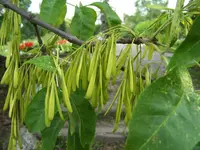
  • Fruits hang in clusters as single-winged samaras, each about 1-2 inches (2.5-5 cm) long.

Check several branches, since opposite compound leaves and winged fruits are especially useful together.

Green ash shows clear visual differences from seedling form to fruiting branches.

  • Seedling: First leaves are simple, then quickly shift to opposite, compound leaves with several leaflets; stems are slender and upright, with little branching.
  • Young plant: Saplings form a narrow crown and straighter central stem; compound leaves are larger and more regular, and bark stays relatively smooth.
  • Mature plant: Fraxinus pennsylvanica develops a broad crown on a single trunk, often 50-70 feet (15-21 m) tall, with thicker, furrowed gray-brown bark.
  • Fruiting stage: Female trees carry hanging clusters of narrow samaras, each about 1-2 inches (2.5-5 cm) long, making branch tips look denser than nonfruiting plants.

Several named selections of green ash can be told apart by crown shape, branch habit, or fall leaf color.

  • 'Marshall Seedless': Typically shows a broad oval to rounded crown and dependable yellow fall color, unlike the more variable outline of the species.
  • 'Patmore': Has a straighter trunk with a more symmetrical oval crown and dense branching, giving a more uniform silhouette than typical trees.
  • 'Summit': Usually develops a narrower, strongly upright crown and turns yellow to orange-yellow in fall.
  • 'Cimmzam': Distinguished by a very narrow, columnar crown, often only about 6 to 10 feet (1.8 to 3 m) wide at maturity.

In spring, green ash leafs out with opposite, compound leaves, and flowering clusters may appear before or as the leaves expand. Female trees later develop hanging samaras, the one-seeded winged fruits typical of ash. By late summer into fall, samaras often remain visible in clusters, and the foliage usually turns yellow before dropping. After leaf fall, the stout twigs and opposite branching pattern are easier to see.

Several ash and ash-like trees are regularly mistaken for green ash.

white ash(Fraxinus americana)

Also has opposite, pinnate leaves. White ash leaflets usually have whitish undersides and short stalks; green ash leaflets are typically greener beneath and more often stalked.

black ash(Fraxinus nigra)

Shares opposite compound leaves and ash form. Black ash usually has 7-11 nearly stalkless leaflets and corky, flattened twigs; green ash leaflets are often stalked.

boxelder(Acer negundo)

Confused because it has opposite compound leaves. Boxelder usually has 3-5 irregularly lobed leaflets and paired maple samaras; ash has narrower unlobed leaflets and single samaras.

Native to much of central and eastern North America, Fraxinus pennsylvanica occurs from the Great Plains east to the Atlantic region and from southern Canada into parts of the southern United States. It is most often found in floodplains, bottomland woods, streambanks, lake margins, and other moist lowlands. Seeing an ash in wet ground or along waterways helps narrow identification, especially outside upland forest settings where some other North American ashes are more typical.

Does Your Plant Match?

Use Botan to compare a photo and help verify the identification before you label or buy the plant.

FAQ

Leaves are usually 6 to 12 inches (15 to 30 cm) long and compound, with 5 to 9 leaflets. Each leaflet is often 3 to 6 inches (8 to 15 cm) long.

More Plant Identification Guides

Identify Your Plant and Learn More

Use Botan to identify a plant from a photo, then get species-specific care information, plant details, and common problems.

Botan app identifying a plant from a photo
How to Winterize Your Garden in 6 Steps

5 min read · 28 Sept 2026

How to Winterize Your Garden in 6 Steps

Learn how to prepare your garden for winter with a practical six-step checklist covering cleanup, tender plant care, watering, mulching, winter protection, and winterizing equipment and containers.

Plant Care

How to Winterize Your Garden in 6 Steps
How Fast Does Bamboo Grow Per Day, Month, and Year

10 min read · 7 Jul 2026

How Fast Does Bamboo Grow Per Day, Month, and Year

Bamboo grows extremely fast: some species can reach 5-6 m in just 3-4 months under the right conditions. This guide explains how much bamboo can grow per day, week, and year, and what affects its growth rate.

Plant Recommendations
How Fast Does Bamboo Grow Per Day, Month, and Year
How to Plant Pumpkin Seeds for a Fall Harvest and Grow Your Own Patch

7 min read · 4 Nov 2026

How to Plant Pumpkin Seeds for a Fall Harvest and Grow Your Own Patch

A backyard pumpkin patch starts months before the first leaves turn: the harvest that ends up on the porch in October is decided by what a gardener does in late spring.

Beginner Guides
How to Plant Pumpkin Seeds for a Fall Harvest and Grow Your Own Patch