
water oak Identification (Quercus nigra)

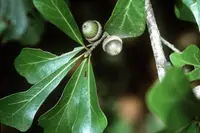
Recognize Quercus nigra by its alternate leaves with a narrow base and a broader, spoon-shaped outer half, often ending in three shallow lobes. Leaves are usually 2 to 4 inches (5 to 10 cm) long.

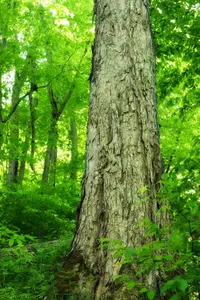
Also check the dark, furrowed bark on mature trunks and the rounded crown formed by broad, spreading branches.

Quercus nigra Identification

Is This water oak?

Upload a plant photo and check the identification in seconds.

Clear images work best. Avoid photos taken too close or too far away

Start by checking the leaves, twigs, and acorns together.

  • Leaves are alternate, simple, and usually 2-4 inches (5-10 cm) long.
  • Many leaves are spoon-shaped, broader near the tip, often with three shallow lobes at the outer end.
  • The leaf base is narrow and wedge-shaped, with a smooth to slightly bristle-tipped margin.
  • Twigs are slender, and the crown often looks broad, rounded, and somewhat open.
  • Acorns are small, about 1/2 inch (1.3 cm) long, nearly round, with a shallow cap covering about one-third of the nut.

Use several traits together, since leaf shape can vary on the same tree.

Water oak shows clear visual shifts from sapling leaves to mature acorns and crown structure.

  • Seedling: Seedlings have alternate leaves that are often narrow and spoon-shaped, with smooth margins; the first stems are slender and upright, with little branching.
  • Young plant: Young plants show more variable leaves, often broader toward the tip, and develop a straight central trunk with ascending side branches.
  • Mature plant: Mature trees form a broad, rounded crown and a thicker trunk; leaves usually measure 2-4 inches (5-10 cm) and remain variably shaped.
  • Fruiting stage: Fruiting branches carry small, rounded acorns set singly or in pairs; the shallow cap covers about one-third of each nut, unlike leaf-focused earlier stages.

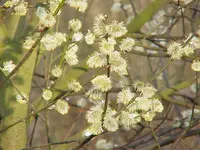
In spring, new leaves emerge pale green and soft, often showing the variable water oak shape from rounded to shallowly lobed. Hanging male catkins can also be visible as the canopy leafs out. By late fall and winter, many leaves turn dull yellow-brown and may persist into winter. After partial leaf drop, the dark bark and irregular branching show more clearly.

Several oaks are often mistaken for Quercus nigra.

willow oak(Quercus phellos)

Confusion comes from the narrow, mostly unlobed leaves. Willow oak leaves are much more uniform and willow-like, usually 2 to 5 inches (5 to 13 cm) long, with smooth sides and a tiny bristle tip. Quercus nigra usually has broader, spoon-shaped leaves near the tip.

laurel oak(Quercus laurifolia)

Both can have unlobed, glossy leaves and a similar crown. Laurel oak leaves are more evenly elliptic, often 3 to 6 inches (8 to 15 cm) long, with a more consistent outline. Quercus nigra more often shows variable leaves that widen toward the outer half.

Quercus nigra is native to the eastern and south-central United States, from coastal New Jersey south to Florida and west to eastern Texas, extending inland along the Mississippi Valley. It is most often found in bottomland woods, streambanks, floodplains, and edges of swamps. Seeing an oak in low, seasonally wet ground across this range can help narrow identification toward water oak.

  • Acorns and leaves: Quercus nigra acorns, young leaves, and buds contain tannins. Ingestion can harm humans and pets, especially livestock, causing stomach upset and, with larger amounts, kidney injury.
  • Pet risk: Dogs and other pets are most often exposed by chewing fallen acorns or leaves. The concern is ingestion, not normal skin contact.

Does Your Plant Match?

Use Botan to compare a photo and help identify or confirm the plant before you label it incorrectly.

FAQ

The leaves are the clearest clue for water oak identification. Many are spoon-shaped with a narrow base and broader tip, often 2-4 inches (5-10 cm) long, though some on the same tree may be lobed.

More Plant Identification Guides

Find Out What Plant It Is

Identify a plant from a photo with Botan, then review species details, care information, and common problems.

Botan app identifying a plant from a photo
12 Most Wanted Rare Houseplants to Grow at Home

6 min read · 21 Sept 2026

12 Most Wanted Rare Houseplants to Grow at Home

Rare houseplants can turn an ordinary corner in your apartment into a living botanical collection. This guide covers 12 most admired picks, what makes them special, and how to grow them successfully at home.

Plant Recommendations
12 Most Wanted Rare Houseplants to Grow at Home
Is Sugar Water Good for Plants?

4 min read · 14 Sept 2026

Is Sugar Water Good for Plants?

Sugar water may sound like an easy boost, but most rooted plants do not need extra sucrose. This guide explains how green tissues produce carbohydrates, when a sweetened solution can be useful, and why too much can cause problems.

Plant Care
Is Sugar Water Good for Plants?
20 Most Popular Fruits Around the World

7 min read · 22 Jul 2026

20 Most Popular Fruits Around the World

Curious which fruits the world actually eats the most? Here's the top-20 by production volume, an overview of what people choose in each region, and a few figures that defy common assumptions.

Plant Recommendations
20 Most Popular Fruits Around the World