
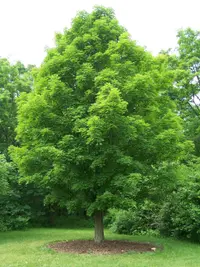

Sessile Oak Identification (Quercus petraea)

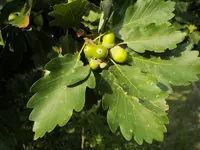
To recognize Sessile Oak, look for lobed leaves with a very short stalk, arranged alternately on twigs, and acorns that sit almost directly on the twig rather than on long stalks.

Mature trees also show a broad rounded crown and a sturdy trunk with gray, fissured bark.

Quercus petraea Identification

Identify a Plant by Photo

Check your plant ID by uploading a clear photo to Botan.

Clear images work best. Avoid photos taken too close or too far away

  • 1 free identification
  • No sign-up
  • 30,000+ plants in database

Check the leaf shape, acorns, and bark first.

  • Leaves are oblong with 5-8 rounded lobes on each side and usually measure about 3-5 inches (8-12 cm) long.
  • Leaf stalks are clearly visible and relatively long, often around 0.6-1 inch (1.5-2.5 cm).
  • Acorns sit almost directly on the twig, with little or no stalk, often in small clusters.
  • The acorn cups are shallow and scaly, covering only the base of the nut.
  • Bark is gray-brown and develops long vertical fissures and broad ridges on mature trunks.

Use several traits together, especially the stalked leaves and nearly stalkless acorns.

Quercus petraea shows clear visual shifts from sapling form to acorns on older branches.

  • Seedling: Seedlings show a straight stem with a few alternate leaves; the first true leaves are small, lobed, and held on relatively long stalks.
  • Young plant: Young plants become a narrow sapling, often under 6 feet (1.8 m), with smoother gray bark and more regular side branching than seedlings.
  • Mature plant: Mature plants develop a broad, rounded crown, a stout trunk with shallow fissured gray bark, and thicker limbs that spread outward rather than staying upright.
  • Fruiting stage: Fruiting branches carry oval acorns in shallow cups on very short stalks, a visible change from nonfruiting shoots that show only leaves and buds.

In spring, Quercus petraea leafs out with fresh green lobed leaves, and the hanging male catkins become visible as the canopy opens. By late summer into fall, acorns can be seen attached directly to the twigs rather than on long stalks. In fall, foliage usually turns yellow-brown before dropping. Through winter, the broad crown, sturdy branching, and clustered terminal buds are easier to see once the tree is bare.

These oaks are the most realistic sources of confusion with Sessile oak.

English oak(Quercus robur)

Leaves are similarly lobed, but English oak usually has a very short leaf stalk and clear ear-like lobes at the leaf base. Quercus petraea has a longer leaf stalk and a more wedge-shaped base.

Durmast oak(Quercus × rosacea)

This recognized hybrid between Q. petraea and Q. robur often shows intermediate leaves, so it can be hard to place. Look for mixed traits on one tree, especially partly stalked leaves with a somewhat eared base.

Quercus petraea is native across much of Europe, from the British Isles through central Europe to the Balkans, with a limited reach into western Asia. It is most often found in upland oak woods, mixed deciduous forest, and on well-drained hillsides and rocky slopes. This setting helps separate it from lowland, floodplain, or marsh oaks when geography and habitat are known.

  • Acorns and leaves: Quercus petraea contains tannins, especially in acorns and young leaves. Ingestion can harm both humans and pets, causing stomach upset, and larger amounts are more concerning for livestock and dogs.
  • Dust exposure: Oak wood and bark dust from handling or cutting can irritate skin, eyes, and the airways in humans by contact or inhalation. This is a handling risk rather than a poisoning risk.

Not Sure About the ID?

Use Botan to identify or confirm the plant from a photo, which helps avoid mix-ups with similar species.

FAQ

The most useful clue is the acorn stalk. In this species, acorns sit almost stalkless on the twig, while the leaf stalk is usually longer. That contrast is central to how to identify Sessile Oak.

More Plant Identification Guides

Identify It. Learn More About It.

Use Botan to identify a plant from a photo, then get plant details, care information, and common problems for that species.

Botan app identifying a plant from a photo
Plants That Repel Bugs – 20 Effective Options

12 min read · 16 Jul 2026

Plants That Repel Bugs – 20 Effective Options

Mosquitoes on the patio? Gnats in the kitchen? Some plants keep them away with the scent of their own leaves. Here are 20 that deal with mosquitoes, flies, aphids, and more, plus where to put them so they help.

Plant Recommendations
Plants That Repel Bugs – 20 Effective Options
12 Best Plants for Bathroom That Thrive in Humid Conditions

9 min read · 29 Sept 2026

12 Best Plants for Bathroom That Thrive in Humid Conditions

Discover the 12 best plants for bathroom spaces. Each pick comes with its own advantages, plus light, humidity, watering, and placement tips. Take a look and match the plant to your specific bathroom.

Plant Recommendations
12 Best Plants for Bathroom That Thrive in Humid Conditions
How to Water Succulents: When, How Often, and How Much

7 min read · 18 Nov 2026

How to Water Succulents: When, How Often, and How Much

Yellowing, mushy, or shriveled leaves can all point to a watering problem, yet each can have a different cause. This guide explains how to water succulents, when to wait, and how soil, pots, and seasons change the routine.

Plant Care
How to Water Succulents: When, How Often, and How Much