Wind-firm training
In the first 2–3 years, lightly stake young plants on the windward side and loosen ties annually so stems flex without snapping, which encourages a stronger, wind-resistant framework.

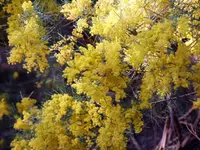
Snowy river wattle, Acacia boormanii, is an evergreen shrub or small tree known for its fine, blue-green foliage and dense, upright habit. In late winter to spring it produces masses of soft yellow flower clusters that cover the branches and attract pollinators.
This species is native to cold, high-altitude regions of southeastern Australia, especially near the Snowy River. It is valued in gardens for its tolerance of frost, wind, and poor, well-drained soils, which makes it relatively easy to establish.
Gardeners who want to learn how to care for Snowy River Wattle should note its preference for full sun, moderate watering, and low-maintenance pruning once it is mature.

Care Difficulty
Easy Care

Light Preference
Full Sun

Water Requirements
Low Water

Temperature Preference
Cold Hardy

Hardiness Zone
7–9

Soil Texture
Sandy, Loamy, Rocky

Soil pH
Acidic (5.5–6.5), Slightly acidic (6.5–7.0)

Soil Drainage
Well-drained

Fertilization
Minimal (feed rarely)
Scan your plant to receive care tips personalized for your specific plant
Available on iOS and Android
Acacia boormanii thrives in bright, open positions with plenty of direct sun.
Acacia boormanii prefers infrequent, deep watering once established, with fast-draining soil.
This species is adapted to cool to warm climates and handles notable cold once established.
This species tolerates a wide humidity range and rarely needs special humidity management indoors or outdoors.
Acacia boormanii prefers lean, fast-draining, sandy or gravelly soil that mimics its natural habitat.
This species can be grown in containers when given a large, heavy pot and very free-draining mix.
This Australian wattle grows well in lean soils, so use fertilizer sparingly for container or poor-site plants.
Acacia boormanii benefits from light, well-timed pruning to maintain form and flowering.
This species is usually grown in the ground, so focus on careful transplanting rather than frequent repotting.
Acacia boormanii is most commonly propagated from seed, with some growers also using semi-ripe cuttings.
This wattle is relatively cold hardy but benefits from some winter attention in colder regions.

Plant Health Check
Not sure what's wrong with your plant? Check your plant's health inside the app.
This species is naturally restricted to cold, high-altitude areas along the Snowy River region of southeastern Australia, where it forms dense shrubby thickets on poor, often rocky soils.
Unlike many Australian acacias, it tolerates regular frosts and brief drops well below freezing, which has led to its selection as a landscape shrub in cool-temperate climates outside Australia.
Its narrow, grey-green phyllodes (leaf-like leaf stalks) create a soft, cloud-like texture, which contrasts strongly with the dense masses of small, pale yellow flower balls produced in late winter to early spring.

Acacia boormanii is widely used in Australian land rehabilitation projects because its nitrogen-fixing root nodules help restore degraded soils while its dense root system stabilizes steep, erosion-prone slopes in its native range.
Lack of flowers is often due to pruning at the wrong time, excessive nitrogen fertilizer, or insufficient winter chill. Lightly prune only after flowering and avoid heavy feeding to support Acacia boormanii care focused on flowering performance.
Keep your plants happy and healthy with plant identification, disease detection, and easy care guidance.