Early structural pruning
In the first 2–3 years, selectively remove crossing or steeply upright shoots in late winter to create a strong, open framework that can support the plant’s naturally weeping habit without splitting in wind.

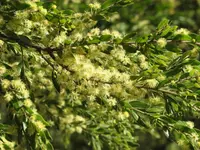
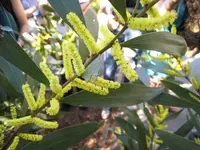
Sticky wattle (Acacia howittii) is an evergreen shrub or small tree from southeastern Australia, valued for its fine, pendulous foliage and scented yellow pompom flowers. It often forms a dense, weeping outline that works well as a screen, hedge, or specimen plant in mild climates.
In its natural range it grows in moist gullies and coastal areas, which hints at its preference for moderate moisture and well-drained soil. It generally grows fast and adapts well to pruning, which makes it straightforward to shape and maintain.
Gardeners who want to care for sticky wattle usually find it undemanding if given good light, protection from severe frost, and soil that does not stay waterlogged.

Care Difficulty
Easy Care

Light Preference
Full Sun

Water Requirements
Moderate Water

Temperature Preference
Warm Climate

Hardiness Zone
9–11

Soil Texture
Sandy, Loamy, Clay

Soil pH
Acidic (5.5–6.5), Slightly acidic (6.5–7.0)

Soil Drainage
Well-drained

Fertilization
Minimal (feed rarely)
Scan your plant to receive care tips personalized for your specific plant
Available on iOS and Android
Acacia howittii grows best with bright outdoor light and some protection from harsh extremes.
This shrub prefers evenly drained soil and is more tolerant of dryness than prolonged wet conditions.
This species handles a range of outdoor conditions but thrives in mild, temperate climates.
This species is adaptable and humidity is not a major concern in most homes or outdoor settings.
Acacia howittii prefers freely draining, moderately fertile soil that does not stay wet after watering or rain.
This species can grow successfully in containers if the pot is chosen and managed to prevent instability and waterlogging.
Acacia howittii is a light feeder, so focus on modest nutrition rather than heavy fertilization.
Pruning Acacia howittii is mainly used to maintain shape and remove problem growth after flowering.
This species is usually grown in the ground, so focus on careful transplanting rather than frequent repotting.
New Acacia howittii plants are most often raised from seed, with semi-ripe cuttings as a secondary method.
This species is only mildly frost tolerant, so some winter care improves survival in cooler climates.

Plant Health Check
Not sure what's wrong with your plant? Check your plant's health inside the app.
This species is naturally restricted to a small area of coastal and near-coastal forest in Gippsland, Victoria, Australia, where it grows as an understory shrub in moist, sheltered sites.
The fine, pendulous leaves release a noticeable sweet, resinous scent, especially in warm weather or when brushed, which is one reason it is often planted near paths and seating areas.
It has been used in horticulture as a parent in breeding programs, contributing its weeping habit and fragrant foliage to several ornamental Acacia hybrids grown in Australia.

In its native range, this species can form dense thickets that provide important protective cover for small birds and other wildlife in otherwise open or disturbed eucalypt woodland and forest edges.
Poor flowering usually comes from insufficient light, heavy or waterlogged soil, or lack of phosphorus. Light pruning after flowering encourages new flowering wood. Avoid high‑nitrogen fertilizer, which promotes leaves instead of blooms. These points are key in Acacia howittii care.
Keep your plants happy and healthy with plant identification, disease detection, and easy care guidance.