Wind-hardening young plants
Gradually expose young plants to stronger wind over 2–3 weeks so their stems and root systems strengthen before planting into a permanently exposed position.

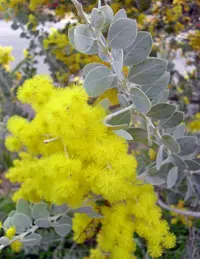
Pearl wattle (Acacia podalyriifolia) is a small evergreen tree or large shrub from Australia, valued for its silvery blue-green foliage and dense, rounded form. It produces masses of fragrant yellow flower clusters in late winter to spring, giving strong seasonal interest.
This species naturally occurs in Queensland and New South Wales, often in dry, open woodland. It tends to grow quickly and can become leggy if not pruned, but is generally considered easy to establish in mild climates.
Acacia podalyriifolia prefers full sun, well-drained soil, and low to moderate moisture, which makes it suitable for water-wise gardens. For gardeners learning how to care for pearl wattle, understanding its need for sun and good drainage is the main priority.

Care Difficulty
Moderate Care

Light Preference
Full Sun

Water Requirements
Low Water

Temperature Preference
Warm Climate

Hardiness Zone
9–11

Soil Texture
Sandy, Loamy, Rocky

Soil pH
Slightly acidic (6.5–7.0), Neutral (7.0)

Soil Drainage
Well-drained

Fertilization
Minimal (feed rarely)
Scan your plant to receive care tips personalized for your specific plant
Available on iOS and Android
This sun-loving shrub thrives in bright conditions and needs strong light to flower well.
This species prefers infrequent, deep watering once established, supported by fast-draining soil.
This plant is adapted to warm, mild climates and is not reliably hardy in cold regions.
This species tolerates a wide humidity range and usually does not need special humidity management indoors or outdoors.
Acacia podalyriifolia prefers sharply drained, light soil that does not stay wet around the roots.
This species can be grown in containers for a time, especially in mild climates or for young plants.
This small Australian tree grows well in lean soils, so pearl wattle indoor care should use light, controlled feeding only.
Pruning Acacia podalyriifolia is helpful to manage size, encourage a strong framework, and maintain flowering performance.
This species is usually grown in the ground, so focus on careful transplanting and only occasional repotting for container specimens.
Acacia podalyriifolia is most often propagated from seed, with some growers also using semi-hardwood cuttings.
This wattle prefers mild winters and needs protection in regions with hard frost.

Plant Health Check
Not sure what's wrong with your plant? Check your plant's health inside the app.
The distinctive silvery-grey leaves are covered with fine hairs that reflect strong sunlight and reduce water loss, an adaptation to the bright, dry conditions of its native Queensland habitats.
In many warm-temperate climates it flowers in late winter to early spring, producing dense clusters of fragrant yellow globular flower heads when many other woody plants are still dormant.
Like many members of the legume family, this species forms root nodules with nitrogen-fixing bacteria, allowing it to capture atmospheric nitrogen and improve soil fertility around its root zone.

This species has naturalized in several Mediterranean and subtropical regions outside Australia and is considered invasive in some areas, where its fast growth, prolific seeding, and tolerance of poor soils allow it to outcompete native vegetation and alter local plant communities.
This species is considered fast-growing, often adding 30–90 cm of height per year in suitable climates. Growth is strongest in the first 3–5 years, especially in well-drained soil and full outdoor exposure.
Keep your plants happy and healthy with plant identification, disease detection, and easy care guidance.