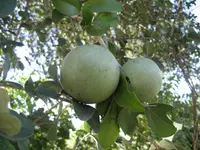
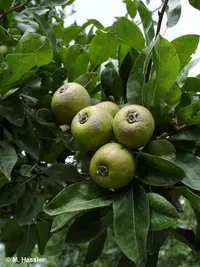
Bosc Pear Care (Pyrus communis 'Beurre Bosc')

Also known as: Common Pear, European Pear

About Bosc Pear

Pyrus communis 'Beurre Bosc', commonly called Bosc pear, is a deciduous fruit tree grown for its firm, aromatic pears and reliable cropping habit. It forms a medium to large tree with an upright, somewhat pyramidal crown and dense branching.

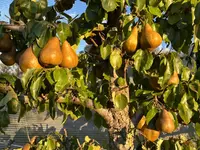
This cultivar likely originated in Europe and is now widely grown in temperate orchards and home gardens in North America and beyond. It produces russeted, bronze-brown fruits with a long neck and white, fine-textured flesh.

The tree is moderately vigorous and generally robust but needs full sun, good air movement, and suitable winter chill to crop well. Understanding how to care for Bosc Pear helps maintain healthy growth and consistent fruit quality.

It prefers well-drained, moderately fertile soil and benefits from regular moisture without prolonged waterlogging or extreme drought stress.

Main Plant Requirements

Care Difficulty

Moderate Care

Light Preference

Full Sun

Water Requirements

Moderate Water

Temperature Preference

Cold Hardy

Hardiness Zone

5–9

Soil Texture

Loamy, Sandy, Clay

Soil pH

Acidic (5.5–6.5), Slightly acidic (6.5–7.0)

Soil Drainage

Moist but well-drained

Fertilization

Minimal (feed rarely)

Get Personalized Care Plan

Scan your plant to receive care tips personalized for your specific plant

Available on iOS and Android

How to Care for the Bosc Pear

This pear cultivar needs strong, direct sun to flower and fruit well outdoors.

  • Provide 6–8 hours of full sun daily; morning and midday sun give the best flowering and fruit quality for Bosc Pear.
  • Trees tolerate light partial shade, but yields drop and shoots stretch if they receive under 4–5 hours of direct sun.
  • In hot inland summers, protect from extreme late-afternoon sun with light shade, and in winter ensure an open, unshaded site to maximize low-angle light.

This tree prefers evenly moist, well-drained soil rather than frequent shallow watering.

  • Water when the top 5–8 cm of soil feels dry, applying a deep soak that moistens the root zone 20–30 cm down.
  • Reduce watering in fall and winter once growth slows, but do not allow prolonged dryness during flowering, fruit set, or fruit swelling.
  • Ensure soil drains freely; yellowing leaves and soft, cracking bark suggest overwatering, while dull, curling leaves and small fruit indicate drought stress.

This pear thrives in temperate climates with cold winters and mild to warm growing seasons.

  • Active growth and fruiting are best at 60–80°F (16–27°C), with cool nights supporting good flower bud development.
  • Dormant trees tolerate down to about -10°F (-23°C) once established, but young trees need protection from hard freezes and drying winter winds.
  • During summer heat above 90–95°F (32–35°C), provide soil moisture and mulch to protect roots, as prolonged extremes can scorch leaves and reduce fruit quality.

This pear tree tolerates a wide humidity range and usually does not need special humidity management outdoors.

Pyrus communis 'Beurre Bosc' performs best in deep, well-structured, moisture-retentive but free-draining soil.

  • Use a loam or loam-sand mix enriched with 20–30% compost to provide stable structure and nutrients.
  • Aim for slightly acidic to neutral pH around 6.0–7.0; avoid strongly acidic or alkaline soils that limit nutrient uptake.
  • Improve drainage and aeration on heavy clay sites by incorporating coarse sand or fine gravel into the top 30–40 cm.
  • Avoid waterlogged, compacted, or very shallow soils, as these restrict root development and increase risk of root rot.

This pear can be grown in large outdoor containers when given adequate root volume and stability.

  • Choose a container at least 50–60 cm deep and wide to accommodate the vigorous root system and maintain moisture buffering.
  • Use a heavy, stable pot material such as thick terracotta or concrete to reduce tipping from wind and top-heavy growth.
  • Elevate the pot on feet so all drainage holes stay clear, allowing rapid runoff after heavy rain and preventing chronic sogginess.

Nutrient inputs support strong growth and consistent fruiting in Pyrus communis 'Beurre Bosc'.

  • Apply a balanced granular NPK, such as 10-10-10, in early spring as buds swell, following label rates for fruit trees.
  • Top-dress with 2–5 cm of compost around the drip line once a year to improve soil structure and biology.
  • During the growing season, avoid additional high-nitrogen products that cause soft, leafy growth at the expense of fruiting.
  • In winter dormancy, skip feeding entirely and never exceed half-strength liquid feeds for young or container-grown Bosc Pear.

Structural pruning keeps Pyrus communis 'Beurre Bosc' productive, well-shaped, and easier to manage.

  • Schedule main pruning in late winter to very early spring before buds break, in dry weather to limit disease entry.
  • Remove dead, diseased, damaged, and crossing branches first, cutting back to healthy wood with clean, sharp bypass pruners or a pruning saw.
  • Thin crowded interior shoots to open the canopy, improving airflow, light penetration, and fruit quality.
  • Maintain a balanced central leader or open-center form by shortening overly vigorous upright shoots and favoring wide-angled branches.

Movement of Pyrus communis 'Beurre Bosc' is mainly done when shifting young trees from nursery containers into their permanent ground position.

  • Transplant in late winter to early spring while still dormant, avoiding periods of hard freeze or hot, dry weather.
  • Plan moves when roots circle the pot, growth is stunted, or the tree becomes top-heavy and unstable in its container.
  • Dig a wide planting hole, gently loosen circling roots, and set the tree at the same soil level as in the nursery container.
  • Water deeply after planting, apply a 5–8 cm mulch ring away from the trunk, and keep soil evenly moist to reduce transplant shock.

Multiplication of Pyrus communis 'Beurre Bosc' for orchard use is typically done by grafting rather than simple home methods.

  • Use dormant hardwood scion wood grafted onto compatible pear rootstocks in late winter to very early spring.
  • Store scion wood cool and slightly moist before grafting to maintain viability and prevent desiccation.
  • Perform whip-and-tongue or cleft grafts with sterile, sharp tools, then seal unions with grafting tape or wax.
  • Grow grafted trees in full sun with evenly moist, well-drained soil to support callus formation and strong union development.

Mature Pyrus communis 'Beurre Bosc' trees are generally cold hardy and need minimal winter intervention in most temperate regions.

  • Expect the tree to tolerate typical winter frosts in USDA zones suited to European pears once well established.
  • Apply a 5–8 cm mulch layer over the root zone in late fall, keeping it a few cm away from the trunk to prevent rot.
  • For young or container trees in colder zones, heel containers into the ground or move them into an unheated, sheltered space.
  • Brush off heavy snow loads from branches to reduce breakage and inspect for winter rodent damage at the base.

Care Tips

Early tree training

During the first 3–4 years, select 3–5 well-spaced scaffold branches and remove steep, upright competitors to build a strong, open framework that can support heavy Bosc pear crops later.

Use branch spreaders

Install simple wooden or plastic spreaders to widen young branch angles to about 60–70° from the trunk, which greatly reduces the risk of limb breakage under fruit load and improves light penetration.

Thin fruit clusters

About 3–4 weeks after petal fall, thin clusters so that fruits are spaced about 15–20 cm apart, leaving only 1–2 pears per spur to improve fruit size, quality, and reduce biennial bearing tendency.

Monitor for fire blight

Inspect blossoms, shoot tips, and young branches every 1–2 weeks in spring and early summer, promptly cutting out wilted, blackened tissue at least 20–25 cm below the damage and disinfecting tools between cuts to limit spread of this bacterial disease when growing Bosc Pear.

Install sturdy support

In windy or exposed sites, stake the trunk with a solid post and use soft, adjustable ties, checking yearly to loosen or reposition them so the bark is not constricted as the tree thickens.

Common Pests and Diseases

Pear psylla

This pest feeds on leaves and young shoots, causing honeydew, sooty mold, leaf yellowing, and reduced vigor. Heavy infestations can lead to defoliation and smaller, misshapen fruit.

Solution

Monitor buds and young shoots from early spring and wash small populations off with a strong water spray. For ongoing issues, use horticultural oil during dormant season to smother overwintering stages and apply insecticidal soap or a labeled systemic product at crawler stages, combined with removal of heavily infested shoots to reduce populations.

Pear scab

This disease causes dark, velvety or crusty spots on leaves, shoots, and fruit, which may crack and become misshapen. Symptoms include early leaf drop and rough, corky patches on pears that reduce quality.

Solution

Remove and dispose of fallen leaves and mummified fruit to lower spore levels, and prune to improve airflow through the canopy. In areas with a history of scab, apply a labeled fungicide from green tip through early fruit development, and avoid overhead watering that keeps foliage wet for long periods.

Fire blight

This disease causes blackened, wilted blossoms and shoots that look scorched, often with a characteristic shepherd’s crook at the tip. Infected twigs, branches, and sometimes fruit ooze a bacterial exudate in warm, humid conditions.

Solution

Prune out infected shoots at least 20–30 cm below visible symptoms during dry weather, disinfecting pruning tools between cuts with alcohol or a 10% bleach solution. Avoid high-nitrogen fertilization and heavy pruning during active growth, and in areas with recurrent outbreaks, use labeled blossom-protectant bactericides timed to bloom.

Pear rust

This disease produces bright orange or rust-colored spots on leaves and sometimes on fruit, often with raised or blister-like structures on the underside of leaves. Severe infections can weaken trees and reduce fruit quality.

Solution

Rake and destroy fallen leaves, and prune to open the canopy and promote faster drying of foliage. If nearby junipers act as alternate hosts, remove heavily infected juniper galls where practical, and apply a labeled protective fungicide at bud break and during early leaf expansion in regions with a known rust problem.

Codling moth

These insects are the classic worm-in-fruit pest, with larvae tunneling into pears and leaving frass-filled entry holes and internal damage. Infested fruit often drops early or is unusable despite appearing normal from the outside at first.

Solution

Collect and destroy dropped fruit throughout the season and use corrugated cardboard bands around trunks to trap migrating larvae, then remove and discard the bands. For more precise control, use pheromone traps to monitor moth flights and time applications of a labeled product such as Bacillus thuringiensis kurstaki (Bt) or other selective insect growth regulators to target young larvae before they enter the fruit, which is a key part of effective Pyrus communis 'Beurre Bosc' care instructions.

Interesting Facts

Reddish Bronze Skin

This cultivar is known for its naturally russeted, cinnamon‑brown skin, which forms a slightly rough, dry surface rather than the smoother green or yellow skin seen in many other pears.

Late-Ripening Dessert Pear

It ripens relatively late in the season compared with many European pears and develops a dense, fine-textured, buttery flesh that is valued for both fresh eating and classic pastry applications.

Reliable Culinary Structure

The fruit keeps its shape well during baking and poaching, which has made it a standard choice in professional kitchens for tarts, poached pear desserts, and long-cooked recipes.

Botan icon

Did you know?

Beurre Bosc originated in Belgium in the early 19th century and was quickly adopted in European and later North American orchards, becoming one of the classic European pear cultivars used as a benchmark for dessert quality and storage behavior in pomology trials.

FAQs about Bosc Pear

Growth is moderate. On common rootstocks, this tree usually extends 30–60 cm per year once established. Young trees may grow slightly faster, while older specimens slow down as they reach structural maturity and begin regular fruiting.

Grow Healthy Plants with Botan Care

Keep your plants happy and healthy with plant identification, disease detection, and easy care guidance.

Botan plant care app — identify plants on mobile

Explore More Plants