Wind-hardening young plants
Expose young plants to gradually stronger wind over several weeks by reducing windbreaks or rotating pots, which encourages sturdier trunks and roots before planting into permanently windy coastal or exposed sites.

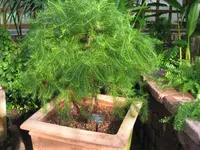
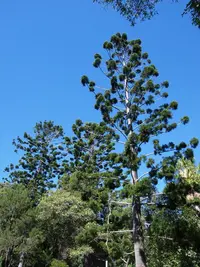
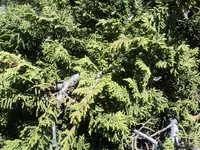
Pancher's cypress-pine, Callitris pancheri, is a slow-growing conifer native to New Caledonia. It forms a small tree or large shrub with fine, scale-like foliage and a compact, often irregular crown. Cones are small and woody, giving the plant a distinctly textured look.
In nature it grows on rocky, nutrient-poor soils, which makes it relatively tolerant of lean substrates and moderate drought once established. It prefers bright light, good air movement, and sharply draining soil. Gardeners who learn how to care for Pancher's cypress-pine often value it for its architectural form and steady, controlled growth rather than fast height gain.

Care Difficulty
Hard Care

Light Preference
Full Sun

Water Requirements
Low Water

Temperature Preference
Warm Climate

Hardiness Zone
11–12

Soil Texture
Sandy, Rocky, Loamy

Soil pH
Slightly acidic (6.5–7.0)

Soil Drainage
Well-drained

Fertilization
Minimal (feed rarely)
Scan your plant to receive care tips personalized for your specific plant
Available on iOS and Android
This species prefers bright, open sites but benefits from some protection from extreme afternoon sun in hot climates.
Callitris pancheri prefers evenly moist, well-drained soil and is sensitive to both chronic dryness and prolonged saturation.
This conifer prefers mild, stable conditions and does not tolerate hard frost or extreme, dry heat well.
This species handles a wide humidity range and usually needs no special humidity management indoors or outdoors.
Callitris pancheri prefers mineral, sharply draining soil that mimics rocky, low-organic habitats.
This species can be grown in containers, especially in its early years or where in-ground planting is not possible.
This New Caledonian conifer grows slowly and usually needs only light feeding in containers or poor soils.
Pruning Callitris pancheri is minimal and focused on health and structure rather than shaping.
This species is usually grown in the ground, so transplanting young plants correctly is more important than frequent repotting.
Propagation of Callitris pancheri is possible but somewhat specialized and slow, so most home growers rely on nursery plants.
Callitris pancheri prefers mild, frost-free climates and benefits from some winter protection in colder regions.

Plant Health Check
Not sure what's wrong with your plant? Check your plant's health inside the app.
This species is naturally restricted to New Caledonia’s ultramafic substrates, which are metal-rich, nutrient-poor soils that few tree species can tolerate, making it a strong habitat specialist in its native range.
It occurs only in New Caledonia and belongs to a group of island-endemic conifers that evolved in relative isolation, contributing to the region’s status as a global hotspot for conifer diversity.
Current field assessments show that its populations are highly fragmented and declining, mainly due to habitat disturbance and fire, which is why it is assessed as threatened on the IUCN Red List.

Callitris pancheri forms part of a relict Gondwanan flora, meaning its evolutionary lineage traces back to ancient southern supercontinent plant communities that persisted while many related lineages disappeared elsewhere.
This species is evergreen and keeps its scale-like foliage year-round. Individual leaves are small and overlap closely on the twigs, so seasonal change is subtle. Older inner foliage may shed gradually as branches age.
Keep your plants happy and healthy with plant identification, disease detection, and easy care guidance.