Stake young trunks
Install a sturdy stake on the windward side and loosely tie the trunk in 2–3 places with soft tree ties to keep the central leader straight until the root system is well anchored.

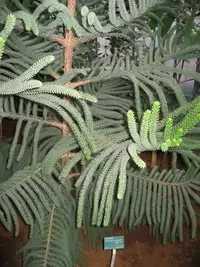
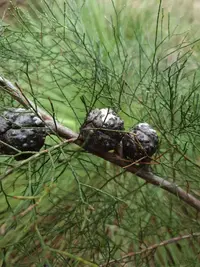
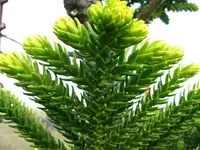
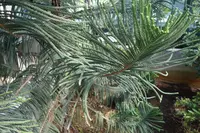
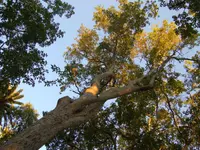
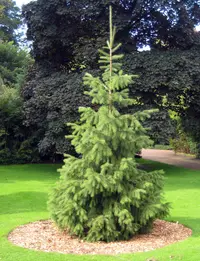
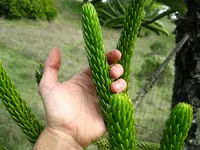
Mueller's araucaria (Araucaria muelleri) is an evergreen conifer tree from New Caledonia, related to the more familiar Norfolk Island pine. It forms a tall, upright trunk with regularly whorled branches and fine, scale-like leaves that create a refined, architectural look.
In nature it grows in coastal and montane forests, often on poor, rocky soils, and can become a large landscape tree in mild, frost-free climates. Growth is moderate but steady, and the species prefers bright light, even moisture, and well-drained soil, which shapes how to care for Mueller's araucaria in gardens or collections.
It is not usually considered a beginner plant outdoors, as it needs space and suitable climate, but container-grown young plants are manageable with consistent conditions.

Care Difficulty
Moderate Care

Light Preference
Full Sun

Water Requirements
Moderate Water

Temperature Preference
Tropical / Frost Sensitive

Hardiness Zone
11–12

Soil Texture
Sandy, Loamy, Organic-rich

Soil pH
Acidic (5.5–6.5), Slightly acidic (6.5–7.0)

Soil Drainage
Well-drained

Fertilization
Minimal (feed rarely)
Scan your plant to receive care tips personalized for your specific plant
Available on iOS and Android
This species prefers bright, gentle light that mimics an open, high-canopy forest edge.
Araucaria muelleri prefers steadily moist but not saturated soil, especially while young and establishing.
This conifer favors mild, frost-free conditions with stable seasonal temperatures.
This species prefers moderate, stable humidity and reacts if air stays very dry.
This conifer prefers airy, fast-draining, slightly acidic growing media.
This species adapts reasonably well to container growing when given a stable, well-balanced setup.
This species grows slowly and needs only modest feeding, especially when grown in containers as Mueller's araucaria indoor care focuses on avoiding excess nutrients.
Araucaria muelleri needs minimal pruning, focused on safety and maintaining a natural, symmetrical outline.
This species is usually grown in the ground, so focus on careful transplanting of young trees and gradual container shifts if potted.
Propagation of Araucaria muelleri is specialized and most home growers rely on nursery-raised plants rather than home methods.
This subtropical conifer dislikes hard freezes and needs thoughtful winter care in regions with cold winters.

Plant Health Check
Not sure what's wrong with your plant? Check your plant's health inside the app.
This species is naturally restricted to New Caledonia and grows almost exclusively on ultramafic soils, which are metal-rich, nutrient-poor substrates that many other trees cannot tolerate.
Conservation assessments list this tree as Critically Endangered due to its very limited distribution, habitat degradation, and the impacts of mining activities within its native range.
In the wild it occurs in a small area of low to mid-elevation coastal hills and mountains in southern New Caledonia, forming scattered stands rather than extensive continuous forests.
Genetic and morphological studies indicate that this species is part of a radiation of Araucaria in New Caledonia that represents one of the most diverse centers of evolution for the entire family Araucariaceae, making it important for understanding conifer evolution in the Southern Hemisphere.
Growth is slow to moderate. Young trees may add about 15–30 cm per year under suitable outdoor conditions, often less in containers. Good light, consistent moisture, and adequate root space are key factors influencing growth rate when you grow Araucaria muelleri.
Keep your plants happy and healthy with plant identification, disease detection, and easy care guidance.