Early structural training
While the plant is young, rotate the container by 90° every 2–3 weeks so light hits all sides evenly, which helps maintain a straight central leader and balanced branch tiers instead of leaning toward one direction.


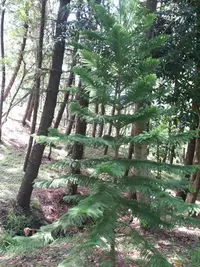
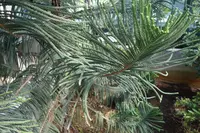
Narrow-leaf araucaria (Araucaria subulata) is a slow-growing, evergreen conifer with a tall, columnar form and dense, narrow branches. Its short, pointed leaves create a fine, textured look compared with the broader foliage of Norfolk Island pine. This species is native to New Caledonia, where it grows in coastal and montane habitats with mild, humid conditions. In cultivation it suits bright, cool indoor spaces or mild outdoor climates, but needs room to develop its upright structure over time. It is moderately demanding, as it dislikes drying out, sudden temperature swings, and cramped roots. Understanding how to care for Narrow-leaf araucaria helps keep its growth steady and its foliage dense.

Care Difficulty
Moderate Care

Light Preference
Full Sun

Water Requirements
Moderate Water

Temperature Preference
Warm Climate

Hardiness Zone
10–11

Soil Texture
Sandy, Loamy, Organic-rich

Soil pH
Acidic (5.5–6.5), Slightly acidic (6.5–7.0)

Soil Drainage
Well-drained

Fertilization
Minimal (feed rarely)
Scan your plant to receive care tips personalized for your specific plant
Available on iOS and Android
This species prefers bright, indirect light with some direct sun but is sensitive to extremes.
Watering should keep the root zone evenly moist but never saturated.
This conifer prefers mild, frost-free conditions with stable temperatures.
This species tolerates a wide range of household humidity but benefits from slightly moist air.
Araucaria subulata prefers a loose, well-drained, slightly acidic to neutral substrate that stays evenly moist but never waterlogged.
This species can be grown in containers if the pot is chosen and managed for its deep, upright root system.
This species grows slowly and needs only light, periodic feeding in containers or poor soils.
Araucaria subulata needs minimal pruning, mainly to maintain safety and structure.
This species is usually grown in the ground, with container plants or young trees transplanted infrequently to limit stress.
Propagation of Araucaria subulata is possible but slow and usually reserved for specialist growers.
This warm-climate conifer dislikes hard frost and benefits from basic winter protection in cooler regions.

Plant Health Check
Not sure what's wrong with your plant? Check your plant's health inside the app.
This species is naturally restricted to New Caledonia, where it grows on ultramafic soils that are rich in heavy metals and poor in nutrients, a substrate that many plants cannot tolerate.
In its native habitat the tree forms an unusually slender, tower-like crown with tightly packed, upward-pointing branch whorls, making it more columnar than many related Araucaria species.
Its female cones are serotinous, meaning they often remain closed on the tree until they dry and weather, then release seeds gradually rather than all at once.
Araucaria subulata is part of an ancient Gondwanan lineage, and New Caledonia is considered a refugium where this and several related Araucaria species survived while their relatives disappeared from many other continents.
This species can be grown indoors when young, as a container accent or architectural focal point. It needs bright light, cool to mild room temperatures, and space for its upright, symmetrical form as it slowly becomes tree-sized.
Keep your plants happy and healthy with plant identification, disease detection, and easy care guidance.