Encourage multi-stem form
Lightly tip-prune very young shoots once after establishment to encourage a low, multi-stem structure that better resists strong winds and reduces risk of limb breakage as the shrub matures.

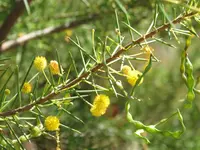
Dead finish, Acacia tetragonophylla, is a dense, spiny shrub or small tree native to arid inland regions of Australia. It typically forms a tangled, thorny thicket with narrow, four-angled stems instead of soft leaves.
This species is adapted to extreme heat, drought, and poor soils, which makes it tough in dry landscapes but slow-growing. Its hardiness can simplify how to care for dead finish in low-rainfall areas, provided drainage is excellent.
The plant prefers full sun, dry to very dry conditions, and coarse, well-drained soil, similar to its natural desert and scrub habitats.

Care Difficulty
Moderate Care

Light Preference
Full Sun

Water Requirements
Low Water

Temperature Preference
Warm Climate

Hardiness Zone
9–11

Soil Texture
Sandy, Loamy, Rocky

Soil pH
Slightly acidic (6.5–7.0), Slightly alkaline (7.0–7.5)

Soil Drainage
Well-drained

Fertilization
Minimal (feed rarely)
Scan your plant to receive care tips personalized for your specific plant
Available on iOS and Android
Acacia tetragonophylla prefers strong, direct sun typical of arid landscapes.
This desert shrub is adapted to very dry conditions and needs infrequent deep watering.
This species thrives in hot, dry climates and tolerates significant heat once established.
This arid-adapted species grows best in low to moderate humidity and rarely needs special humidity management.
This species prefers very well-drained, low-organic, sandy soil that mimics its native desert and semi-arid habitats.
This species can be grown in containers, mainly for young plants or in regions outside its hardiness range.
Acacia tetragonophylla, or dead finish, needs minimal fertilization when grown in the ground on lean, well-drained soils.
Pruning for Acacia tetragonophylla is mainly light structural and hygiene work rather than heavy reshaping.
This species is usually grown in the ground, so care focuses on careful transplanting rather than frequent repotting.
Propagation of Acacia tetragonophylla is most reliable from seed, with some pretreatment to improve germination.
This arid-climate shrub is best suited to mild, frost-free or light-frost regions and usually needs little winter attention in such areas.

Plant Health Check
Not sure what's wrong with your plant? Check your plant's health inside the app.
This species develops distinctive green, four-angled branchlets that function like leaves and end in sharp spines, an adaptation that reduces water loss in arid environments.
Dead finish is naturally distributed across some of the driest inland regions of Australia, where it survives on very low and irregular rainfall due to its deep root system and reduced leaf surface.
The dense, spiny canopy of this shrub provides important shelter for small birds and animals in open, arid landscapes, offering protection from predators and extreme temperatures.

In parts of inland Australia, the extremely hard, durable wood of dead finish has been traditionally valued for making tool handles and fence posts because it resists decay even under harsh, dry conditions.
Growth is slow to moderate. Young plants often add about 10–20 cm per year, sometimes less in very dry years. Once established, it focuses more on forming dense, woody branches than on rapid height gain.
Keep your plants happy and healthy with plant identification, disease detection, and easy care guidance.