Trunk coloration management
Ensure the trunk base is not shaded by dense groundcovers or low shrubs so the distinctive green-and-white bark develops full color and stays dry enough to reduce moss and lichen buildup.

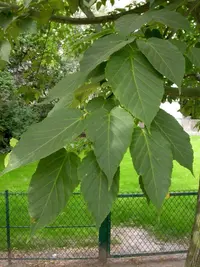
Père David's maple, Acer davidii, is a small to medium deciduous tree known as one of the snakebark maples. It typically has an upright, rounded crown and graceful, arching branches.
Its most distinctive feature is the smooth green bark marked with pale vertical stripes, which adds interest even in winter. Leaves are simple, oval, and turn yellow to orange in autumn.
This species is native to forested mountain regions of central China, where it grows in cool, moist habitats. It is generally considered a moderate-demand ornamental tree, needing consistent moisture, shelter from harsh heat, and fertile, well-drained soil.
Gardeners who learn how to care for Père David's maple usually find it reliable in temperate climates with mild summers.

Care Difficulty
Moderate Care

Light Preference
Partial Shade

Water Requirements
Moderate Water

Temperature Preference
Cold Hardy

Hardiness Zone
5–7

Soil Texture
Loamy, Clay, Organic-rich

Soil pH
Acidic (5.5–6.5), Slightly acidic (6.5–7.0)

Soil Drainage
Moist but well-drained

Fertilization
Minimal (feed rarely)
Scan your plant to receive care tips personalized for your specific plant
Available on iOS and Android
Acer davidii prefers bright, gentle light that mimics an open woodland edge.
This maple prefers evenly moist, well-drained soil that never stays waterlogged.
This species is a hardy, cool-temperate tree with good tolerance to winter cold.
This maple prefers moderate outdoor humidity but tolerates typical temperate climates well.
Acer davidii performs best in deep, moist, well-aerated soil that stays evenly damp but not saturated.
This species can be grown in containers for several years, especially when young or in compact forms.
Acer davidii benefits from modest feeding to support steady growth, especially in young trees.
Pruning Acer davidii is mainly about maintaining structure and removing problem wood rather than heavy shaping.
Père David's maple is usually grown in the ground, so focus on careful transplanting of young trees rather than frequent repotting.
Propagation of Acer davidii is possible but more technical and slower than many garden shrubs.
Established Acer davidii trees are cold hardy in much of the US and usually need minimal winter care.

Plant Health Check
Not sure what's wrong with your plant? Check your plant's health inside the app.
Acer davidii belongs to the snakebark maples, with smooth green bark marked by narrow vertical white to pale stripes that remain conspicuous even on older trunks, making it ornamental year-round.
Unlike many maples that bloom very early in spring, Acer davidii tends to flower later, often after leaf-out, producing small yellowish-green flowers that are important nectar sources for early pollinating insects.
This species crosses readily with other snakebark maples, such as Acer capillipes and Acer rufinerve, and some cultivated trees in collections are suspected hybrids rather than pure Acer davidii.

The species was first described from plant material collected in central China in the 19th century and introduced to European horticulture by the French missionary and naturalist Armand David, after whom both the species and the common name Père David's maple are named.
This species is moderately fast-growing when young, often adding 30–60 cm of height per year, then slowing as it matures. Growth rate improves with consistent moisture, fertile soil, and shelter from strong, drying winds.
Keep your plants happy and healthy with plant identification, disease detection, and easy care guidance.