Wind‑firm training
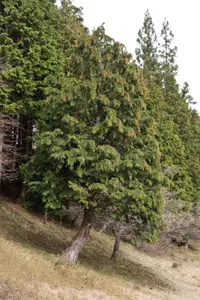
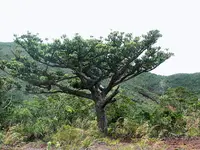
In the first 2–3 years, lightly stake young trees and gradually loosen ties every 6–12 months so the trunk flexes in wind and develops a strong taper instead of remaining weak and top‑heavy.

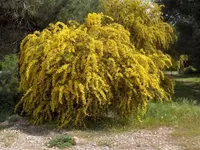
Orange wattle (Acacia saligna) is a fast-growing evergreen shrub or small tree from southwestern Australia. It is often used for shelterbelts, erosion control, and quick landscape cover.
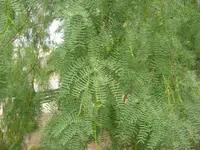
Plants form a dense, spreading canopy with long, narrow, drooping leaves and abundant golden-yellow flower balls in late winter or spring. The overall habit is graceful but can become untidy without management.
Acacia saligna adapts to poor, sandy, or coastal soils and tolerates drought once established, which makes it relatively easy to grow in suitable climates. Understanding how to care for orange wattle starts with providing full sun, well-drained soil, and enough space for its vigorous growth.

Care Difficulty
Easy Care

Light Preference
Full Sun

Water Requirements
Low Water

Temperature Preference
Warm Climate

Hardiness Zone
9–11

Soil Texture
Sandy, Loamy, Rocky

Soil pH
Slightly acidic (6.5–7.0), Slightly alkaline (7.0–7.5)

Soil Drainage
Well-drained

Fertilization
Minimal (feed rarely)
Scan your plant to receive care tips personalized for your specific plant
Available on iOS and Android
Acacia saligna thrives in bright, open sites with strong sun exposure.
Acacia saligna prefers dry to moderately moist conditions and is highly drought tolerant once established.
This species is adapted to warm, dry climates and dislikes prolonged cold or frost.
Humidity is not a critical factor for orange wattle, which adapts well to dry outdoor air in most climates.
Acacia saligna prefers lean, sandy, sharply drained soil and is sensitive to waterlogged conditions.
This species can be grown in large outdoor containers, mainly as a temporary or space-limited solution.
Acacia saligna grows in poor soils and usually needs only light feeding, especially when cultivated as orange wattle in gardens.
Pruning Acacia saligna helps manage size, maintain structure, and keep the canopy healthy.
Acacia saligna is usually grown in the ground, so transplanting young plants at the right time is more important than frequent repotting.
Acacia saligna is most often propagated from seed, which allows many uniform young plants for landscape use.
Acacia saligna is suited to mild-winter climates and is not fully hardy in regions with prolonged freezes.

Plant Health Check
Not sure what's wrong with your plant? Check your plant's health inside the app.
This fast-growing Australian shrub or small tree changes its form dramatically depending on conditions, staying low and shrubby in poor, dry sites but forming taller, single-stemmed trees in deeper, moister soils.
Acacia saligna forms nodules on its roots with nitrogen-fixing bacteria, allowing it to colonize nutrient-poor sandy soils and improve them for later plant communities.
Introduced for dune stabilization, shade, and fodder, this species has become a serious invasive plant in Mediterranean-climate regions such as South Africa, where it displaces native vegetation and alters fire regimes.

In its native southwestern Australia, Acacia saligna shows marked genetic and morphological variation between coastal, inland, and riverine populations, and some authorities consider that this complex diversity may warrant splitting it into several closely related taxa rather than treating it as a single uniform species.
Lack of flowers usually relates to insufficient light, pruning at the wrong time, or nutrient imbalance, especially excess nitrogen. Age also matters, as young plants may need several seasons before reliable flowering develops.
Keep your plants happy and healthy with plant identification, disease detection, and easy care guidance.