Root-zone aeration
Install a few coarse vertical drainage tubes (PVC or perforated pipe filled with gravel) around the planting hole to keep the root zone well aerated and reduce the risk of root diseases in heavy or compacted soils.

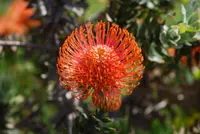
Red pincushion-protea, Leucospermum cordifolium, is an evergreen shrub from the Proteaceae family, native to South Africa’s coastal and mountain regions. It forms a rounded, bushy shape with leathery leaves.
The plant is known for its spherical flower heads with long, radiating styles that resemble pins in a pincushion, usually in shades of red, orange, or yellow. These long-lasting blooms are popular in cut flower arrangements.
Leucospermum cordifolium prefers poor, sandy, very well-drained soil and does not tolerate heavy fertilizing or waterlogged conditions. Its need for strong light, low-nutrient soil, and good air movement means it can be challenging to care for red pincushion-protea in humid or poorly drained sites.

Care Difficulty
Hard Care

Light Preference
Full Sun

Water Requirements
Low Water

Temperature Preference
Warm Climate

Hardiness Zone
9–11

Soil Texture
Sandy, Loamy, Rocky

Soil pH
Strongly acidic (4.5–5.5), Acidic (5.5–6.5)

Soil Drainage
Well-drained

Fertilization
Minimal (feed rarely)
Scan your plant to receive care tips personalized for your specific plant
Available on iOS and Android
This shrub needs strong, direct light to flower well and stay compact.
This plant prefers infrequent, deep watering in sharply drained, low-nutrient soil.
This species thrives in mild, frost-free climates with moderate, stable temperatures.
This shrub prefers relatively dry air and usually does not need humidity adjustment outdoors.
This species needs very free-draining, low-nutrient soil to avoid root disease.
This species can be grown in containers only if excellent drainage and air pruning of roots are provided.
Leucospermum cordifolium is highly sensitive to excess nutrients, so feeding must be minimal and very low in phosphorus.
Pruning helps maintain the structure and flowering performance of Leucospermum cordifolium.
This species is usually grown in the ground, so focus on careful transplanting rather than frequent repotting.
Leucospermum cordifolium is most commonly propagated from semi-hardwood cuttings, with seeds used mainly by specialists.
Winter care focuses on avoiding prolonged frost and cold, wet soil around the roots.

Plant Health Check
Not sure what's wrong with your plant? Check your plant's health inside the app.
This species is native to the winter-rainfall fynbos of South Africa’s Western Cape, where it has adapted to extremely nutrient-poor, acidic, sandy soils that would stress many other ornamentals.
Mature shrubs are often killed by wildfire, but their seeds survive in the soil seed bank and germinate in the nutrient flush and open light that follow the burn, a typical strategy in fire-prone fynbos ecosystems.
Its bright pincushion flowerheads are mainly pollinated by sunbirds and sugarbirds, which brush against the protruding styles as they drink nectar, transferring pollen between plants over relatively long distances.

In its native range, this species often relies on native ants to carry its nutrient-rich, oil-bearing seeds underground, where they are protected from predators and fire until conditions are suitable for germination, an interaction known as myrmecochory.
Lack of flowers usually comes from plants being too young, pruned too hard, or stressed by poor drainage or excess fertilizer. Avoid high-phosphorus feeds, keep roots undisturbed, and allow several seasons to establish before expecting full flowering.
Keep your plants happy and healthy with plant identification, disease detection, and easy care guidance.