Offset management
Once pups reach about 1/3–1/2 the height of the mother rosette and have their own roots, detach them with a clean, sharp knife and pot them separately to maintain a compact clump and encourage continuous flowering cycles.

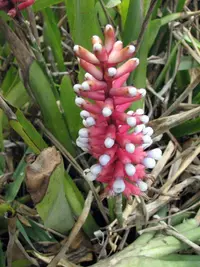
Matchstick bromeliad (Aechmea gamosepala) is a compact epiphytic bromeliad valued for its colorful flower spikes and tidy rosette of arching leaves. It naturally occurs in the Atlantic forests of Brazil, where it often grows on trees in warm, humid conditions.
The plant forms a funnel-shaped center that can hold water and produces dense spikes of pink bracts with blue tips that resemble match heads. Its slow to moderate growth, tolerance of indoor conditions, and modest care needs make it suitable for many homes.
It prefers bright, indirect light, airy potting mixes, and regular but not excessive moisture, which simplifies how to care for matchstick bromeliad for beginners and intermediate growers.

Care Difficulty
Easy Care

Light Preference
Bright Indirect Light

Water Requirements
Moderate Water

Temperature Preference
Tropical / Frost Sensitive

Hardiness Zone
10–11

Soil Texture
Sandy, Loamy, Organic-rich

Soil pH
Acidic (5.5–6.5), Slightly acidic (6.5–7.0)

Soil Drainage
Well-drained

Fertilization
Light (every 4–6 weeks)
Scan your plant to receive care tips personalized for your specific plant
Available on iOS and Android
This species prefers bright, indirect light that mimics the dappled shade of tree canopies.
Watering focuses on both the central cup and the surrounding soil without keeping either stagnant or bone-dry for long periods.
This plant favors warm, frost-free conditions with stable temperatures across the year.
This bromeliad handles typical home humidity but benefits from slightly moist air.
This species prefers a loose, airy, fast-draining mix similar to an epiphytic orchid medium.
This species grows very well in containers and adapts easily to pot culture.
This bromeliad benefits from light, consistent feeding during its active growing season.
Pruning needs for Aechmea gamosepala are minimal and focus on cleanliness and removing spent growth.
This bromeliad grows slowly and usually needs repotting only when the clump outgrows its container.
New plants are most commonly produced from pups rather than from seed in this species.
This bromeliad is frost sensitive and needs protection in regions with cold winters.

Plant Health Check
Not sure what's wrong with your plant? Check your plant's health inside the app.
Its inflorescences carry dozens of small tubular flowers with bright blue tips and pink bracts, which creates the distinctive matchstick appearance that gives the plant its common name.
The stiff, arching leaves form a tight central tank that naturally collects rainwater and organic debris, an adaptation that allows the plant to absorb nutrients and moisture from the water stored between its leaf bases.
Unlike many tropical bromeliads that demand constant warmth, this species tolerates relatively cool conditions and brief drops close to 40°F, which makes it more adaptable in subtropical gardens and unheated spaces.

In its native habitats of southern Brazil, Uruguay, and Paraguay, this species often grows as an epiphyte on trees and rocks, where its water-filled leaf tanks can provide small microhabitats for insects and other invertebrates.
Lack of flowering usually comes from insufficient light, a plant that is still immature, or old, exhausted rosettes. Stable warmth, bright but indirect light, and light feeding help, as do offsets maturing undisturbed for 1–3 years.
Keep your plants happy and healthy with plant identification, disease detection, and easy care guidance.