Optimize air movement
Place plants where they receive gentle, constant air movement from a ceiling or oscillating fan to help foliage dry quickly after misting and reduce fungal and bacterial issues.

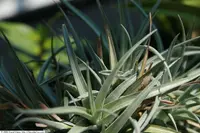
Tillandsia ixioides is a small epiphytic air plant from the drier regions of South America, where it often grows on rocks or tree branches. It belongs to the bromeliad family and absorbs water and nutrients mainly through its leaves rather than roots.
Plants form tight rosettes of stiff, narrow, silvery leaves and can produce showy yellow flowers on short stalks. The silvery color comes from tiny scales on the leaves that help the plant reflect strong sun and capture moisture from the air.
These adaptations make it relatively forgiving in indoor conditions and suitable for those learning how to care for Tillandsia ixioides, provided it receives bright light, good air movement, and regular, moderate misting or soaking.

Care Difficulty
Moderate Care

Light Preference
Partial Sun

Water Requirements
Low Water

Temperature Preference
Warm Climate

Hardiness Zone
10–12

Soil Texture
Rocky, Sandy

Soil pH
Slightly acidic (6.5–7.0), Neutral (7.0)

Soil Drainage
Well-drained

Fertilization
Minimal (feed rarely)
Scan your plant to receive care tips personalized for your specific plant
Available on iOS and Android
This species thrives in bright, dry conditions that mimic high-elevation grasslands and rocky habitats.
Watering should keep the plant hydrated without staying wet for long periods.
Temperature should follow a warm, frost-free pattern similar to its native South American habitats.
This species prefers bright, airy conditions with moderate humidity rather than constant dampness.
This epiphytic air plant does not need conventional soil and should never be buried in potting mix.
This plant can be displayed in containers as long as they provide full air circulation and do not hold water around the base.
Light feeding supports growth in Tillandsia ixioides but the plant stays healthy with modest nutrition.
Pruning needs are minimal and focus on hygiene rather than shaping the plant.
Transplanting Tillandsia ixioides usually means remounting rather than traditional repotting in soil.
Propagation is most reliable by division of offsets formed around the mother plant.
This species dislikes hard frost and benefits from simple protective measures in cold climates.

Plant Health Check
Not sure what's wrong with your plant? Check your plant's health inside the app.
This species naturally grows on exposed rocks and steep cliffs in parts of Argentina, Bolivia, Paraguay, and Uruguay, where it experiences intense sun, wind, and rapid drying after rain.
Its leaves are densely covered with silvery trichomes, specialized scale-like hairs that allow rapid water uptake from fog and brief showers while also reflecting strong sunlight in its open habitats.
It produces relatively small, yellow tubular flowers that are often fragrant, attracting flying pollinators such as bees in its native range despite the harsh, open conditions it occupies.

In some highland populations this species forms dense cushions on rock faces, creating microhabitats that trap organic dust and moisture, which in turn support small invertebrates and other epiphytic organisms that could not colonize the bare rock alone.
Lack of blooms usually relates to insufficient light intensity, too little air movement, or irregular nutrition. Provide bright conditions, good airflow, and occasional low-dose epiphyte fertilizer. Stable conditions over time encourage flowering in mature plants.
Keep your plants happy and healthy with plant identification, disease detection, and easy care guidance.