Mounting technique
Attach plants to a small cork slab or fern bark using sphagnum moss and soft ties, then grow the mount in a pot or basket so roots can extend into a coarse orchid mix for better aeration and stability.

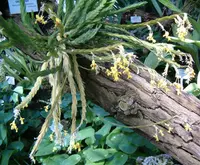
Lockhartia oerstedii is a small epiphytic orchid that naturally grows on trees in humid tropical forests of Central and South America. It forms flattened, overlapping leaf stems that look a bit like braided or fern-like chains.
The plant produces small, yellow to greenish flowers along these zigzag stems, giving it a delicate, textured look rather than a single showy bloom. Its compact size suits terrariums, orchid cases, and bright indoor spots with stable humidity.
This species prefers gentle, filtered light, regular moisture with good air flow, and a loose, airy orchid medium. With stable conditions, it is not difficult to care for Lockhartia oerstedii.

Care Difficulty
Hard Care

Light Preference
Bright Indirect Light

Water Requirements
Keep Soil Moist

Temperature Preference
Tropical / Frost Sensitive

Hardiness Zone
12–13

Soil Texture
Peaty, Organic-rich, Loamy

Soil pH
Acidic (5.5–6.5)

Soil Drainage
Moist but well-drained

Fertilization
Light (every 4–6 weeks)
Scan your plant to receive care tips personalized for your specific plant
Available on iOS and Android
This orchid prefers bright, filtered light that mimics dappled forest conditions.
Watering should keep the roots evenly moist but never stagnant.
This species prefers intermediate to warm, stable temperatures with no frost exposure.
This orchid prefers consistently moist air and reacts quickly to very dry conditions.
Lockhartia oerstedii thrives in a loose, airy epiphytic mix rather than dense potting soil.
This species is well suited to container culture, including baskets and small orchid pots.
This orchid benefits from light, regular feeding during active growth for balanced Lockhartia oerstedii plant care.
Pruning focuses on hygiene and gentle shaping rather than heavy cutting on Lockhartia oerstedii.
This orchid prefers snug conditions but benefits from timely repotting to keep the medium fresh.
Propagation of Lockhartia oerstedii is usually done by careful division of mature clumps.
This tropical orchid has low cold tolerance and needs stable indoor conditions in winter.

Plant Health Check
Not sure what's wrong with your plant? Check your plant's health inside the app.
This orchid’s flattened, overlapping leaves grow in two ranks along the stem and resemble tiny roof shingles, an adaptation that helps shed excess water and intercept dappled forest light in its native Central American habitats.
It has slender pseudobulbs that store some water and nutrients and produce fine, branching roots adapted to cling tightly to bark, reflecting its life as an epiphyte attached to tree trunks and branches.
Its yellow, often brown-marked flowers typically appear in succession along the inflorescence rather than all at once, extending the overall flowering period in the wild and improving chances of successful pollination.

This species is part of a small orchid genus often called braid orchids because the tightly imbricated leaves can resemble woven plant material, and L. oerstedii is one of the better-known representatives used to help botanists interpret leaf evolution in this unusual group.
Lack of blooms usually relates to insufficient light, too little temperature difference between day and night, or recent repotting. Avoid heavy root disturbance, keep it slightly snug in its pot, and provide a mild cooler night period.
Keep your plants happy and healthy with plant identification, disease detection, and easy care guidance.