Resting period management
Allow the plant a marked dry rest once foliage dies back, keeping the pot just barely dry and stored cool and bright, which helps the rhizomes reset and flower more reliably the next season.

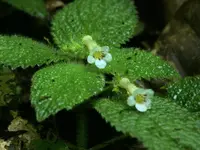
Diastema affine is a small, tuberous perennial from the Gesneriaceae family, related to African violets. It typically forms low clusters of soft, opposite leaves and delicate tubular flowers. In cultivation it is valued for its compact habit and attractive blooms, often used in pots or specialized collections. The plant naturally occurs in humid, shaded forests of Central and South America, where it grows in leaf litter and well-drained, rich soils. Its need for stable warmth, moisture, and protection from strong light makes it more suitable for growers who already know how to care for Diastema affine or similar tropical understory plants.

Care Difficulty
Moderate Care

Light Preference
Partial Shade

Water Requirements
Regular Water

Temperature Preference
Tropical / Frost Sensitive

Hardiness Zone
Unknown

Soil Texture
Loamy, Peaty, Organic-rich

Soil pH
Acidic (5.5–6.5)

Soil Drainage
Moist but well-drained

Fertilization
Light (every 4–6 weeks)
Scan your plant to receive care tips personalized for your specific plant
Available on iOS and Android
This understory gesneriad prefers bright, filtered light that mimics light on a forest floor.
Watering should keep the root zone consistently moist but never saturated.
Stable, warm conditions support strong growth and flowering.
This species prefers moderately moist air and reacts if kept too dry for long periods.
Diastema affine grows best in a loose, organic-rich medium that stays evenly moist yet drains freely.
This species is well suited to container growing, especially for controlled moisture and protection from cold.
Moderate feeding supports compact growth and flowering in Diastema affine when grown in containers or depleted substrates.
Light pruning helps maintain shape and flowering quality in Diastema affine.
Container-grown Diastema affine benefits from thoughtful repotting to avoid root stress and maintain vigor.
Propagation of Diastema affine is usually done from cuttings or seed under warm, stable conditions.
Diastema affine is not frost tolerant and needs careful winter management in climates with cold seasons.

Plant Health Check
Not sure what's wrong with your plant? Check your plant's health inside the app.
This species is native to humid lowland forests of Central and South America, where it grows as a small understory herb in shaded, leaf-litter rich sites along slopes and stream edges.
Diastema affine forms underground tubers that allow it to retreat during less favorable conditions and resprout, a strategy common in the Gesneriaceae that helps it survive seasonal changes in moisture and light.
Its tubular, often bicolored flowers are typical of the Gesneriaceae family and are adapted for pollination by specialized visitors such as hummingbirds or certain insects that can access nectar deep in the corolla tube.
Lack of flowers usually comes from insufficient light, too little seasonal temperature change, or nutrient imbalance. Provide bright but indirect light, a slight dry rest after flowering, and balanced fertilizer to support bud formation and repeat bloom.
Keep your plants happy and healthy with plant identification, disease detection, and easy care guidance.