


Optimize mounting surfaces
Attach plants to hard, non-porous materials like cork bark, hardwood, or plastic-coated wire mesh so they dry quickly after misting and avoid rot in the leaf bases.

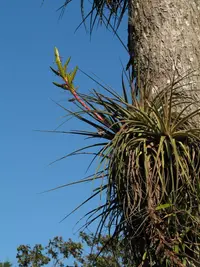
Tillandsia rodrigueziana is a small epiphytic air plant that grows without soil, anchoring itself on trees or other rough surfaces. It forms soft, arching rosettes of narrow, silvery-green leaves.
This species is native to Central America, where it absorbs moisture and nutrients from humid air and rain through specialized leaf scales. It usually produces tubular flowers on a short spike when mature.
Its compact size, slow growth, and tolerance of indoor conditions make it suitable for beginners, as long as light and airflow are adequate. Understanding how to care for Tillandsia rodrigueziana mainly involves providing bright indirect light, good air movement, and regular moisture without waterlogging the base.

Care Difficulty
Moderate Care

Light Preference
Bright Indirect Light

Water Requirements
Moderate Water

Temperature Preference
Tropical / Frost Sensitive

Hardiness Zone
10–12

Soil Texture
Rocky, Sandy, Organic-rich

Soil pH
Acidic (5.5–6.5)

Soil Drainage
Well-drained

Fertilization
Light (every 4–6 weeks)
Scan your plant to receive care tips personalized for your specific plant
Available on iOS and Android
This species thrives in bright, indirect light that mimics its native canopy habitat.
This air plant needs thorough wetting followed by complete drying of the leaves between waterings.
This epiphytic bromeliad prefers warm, frost-free conditions with moderate seasonal variation.
This epiphytic air plant needs consistently moderate to high humidity to stay hydrated and healthy.
This species does not grow in traditional soil and instead needs a mount or very loose, airy support.
This air plant can be displayed in containers as long as air circulation and rapid drying are maintained.
Feeding is helpful but light for Tillandsia rodrigueziana, since it absorbs nutrients mainly through its leaves.
Pruning needs are minimal and focus on hygiene and shaping rather than strict size control for Tillandsia rodrigueziana.
This air plant is usually mounted rather than potted, so transplanting focuses on refreshing its support rather than managing roots.
Propagation of Tillandsia rodrigueziana is commonly done by separating offsets rather than raising new plants from seed.
This air plant dislikes prolonged cold and needs sheltered winter conditions in most climates.

Plant Health Check
Not sure what's wrong with your plant? Check your plant's health inside the app.
This epiphytic air plant is naturally concentrated in moist pine–oak forests of Chiapas and nearby regions, where it often anchors on rough limestone cliffs and exposed tree branches rather than deep forest interiors.
It forms compact rosettes rarely exceeding a few cm across, with stiff, upward-curving leaves that create a small, spherical clump adapted to intercept light and moisture in bright but breezy mountain habitats.
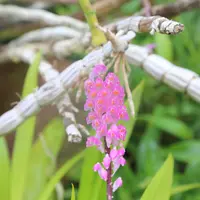
Mature plants produce short but conspicuous pink bracts that hold tubular white to pale-colored flowers, which are visited by small pollinators in its native range in southern Mexico and Central America.
This species usually needs to be fully mature, receive bright filtered light, good air movement, and regular fertilizing with a very dilute bromeliad or air-plant fertilizer to bloom. Significant stress or frequent relocation often delays or prevents flowering.
Keep your plants happy and healthy with plant identification, disease detection, and easy care guidance.

Haworthia angustifolia
Haworthia angustifolia
Wispy umbrella orchid
Bulbophyllum gracillimum
 POPULAR
Golden Pothos
Epipremnum aureum
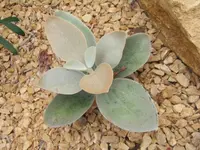
Copper Spoons
Kalanchoe orgyalis
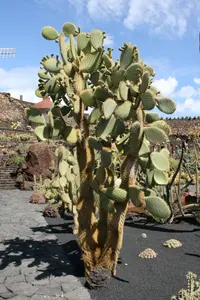
Galápagos Prickly Pear
Opuntia galapageia
Epidendrum fulgens
Epidendrum fulgens
Creeping pilea
Pilea nummulariifolia
Toothbrush orchid
Dendrobium secundum