Rotate Regularly
Gently rotate the balls every 1–2 weeks so all sides receive similar light exposure, which helps maintain a spherical, dense form instead of flattening on one side.

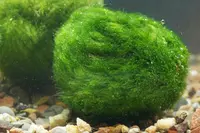
Cladophora Ball, also sold as marimo moss ball, is a form of the freshwater green alga Aegagropila linnaei. It naturally grows in cold lakes in Japan, Iceland, and parts of northern Europe, where currents roll it into dense, velvety spheres.
In home aquariums or small containers, it stays compact, slow-growing, and easy to manage. Its simple needs and tolerance for a range of water conditions make it suitable for beginners.
This alga prefers cool, clean water, gentle movement, and indirect light. Understanding how to care for Cladophora Ball helps keep it green, firm, and free from unwanted competing algae.

Care Difficulty
Easy Care

Light Preference
Partial Shade

Water Requirements
Aquatic

Temperature Preference
Cool Climate

Hardiness Zone
Unknown

Soil Texture
Organic-rich, Peaty

Soil pH
Slightly acidic (6.5–7.0), Neutral (7.0)

Soil Drainage
Waterlogged tolerant

Fertilization
Minimal (feed rarely)
Scan your plant to receive care tips personalized for your specific plant
Available on iOS and Android
This aquatic alga prefers low to moderate light and is easily damaged by strong sun.
This species lives fully submerged, so water quality and movement matter more than classic soil moisture.
This cold to cool-water alga prefers stable, moderate temperatures without sudden swings.
This aquatic alga does not rely on air humidity, as long as its tank water is stable and clean.
Aegagropila linnaei does not grow in soil; it anchors in or rolls over lake substrates but is kept in clean water in cultivation.
This species is very suitable for container culture in aquariums, jars, or bowls.
This aquatic alga needs very little feeding, as it absorbs nutrients directly from the water.
Pruning Aegagropila linnaei is minimal and mainly cosmetic, aimed at maintaining a compact, even shape.
This species is not repotted in the usual sense but may need its aquarium or container setup refreshed over time.
Propagation is slow and not always successful, but small divisions can form new balls under stable conditions.
Indoor-grown Cladophora Ball usually needs only stable, cool-to-room-temperature water during winter.

Plant Health Check
Not sure what's wrong with your plant? Check your plant's health inside the app.
In calm, shallow lakes of northern Europe and Japan, this alga forms dense spherical mats as wave action slowly rolls and compacts loose filaments over time.
Individual spheres grow only a few millimeters per year, which is why wild populations can take decades to recover if heavily disturbed or collected.
Wild populations are strongly associated with cold, clear, low-nutrient lakes, where they act as habitat for small invertebrates and help stabilize bottom sediments.
In Japan’s Lake Akan, some colonies historically formed large, near-perfect green balls over 20–30 cm in diameter and became designated as a Special Natural Monument because of their rarity and cultural importance.
Growth is slow. In stable conditions it usually enlarges only a few millimeters per year, sometimes reaching golf-ball size after several years. Growth speed depends on light intensity, nutrient availability, water cleanliness, and stable, cool temperatures.
Keep your plants happy and healthy with plant identification, disease detection, and easy care guidance.