


Seasonal Rest Period
Allow the plant a drier, cooler rest in late fall–winter by slightly reducing water and avoiding repotting, which helps maintain a strong rosette structure for the next growth cycle when growing Cape Verde Tree Houseleek.

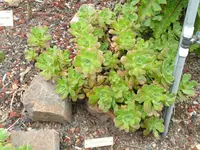
Aeonium gorgoneum, commonly called Cape Verde tree houseleek, is a shrubby succulent from the Cape Verde Islands off the West African coast. It forms branching stems topped with dense rosettes of fleshy, spoon-shaped leaves. Mature plants can look like small, architectural shrubs, often with a single main stem and side branches. Leaf color ranges from green to slightly reddish tones in strong light. As a succulent, it prefers bright exposure, moderate warmth, and well-drained, gritty soil. Its drought tolerance makes it relatively undemanding, but it dislikes prolonged cold and excessive moisture. Understanding how to care for Cape Verde Tree Houseleek mainly involves avoiding overwatering and giving it enough light.

Care Difficulty
Moderate Care

Light Preference
Full Sun

Water Requirements
Low Water

Temperature Preference
Tropical / Frost Sensitive

Hardiness Zone
10–11

Soil Texture
Sandy, Loamy, Rocky

Soil pH
Slightly acidic (6.5–7.0), Neutral (7.0)

Soil Drainage
Well-drained

Fertilization
Minimal (feed rarely)
Scan your plant to receive care tips personalized for your specific plant
Available on iOS and Android
This succulent prefers bright conditions that balance strong light with protection from harsh extremes.
Watering should support firm, plump rosettes while keeping the root zone airy and free‑draining.
Stable mild conditions support compact growth and reduce stress in this succulent shrub.
This succulent tolerates a wide humidity range and rarely needs special humidity control indoors.
Aeonium gorgoneum needs a mineral, sharply draining substrate to prevent root and stem rot.
This species is well suited to container growing when the pot is chosen to manage top weight and rapid drainage.
Aeonium gorgoneum benefits from light, occasional feeding during active growth but does not need heavy fertilization.
Pruning Aeonium gorgoneum is mainly used to keep plants tidy and control shape.
Aeonium gorgoneum in containers needs only infrequent repotting due to its modest root system.
Aeonium gorgoneum is most commonly propagated from stem cuttings taken during its active season.
Aeonium gorgoneum is tender and needs protection from freezing conditions in most climates.

Plant Health Check
Not sure what's wrong with your plant? Check your plant's health inside the app.
This species is naturally restricted to a few of the Cape Verde islands, where it grows on dry, rocky slopes exposed to strong sun and wind.
It forms compact leaf rosettes at the tips of branching, woody stems, creating a small, shrub-like structure rather than a single ground-hugging rosette.
In its native habitat it grows mainly during the cooler, slightly moister season and slows or partially sheds leaves in the driest months, an adaptation to limited and irregular rainfall.
Brown leaves usually result from underwatering, intense direct sun scorch, or old lower rosettes naturally aging and drying. Check soil moisture, light intensity, and airflow, then remove fully dry, crispy leaves to prevent trapped moisture and decay.
Keep your plants happy and healthy with plant identification, disease detection, and easy care guidance.

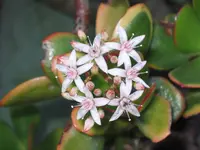
Crassula obovata
Crassula obovata
 POPULAR
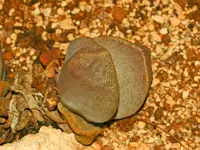
Splitrock Quaggafig
Pleiospilos nelii
 POPULAR
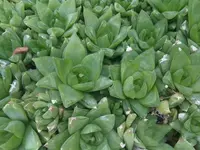
Cathedral Window Haworthia
Haworthia cymbiformis
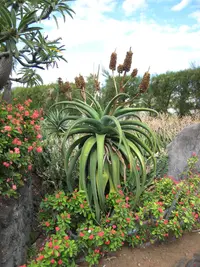
Malagasy Tree Aloe
Aloe vaombe
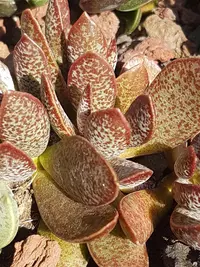
Adromischus trigynus
Adromischus trigynus
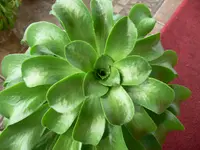
Viscid Houseleek
Aeonium glutinosum
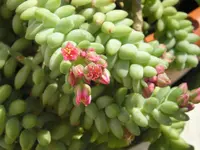 POPULAR
Burro's-tail
Sedum morganianum
Eriosyce curvispina
Eriosyce curvispina