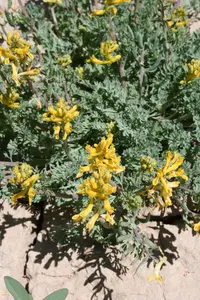
sensitive jointvetch Care (Aeschynomene sensitiva)

About sensitive jointvetch

Sensitive jointvetch, Aeschynomene sensitiva, is a small, fast-growing legume known for its finely divided leaves that fold when touched or disturbed. This touch response makes it visually similar to the more familiar sensitive plant, Mimosa pudica, though it is a different species.

It typically grows as a short-lived perennial or annual in warm, wet habitats, often along ponds, ditches, or rice fields in tropical and subtropical regions. Stems may be slightly woody at the base, with small yellowish flowers and a light, airy look.

Its preference for consistent moisture, warmth, and bright light can make it somewhat challenging indoors. Understanding how to care for sensitive jointvetch starts with recreating humid, sunlit, and evenly moist conditions without waterlogging the roots.

Main Plant Requirements

Care Difficulty

Moderate Care

Light Preference

Full Sun

Water Requirements

Aquatic

Temperature Preference

Tropical / Frost Sensitive

Hardiness Zone

10–11

Soil Texture

Sandy, Loamy, Silty

Soil pH

Acidic (5.5–6.5)

Soil Drainage

Waterlogged tolerant

Fertilization

Minimal (feed rarely)

Get Personalized Care Plan

Scan your plant to receive care tips personalized for your specific plant

Available on iOS and Android

How to Care for the sensitive jointvetch

This plant prefers bright, warm conditions similar to open, wet meadows.

  • Provide 4–6 hours of direct morning sun with light or filtered sun the rest of the day; avoid harsh, all-day exposure on dry sites.
  • Allow light partial shade, especially in hot summers, as sensitive jointvetch foliage can scorch under intense afternoon sun.
  • In cooler seasons, choose a location with maximum sun to support growth, but in midsummer consider slight shade to reduce leaf stress and moisture loss.

This species naturally grows in wet ground and needs consistently moist conditions.

  • Aim for soil that stays moist to the touch from surface to 5–8 cm depth, avoiding both cracking dryness and standing water on compacted clay.
  • Water when the upper 2–3 cm begin to feel less damp, increasing frequency during hot, windy periods and reducing slightly in cooler weather.
  • Watch for yellowing, soft stems as a sign of overwatering in poorly drained soil, and drooping or crisping leaflets as a sign of underwatering.

This warm-season species thrives in mild to hot conditions and reacts poorly to cold.

  • Provide an active growing range of 70–90°F (21–32°C), where Aeschynomene sensitiva shows fastest shoot and root growth.
  • Protect plants when temperatures approach 40°F (4°C), as tissue damage can occur near this point and death is likely with any frost.
  • In hot spells above 95°F (35°C), ensure ample soil moisture; high heat is tolerated if roots stay wet, but dry heat can stunt growth and brown the foliage.

This species prefers moderately humid air but adapts if moisture around the roots stays consistent.

  • Aim for ambient humidity around 50–70% for best foliage response and movement in sensitive jointvetch.
  • Crisping leaflet tips and slowed leaf movement often indicate air that is too dry or fluctuating sharply.
  • Increase humidity with nearby water trays, grouped plants, or a humidifier rather than misting, which adds only brief moisture.

Aeschynomene sensitiva grows best in consistently moist, airy, organic-rich soil that does not stay waterlogged.

  • Use a loose loam with high organic matter, such as 2 parts peat or coco coir, 1 part compost, and 1 part sand or fine grit for structure.
  • Ensure drainage is moderate, holding moisture yet allowing excess water to escape so roots receive enough oxygen.
  • Maintain soil pH roughly 6.0–7.0, where nutrients remain available and root nodules that fix nitrogen function efficiently.
  • Avoid compacted, heavy clay or mixes loaded with unmodified garden soil, which restrict aeration and promote root rot under constant moisture.

This species can be grown in containers if the pot supports its moisture needs and spreading habit.

  • Choose a wide, shallow container that allows surface roots and stems to spread without deep water accumulation.
  • Use a stable, heavier pot material if the plant becomes top-heavy when fully leafed out and responsive to touch.
  • Elevate the pot slightly on feet or a stand so drainage holes clear quickly and do not sit in residual saucer water.

This nitrogen-fixing legume needs only light feeding when grown in poor or soilless substrates, so overfertilization should be avoided for healthy sensitive jointvetch growth.

  • Use a balanced liquid fertilizer (around 10-10-10 or 20-20-20) diluted to 25–50% strength for container plants.
  • Feed every 4–6 weeks during the warm, active growing season if foliage looks pale or growth is weak.
  • Skip feeding in winter or dormancy, and reduce watering so roots are not forced to take up excess salts.
  • In rich garden soil, rely mainly on compost or not at all, as added nitrogen is rarely necessary.

Light pruning of Aeschynomene sensitiva maintains shape and removes weak growth without stressing the plant.

  • Carry out pruning in late spring or early summer, once new growth is clearly visible.
  • Remove dead, diseased, or storm-damaged stems first using clean, sharp hand pruners.
  • Thin crowded interior shoots to improve air flow and light penetration, encouraging balanced branching.
  • Lightly tip back excessively long stems to keep a compact form, avoiding heavy cuts into older wood.

This species is more often transplanted in garden settings than kept long term in containers, and it resents major root disturbance.

  • Plan transplanting for late spring or early summer, once soil is warm and frost risk has passed.
  • Look for signs such as roots circling the pot, water sitting on the surface, or noticeably slowed growth before moving a container plant.
  • Transplant with a wide root ball, disturbing roots as little as possible, and replant at the same depth in well-drained, moist soil.
  • Water thoroughly after planting, then keep soil evenly moist and shaded for 3–5 days to reduce transplant shock.

New plants of Aeschynomene sensitiva are most reliably raised from seed under warm, bright conditions.

  • Sow fresh seeds in late spring to early summer when temperatures reach 70–80°F.
  • Scarify hard seed coats lightly with sandpaper, then soak in warm water for 12–24 hours to improve germination.
  • Use a sterile, free-draining seed mix and barely cover seeds, keeping the medium evenly moist but not waterlogged.
  • Provide bright, indirect light and good air movement; transplant seedlings gently once roots hold the mix together.

This warmth-loving legume is frost sensitive and needs thoughtful winter care outside tropical or frost-free climates.

  • In regions with frost, treat outdoor plants as annuals or collect seed before cold weather.
  • Apply a light organic mulch around the root zone in mild climates to buffer short cool spells.
  • Move container plants indoors before temperatures fall below 50°F, placing them in bright, indirect light.
  • Keep winter soil slightly drier while maintaining above 55°F to limit stress and root rot risk.

Care Tips

Root zone mulching

Apply a thin 1–2 cm layer of fine bark or composted leaf mulch around the base to keep the shallow roots cool and evenly moist without burying the stem collar.

Gentle stem support

Use small, soft plant ties and low bamboo sticks to guide the flexible stems upright so they do not lodge or snap in wind or heavy rain.

Container edge shading

If grown in pots under strong sun, shade only the container sides with a cachepot or light-colored wrap to prevent root-zone overheating while keeping foliage fully lit.

Regular seed collection

Check the plant weekly as pods mature, and collect seed just as pods turn brown but before they split to maintain a steady supply for succession sowing.

Monitor nodulation sites

When repotting or dividing, look for small pinkish-white root nodules and avoid damaging them, since these nitrogen-fixing structures are important for Aeschynomene sensitiva care and overall vigor.

Common Pests and Diseases

Leaf-mining larvae

This pest tunnels inside the leaf tissue, creating pale, winding trails and causing premature yellowing and drop of the delicate leaflets. Damage is more visible on older, fully expanded leaves.

Solution

Remove and discard mined leaves as soon as they are noticed to break the life cycle. For heavier infestations, use a contact insecticide based on spinosad or neem on new growth and reduce nearby weedy hosts that can harbor leaf miners.

Spider mites

These insects thrive in hot, dry conditions and feed on the undersides of leaflets, causing fine speckling, dull foliage, and occasional webbing on stems and leaves. Symptoms include gradual leaf yellowing and reduced sensitivity of the leaflets to touch when stress is severe.

Solution

Rinse foliage thoroughly with a strong but gentle stream of water, paying attention to leaflet undersides, and increase ambient humidity around the plant. If populations persist, apply insecticidal soap or a neem-based spray every 5–7 days until new growth appears clean.

Bean pod borer

This pest attacks flowers and developing pods, boring into the tissues and causing aborted flowers, distorted pods, and seed loss. Frass and small entry holes can be seen on damaged pods.

Solution

Collect and destroy infested pods and spent flowers promptly to reduce larval development sites. Where the plant is grown outdoors, use fine mesh netting during peak moth activity and, if needed, apply a targeted biological product containing Bacillus thuringiensis (Bt) to flowers and young pods.

Powdery mildew

This disease appears as a white, powdery film on leaflets and young stems, often under warm, stagnant air conditions. Symptoms include reduced leaflet sensitivity, dull color, and early defoliation on heavily affected plants.

Solution

Improve air circulation, avoid overhead watering late in the day, and remove heavily infected leaves to limit spread. If conditions stay favorable for the disease, use a preventive fungicidal spray such as potassium bicarbonate or sulfur on both sides of the foliage, following label instructions.

Bacterial leaf spot

This disease causes small, water-soaked spots on leaflets that enlarge into brown or black lesions, sometimes with a yellow halo, leading to leaflet drop on stressed plants. Symptoms include irregular patches on the compound leaves and slower overall growth.

Solution

Avoid wetting the foliage, especially in the evening, and space plants so leaves dry quickly after rain or irrigation. Remove and discard affected leaves, disinfect cutting tools, and, in recurring outdoor cases, rotate the planting area and use clean seed or propagation material.

Interesting Facts

Rapid leaf movement

This species folds its leaflets and droops its fine stems within seconds after touch or vibration due to rapid changes in water pressure inside specialized hinge cells called pulvini, then reopens again after a short rest period.

Aquatic adaptation

It is naturally semi-aquatic and often grows rooted in shallow, still or slow-moving freshwater, with stems and foliage adapted to tolerate periodic submersion and fluctuating water levels.

Nitrogen-fixing symbiosis

Like many legumes, it forms root nodules that host nitrogen-fixing bacteria, which convert atmospheric nitrogen into forms the plant can use, enriching nutrient-poor wetland soils.
Botan icon

Did you know?

This species is sometimes used as an indicator plant in ecological and physiological studies on plant movement and touch sensitivity, because its responses are fast, easily visible, and repeatable under controlled conditions.

FAQs about sensitive jointvetch

This species can self-seed freely in wet, open sites and form dense patches, especially in ditches or wetlands. In some regions it is listed as a weed, so monitor seedlings and remove unwanted plants before they set seed.

Grow Healthy Plants with Botan Care

Keep your plants happy and healthy with plant identification, disease detection, and easy care guidance.

Botan plant care app — identify plants on mobile

Explore More Plants