Control clumping spread
Inspect the clump once a year and remove older, shading rosettes with a sharp, disinfected knife so younger offsets receive more light and air and the stand remains productive for fruits and foliage.

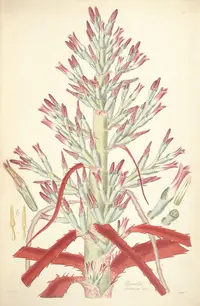
Bromelia pinguin, commonly called pinguin, is a terrestrial bromeliad forming dense clumps of stiff, spiny-edged leaves. The rosettes create a low, architectural shape with a tropical look.
It is native to tropical regions of the Americas, often growing in dry, open areas and disturbed sites. The plant produces a central flower stalk with clustered fruits that can be eaten when fully ripe.
This species is generally tough, drought-tolerant once established, and adapts to poor, sandy soils, which makes it relatively easy to manage outdoors in warm climates. It prefers bright light, good drainage, and moderate moisture, and understanding these needs helps clarify how to care for pinguin.

Care Difficulty
Moderate Care

Light Preference
Full Sun

Water Requirements
Moderate Water

Temperature Preference
Tropical / Frost Sensitive

Hardiness Zone
10–12

Soil Texture
Sandy, Loamy, Organic-rich

Soil pH
Acidic (5.5–6.5), Slightly acidic (6.5–7.0)

Soil Drainage
Well-drained

Fertilization
Minimal (feed rarely)
Scan your plant to receive care tips personalized for your specific plant
Available on iOS and Android
This bromeliad thrives in bright, open conditions that mimic tropical savanna light.
This species prefers moist, fast-draining soil without staying saturated for long periods.
This bromeliad grows best in consistently warm, frost-free conditions.
This species handles a fairly wide range of humidity but grows best with moderately moist air.
This bromeliad prefers fast-draining, sandy to loamy soil that never stays waterlogged.
This species is suitable for container growing, especially in cooler climates or where spread must be controlled.
Bromelia pinguin benefits from light, controlled feeding rather than heavy fertilization.
Pruning Bromelia pinguin focuses on hygiene and space management rather than shaping.
Bromelia pinguin is usually grown in the ground, but container plants may need occasional transplanting.
Bromelia pinguin is most often propagated from basal offsets rather than from seed.
This species is tropical to subtropical and has low frost tolerance, so winter care matters in cool climates.

Plant Health Check
Not sure what's wrong with your plant? Check your plant's health inside the app.
In parts of Central America, this species is traditionally planted in dense rows as a natural barbed barrier to confine livestock and mark property boundaries, taking advantage of its rigid, sharply spined leaves.
The central fruit cluster produces tart, juicy berries whose pulp is used locally to make fermented drinks, vinegar, and jellies, although the fruits are not widely commercialized.
This bromeliad often forms large, clumping stands on slopes and disturbed ground, where its extensive root system and dense rosettes help reduce soil erosion in tropical dry and semi-dry habitats.

The fibrous leaves of this plant have been traditionally processed in some regions to obtain strong fibers that can be twisted into cordage or rope, giving the species added value beyond its use as a living fence and fruit source.
Flowering usually occurs only on mature rosettes, often after several years. Stress, recent division, or nutrient-poor, exhausted soil can delay blooms. After flowering, that rosette slowly declines while offsets develop and will flower in future seasons.
Keep your plants happy and healthy with plant identification, disease detection, and easy care guidance.